How do you become a production follow-up coordinator?
DepartmentProduction, quality and sustainabilityModuleSRM
The production follow-up coordinator is the person at a fashion brand who tracks whether an approved order moves from cutting to shipment as planned and gives early warning of delays.
 Card: Locked · your progress is saved in this browser · save it to your account
 PIMLAND 10 · SRM
Production follow-up coordinator
Production, quality and sustainabilityProduction follow-up coordinator, in brief
Early news is good news: a slipping date comes to the table, together with options, on the day it is spotted.
- Checks that the approved sample, the latest tech pack and the BOM pass into production complete.
- Follows materials, cutting and sewing; records delivered, repaired and defective quantities.
- Season rhythm: order opening, materials, cutting and sewing, pressing-packing and quality, shipment.
- The most important documents are the contract manufacturing order, the production package, the cutting sheet and the tracking chart.
- The moment the estimated date slips, report it: what happened, why, what you propose.
- Judged by on-time shipment and by how early delays are reported.
- Contract manufacturing order (work order)
- Production package (latest tech pack, measurement chart, approved sample)
- Cutting sheet
- Tracking chart (critical path)
 Sourcing / purchasing specialist
 Quality control coordinator
 Product development specialist
Read in detailall documents, workflow, cases
- Checks that the approved sample, the latest version of the tech pack, the measurement chart and the BOM pass to production complete.
- Tracks whether fabric, lining, interlining, buttons, zippers and labels are ready before cutting.
- Follows cutting and sewing at the workshop; makes sure the first pieces off the line are inspected.
- When the delivery date is at risk, informs planning, purchasing and sales without delay.
- Records the delivered, defective and returned-for-repair quantities; this record is the basis for paying the workshop and for choosing workshops.
In a season
- Order opening
Desk work dominates: documents, material list, workshop plan.
- Materials
Fabric and trim arrival dates; shortages go to sourcing.
- Cutting and sewing
Visits to the cutting room and workshops; quantities on the line, measurements of the first pieces.
- Pressing-packing and quality
Planning the mid-production and final inspections on time.
- Shipment
Cartons, assortments, shipping documents. Fieldwork dominates.
- End of season
The workshops' delivery and quality record feeds into the next season's selection.
Who do they work with?
- Sourcing / purchasing specialist
- Product development specialist
 Sample coordinator
- Quality control coordinator
 Collection manager
From school to work
| What you learned at school | At work |
|---|---|
| You learn the production flowchart and see the order of the steps. | At work, that chart runs on phone traffic. The workshop says 'we'll start when the trims arrive', sourcing says 'it's on the way', the warehouse asks 'when is the shipment'. You find out which date is no longer true. |
| An internship is the first step where you start seeing the industry up close. | At work, in this position part of the day is spent in the cutting room and the workshop. The closer you see the factory during your internship, the more ready you are when you start the job. |
| You learn to plan the delivery date as a single deadline. | At work, the delivery date is a chain. If fabric, trims, cutting, sewing, pressing-packing and quality don't make it one after another, the shipment slips. |
| You learn to write reports and describe a process in detail. | At work, a good summary doesn't describe every order; it only says which ones have a delivery date at risk, why, and who is expected to do what. |
| You learn to think about production from inside a factory. | At work, many brands in Turkey have their sewing done in subcontracted workshops. Monitoring the status of several companies remotely is production follow-up. |
What do job ads ask for?
From 242 fashion and retail job ads published in Turkey in August–October 2026.
Season calendar, delivery date, on-time delivery
In 29% of the 242 ads; 38% in office and production positions.
Supplier, manufacturer and contract manufacturing coordination
In 25% of the 242 job ads; 35% in office and production positions.
Travel
17% of the 242 ads ask for no travel restrictions; a shared requirement of positions that go out into the field.
Fast, intense pace
22% of the 242 ads say this explicitly.
Separate job ad
There are 7 production and production follow-up ads in the sample; 'fason takip iş ilanları' (production follow-up job ads) also shows up in searches. Graduates describe what work demands as 'speed of work, discipline' (Çınar 2022).
The first 90 days
- Update the tracking chart at the same time every day; flag any order whose status has changed.
- See every workshop on site at least once: the line, the capacity, the measurements of the first pieces.
- Make it a habit to give bad news early and clearly: what happened, why, who is expected to do what.
Which field of study?
There are two paths. Textile and apparel vocational high schools, the garment production programs of vocational schools, and textile and industrial engineering; or training in a cutting room, sample room or workshop and then moving to a desk role. The foundation you get at school grows stronger in this position with the experience gained on the floor.
Seeing a slipping date before the goods arrive.
From the inside: documents, decisions, cases
Documents, handovers, decisions and mistakes that happen on the job.
A working day
- 08.30
You open the tracking chart (critical path): did the stages due yesterday happen? Next to each one that didn't, you write whom you will get information from today.
- 09.00
Workshop round by phone: how many pieces are on the line, how many came off yesterday, what is missing. You test the date they give against daily output and update the estimated date accordingly.
- 10.00
Materials with sourcing: which day the fabric and trims will be shipped to the workshop, whether the dispatch note has been issued, whether any item is missing.
- 11.00
Opening a new order: the latest version of the tech pack, the approved PP sample, the bill of materials, the color and size breakdown and the scope of work (cutting, sewing, pressing, packing) are written into the contract manufacturing order in full.
- 13.30
Workshop visit: in the cutting room you compare the cutting sheet with the order line, see the first pieces coming off the line, and confirm the inline inspection time with quality.
- 15.30
Leaving pressing-packing: you confirm the final inspection day with quality and have the workshop confirm the carton and assortment instructions.
- 16.30
Risk summary: only the orders whose delivery date is at risk, the reason, and who is expected to do what. It goes to the collection manager and sourcing.
- 17.30
During the day, you record on the order line the quantities received, sent back for repair and set aside as defective.
A sample day; hours vary by company and season.
Workflow: before you, after you
- 1Check the order opening package: tech pack version, approved sample, BOM.
- Input
- Approved order, production package
- Output
- Complete package or a list of what is missing
- Handover
- Product development specialist
- 2Confirm that the materials will be at the workshop before cutting.
- Input
- BOM, material shipping plan
- Output
- Material status and list of missing items
- Handover
- Sourcing / purchasing specialist
- 3Compare the cutting sheet with the order line, start cutting.
- Input
- Marker plan, order line, fabric lot
- Output
- Approved cutting sheet and cutting inspection request
- Handover
- Quality control coordinator
- 4Follow sewing, have an inline inspection scheduled on the first pieces.
- Input
- Daily production report
- Output
- Inline inspection date and line status
- Handover
- Quality control coordinator
- 5If the delivery date is at risk, report early and write down the options.
- Input
- Estimated dates showing a deviation
- Output
- Risk summary: what happened, why, who is expected to do what
- Handover
- Collection manager
- 6Manage the final inspection and repair returns.
- Input
- Pressing-packing output, final inspection report
- Output
- Lot ready to ship, or a repair plan
- Handover
- Quality control coordinator
- 7Prepare the shipment; for exports, pass the documents on to the customer side.
- Input
- Accepted lot, packing list
- Output
- Shipped lot and documents
- Handover
 Merchandiser
- 8Close out delivered, repaired and defective quantities, and carry them into the workshop evaluation.
- Input
- Order line records, quality reports
- Output
- The workshop's delivery and quality record
- Handover
- Sourcing / purchasing specialist
Documents that pass through your hands
| Document | From | To | When | What for |
|---|---|---|---|---|
| Contract manufacturing order (CMT order, work order) | Production follow-up and sourcing | Workshop | When the order is opened | Scope of work, style, color, size breakdown, quantity, unit price and delivery date. Work not written in the order is work not done at the workshop. |
| Production package: latest version of the tech pack, measurement chart, approved sample | Product development and sample room | The workshop, via production follow-up | Before cutting | What the workshop will produce, and to what. A package whose version has not been confirmed does not go to the workshop. |
| Cutting sheet (cutting order) | Production follow-up, based on the pattern maker's marker plan | Cutting room | Before cutting | Color and size breakdown, number of lay plies, the fabric lot to be used. If it doesn't match the order, sizes come up short at shipment. |
| Material dispatch note | Sourcing or warehouse | Workshop; a copy with production follow-up | Before cutting | Which fabric and trims went to the workshop, and in what quantity. It is the basis of any 'materials are missing' dispute. |
| Tracking chart (critical path) | Production follow-up | Collection manager, sourcing, sales | Continuous; summary at the weekly meeting | Each order's stages and their planned, estimated and actual dates. |
| Daily production report | Workshop | Production follow-up | Every day | Quantities cut, sewn and out of pressing-packing. The estimated date is updated accordingly. |
| Packing list, carton labels, dispatch note | Workshop or warehouse | Production follow-up; for exports, the customer and the customs broker | Pre-shipment | How many pieces of which color and size are in which carton. A wrong packing list causes problems in the warehouse and at customs. |
Decisions
- Updating a stage's estimated date and flagging the order as at risk.Approved by: Your decision; doing it early is part of the job.
- Shifting part of the order to another workshop.Approved by: You propose; sourcing and the manager responsible for production approve.
- Partial shipment or faster (more expensive) transport to close a delay.Approved by: The collection manager and the manager; for an export order, the customer's written approval.
- Starting to cut with a fabric lot that has a shade difference.Approved by: Cutting does not start without approval from quality and product development.
What are you evaluated on at work?
- On-time delivery
- How early delays are reported
- Quantities cut, sewn and delivered matching up
- The line waiting because of material shortages
- Risk summaries being clear and short
Common mistakes on the job
Writing the date the workshop gives on the phone into the chart without testing it.
ResultThe delay pops up as a surprise in shipment week.
PreventionCompare the date with the quantity on the line and the daily output; if in doubt, see it on site.
Not comparing the color and size breakdown on the cutting sheet with the order.
ResultSome sizes are cut short and others over; the missing sizes are noticed at shipment.
PreventionBefore cutting, compare the sheet with the order line, line by line.
Leaving the old printout at the workshop when the tech pack is revised.
ResultThe workshop produces to old measurements or old details.
PreventionAt a revision, collect the old printout and get the workshop's written confirmation that it has received the new version.
Holding back bad news in the hope that 'maybe it will make it'.
ResultRecovery options (adding a workshop, partial shipment) close.
PreventionThe moment the estimated date slips, report it: what happened, why, what you propose.
Not recording delivered, repaired and defective quantities.
ResultDisputes come up at payment time; workshop selection is left to memory.
PreventionRecord the quantities on the order line every day.
Case: what would you do?
Case 1At noon, a workshop says the line for one style will stop because the buttons have not arrived. Sourcing says 'they're on the way'.What do you do?
A good answerYou ask sourcing for the dispatch note or the shipping details and find out the real arrival day. You talk with the workshop about bringing forward the operations that don't need buttons. You update the estimated date and write to the collection manager about the impact on shipment the same day.
'On the way' is not a date. Keeping the line from stopping and reporting the impact early is your job.
Case 2While checking the cutting sheet in the cutting room, you see that the size breakdown differs from the order line. The cutter says, 'it was like this last time too'.What do you do?
A good answerYou don't start cutting. You take the current order line as the basis and find out where the difference came from (an old copy of the order?). You send the corrected sheet and get written confirmation from the cutting room.
There is no way to fix the size balance after cutting; either it ships short or more fabric is needed.
Case 3For an export order, the final inspection will be done by an independent inspection company the customer has hired. Pressing-packing is late; packing won't be finished on inspection day.What do you do?
A good answerThrough the merchandiser, you tell the customer before inspection day and ask for a new inspection date based on the day packing will finish. You talk with the workshop about how to speed up packing and write the new shipment date into the chart.
The inspector may not be able to assess a lot whose packing is unfinished; a re-inspection means both cost and delay.
Think of your own answer first, then open it.
How does this position work with the world?
A product sewn in a contract workshop is often an order from a brand abroad; English terms like PO, CMT, FOB, critical path, ex-factory date and packing list are part of everyday language, and the final inspection is sometimes done by an independent inspection company the customer chooses. When the order, stage dates and workshop information sit in a shared record in PLM and SRM, the customer, sourcing and you all see the same date. Regulations such as the EU's digital product passport ask where and at which supplier the product was made; the right source for this information is the production record you keep.
What changes with PLM?
| Before | With PLM |
|---|---|
| The tracking Excel is updated by hand every morning with information gathered by phone. | Each stage's planned, estimated and actual date and the day difference on one screen; a stage that deviates shows up on its own. |
| The tech pack goes to the workshop by e-mail; which version the workshop is working with is unclear. | The workshop sees the current version of the tech pack from the same record; a revision reaches everyone at the same time. |
| Delivered and defective quantities are kept in a notebook or a separate file. | Quantities are linked to the order line; together with inspection results, they flow into the supplier score. |
Career path
- Production follow-up clerk or production follow-up assistant
- Production follow-up coordinator
- Senior production follow-up coordinator
- Middle manager (production planning or supply)
Glossary for this position
- Delivery date
- The date by which a task, material or order must be delivered.
- Critical path
- A chain of linked tasks where any delay directly pushes back the launch.
- Contract manufacturing
- A brand having work such as cutting, sewing or pressing and packing done by outside workshops.
- CMT
- Cut, make, trim: a way of working in which the workshop takes on cutting, sewing and finishing, while the fabric and materials usually come from the party placing the order.
- FOB
- The delivery term under which the seller is responsible until the goods are loaded onto the ship at the port of loading, and the buyer takes over after that.
- Tech pack
- The production package that gathers a style's technical drawing, measurement chart, materials, stitching details and instructions in one document.
- Measurement chart
- A chart showing the target value of each measurement point of a style, size by size.
- PPS (PP) sample
- The last approval sample before bulk production, sewn with the fabric and trims that will be used in production.
- BOM (bill of materials)
- The list of all materials needed to make a product, with quantity, unit, supplier and price.
- Marker plan
- The cutting plan in which pattern pieces are laid on the fabric in the most efficient way; the fabric consumption per unit comes from it.
- Inline (mid-production) inspection
- The quality check made at regular intervals while sewing is under way, starting with the first pieces, that catches a defect before it repeats across bulk.
- Final inspection
- The last inspection, made on a sample drawn from the lot after pressing and packing are complete, that gives an accept or reject decision.
- Supplier score
- An evaluation that measures a supplier's on-time delivery, quality and communication performance.
- SRM
- Supplier relationship management: the system that runs supplier cards, orders, production follow-up and quality inspections in a shared record between brand and supplier.
- DPP (digital product passport)
- A structure that links a product's identity, material, care and end-of-life information to a digital record opened by a QR code on the product.
What does the work look like on screen?
In Pimland, production follow-up lives in SRM: supplier orders, the stage-by-stage production plan and the order details.
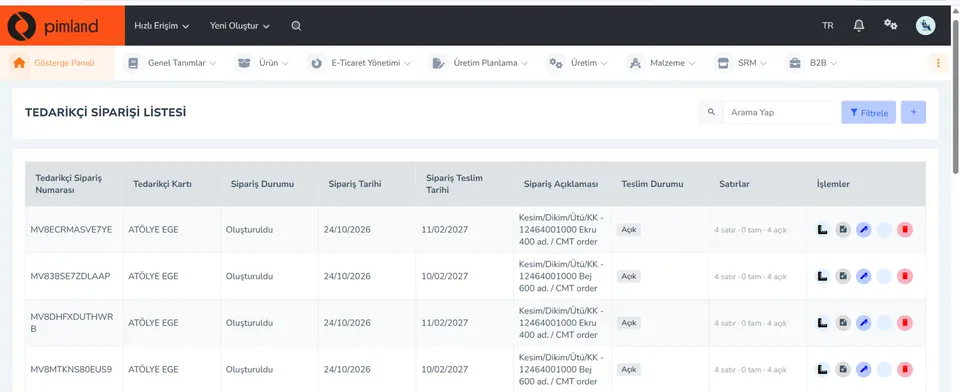
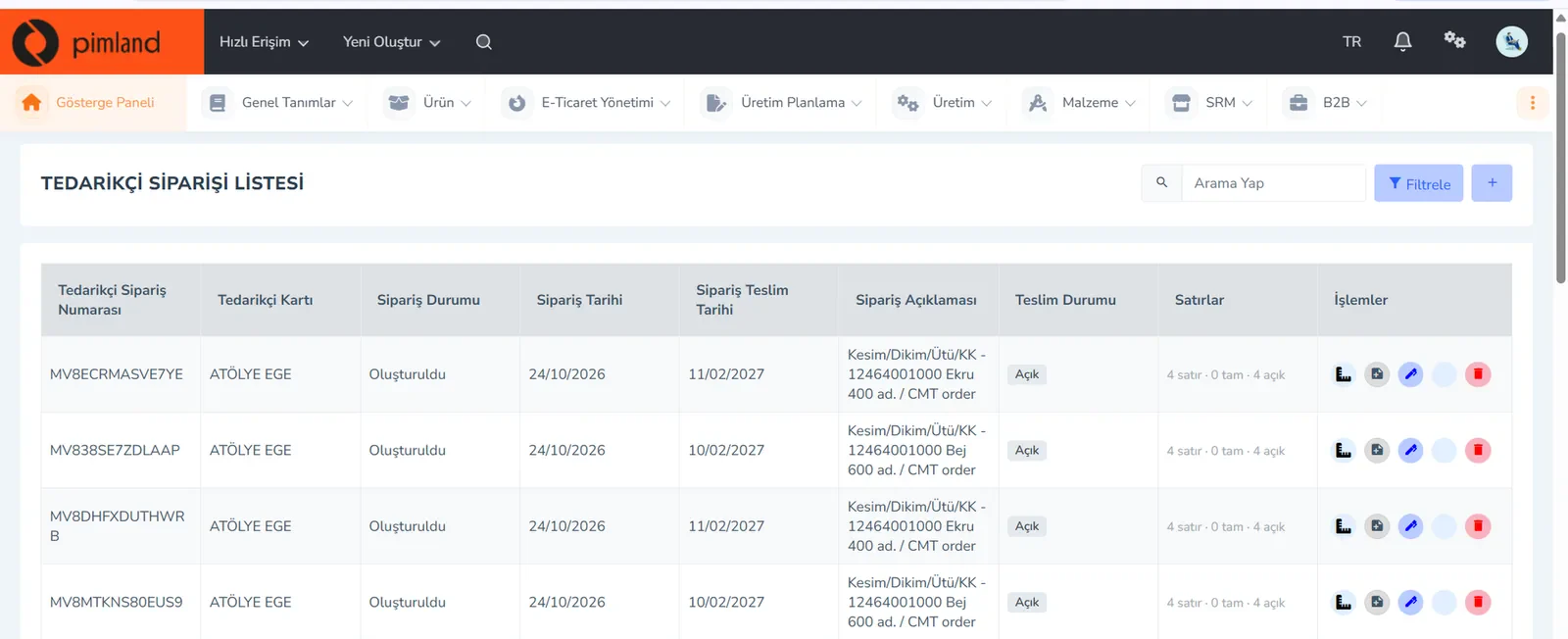
Screen from the demo environment; brands and amounts are demo data. Step 1Find the contract manufacturing order
In the supplier order list, the description states the scope of work: cutting, sewing, pressing, quality control; color and quantity; CMT order. The delivery status and lines columns show how many lines are closed.
At work, in reality, work not written in the description is work not done at the workshop. Make the scope clear when the order is opened.
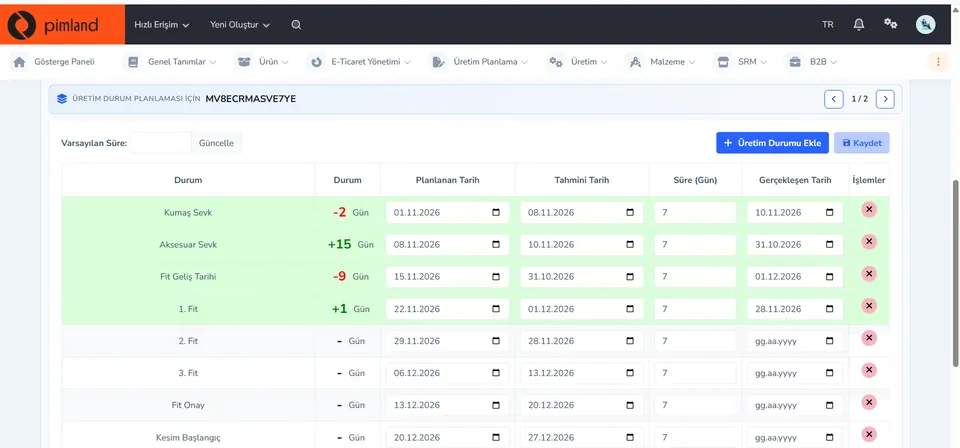
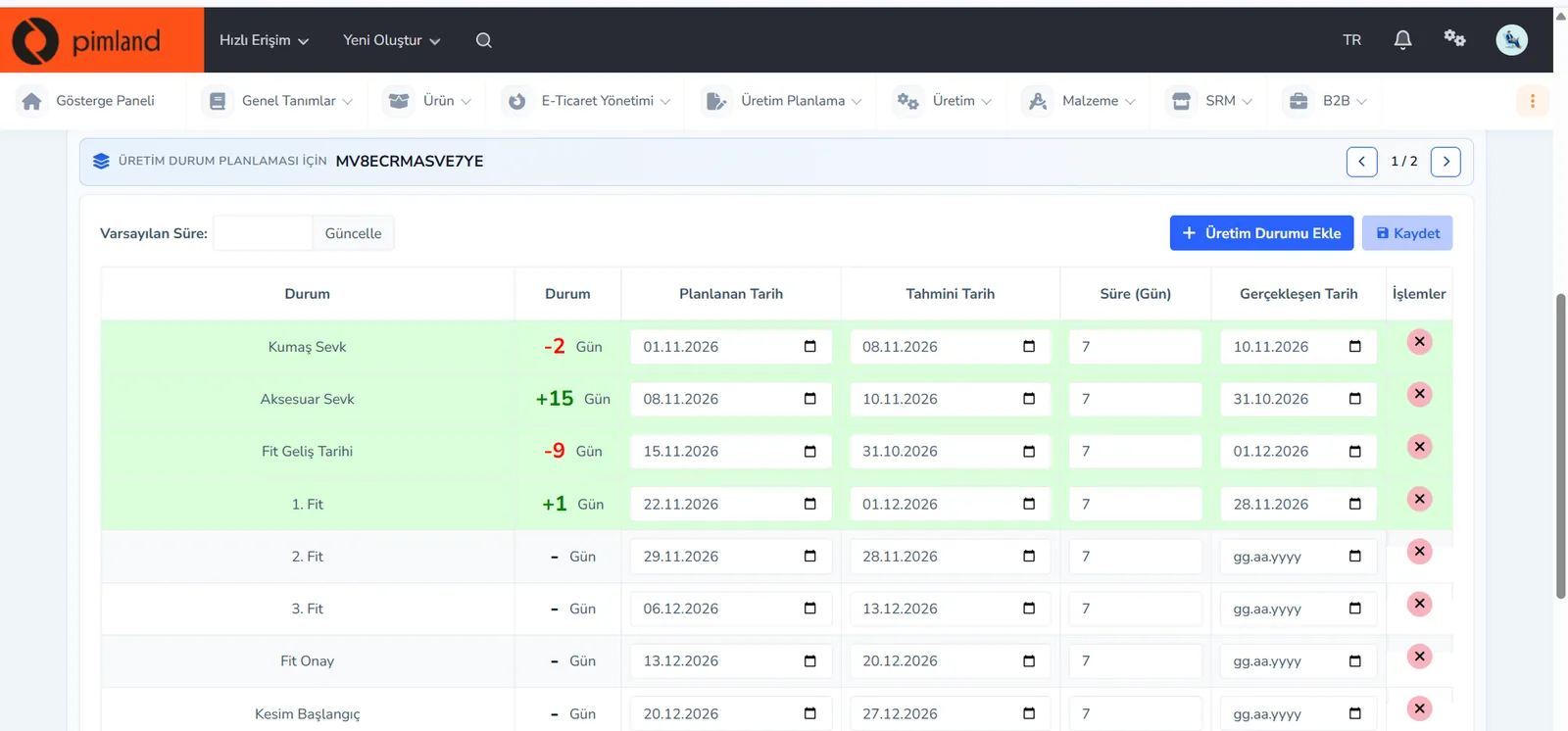
Screen from the demo environment; brands and amounts are demo data. Step 2Track the stages and deviations
In the production status planning, fabric shipment, trim shipment, fit dates, fit approval and cutting start appear line by line. Each line has the planned, estimated and actual date, the duration and the plus or minus day difference. 'Add production status' opens a new stage.
At work, in reality, the estimated date column is the most valuable column. Writing the actual date records the past; updating the estimate saves the future.
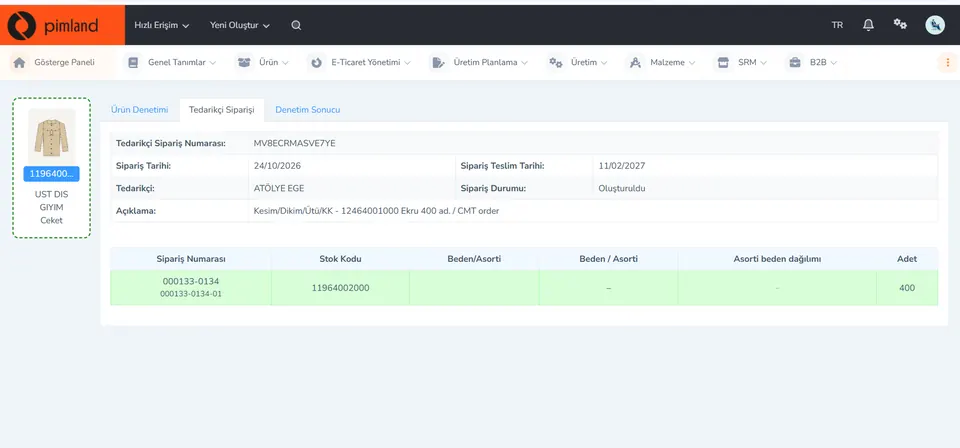
Screen from the demo environment; brands and amounts are demo data. Step 3Drill down into the order
On the order screen: order number, date, delivery date, supplier and status; below that, the stock code, the size and assortment breakdown and the quantity. Tabs: product inspection, supplier order, inspection result.
At work, in reality, if the cutting plan doesn't match the order in its color and size breakdown, sizes come up short at shipment. Compare the cutting quantity with the order line.
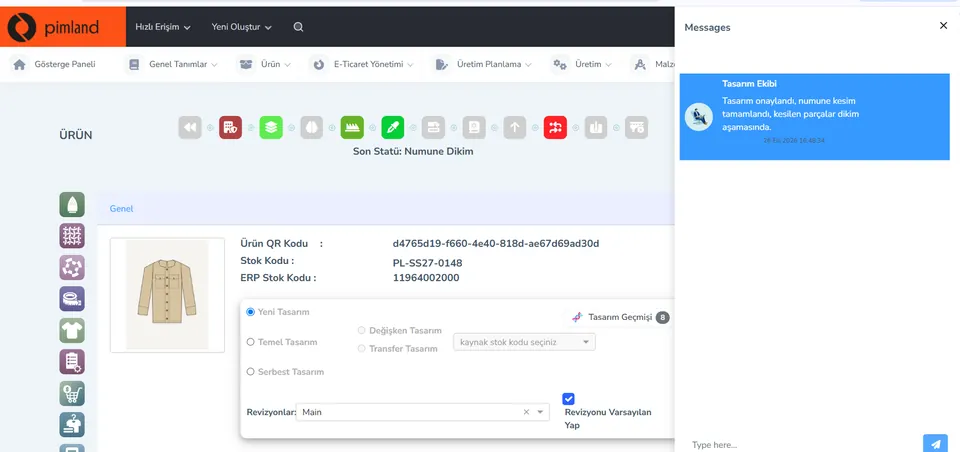
Screen from the demo environment; brands and amounts are demo data. Step 4Write the message on the product
The product's status and the team's messages are on the same screen. When you write the news from the workshop here, everyone sees the same information.
At work, in reality, a date given on the phone doesn't land on anyone's screen. If you work with many workshops at once, move the status information into a shared record.


These screens are from the Pimland SRM module.
Open your card
Open your card
Read the short summary and the Pimland screens and answer at least 2 of 3 questions correctly to open the card. When all 20 cards are open, your Pimland Basic Certificate arrives in your account automatically.
Your Production follow-up coordinator card is open · 0/20
Next suggestion: All position cards
How fashion, retail and manufacturing companies work, and 20 position cards
First the required reading, then the cards for 20 positions: you learn how a fashion company works.
- FirstTraining 1: How is a product born? · read to the end and complete it
- Each cardA summary of the position, audio narration and Pimland screens
- Card3 short questions at the end of each part; 2 correct answers open the next part · no time limit
- AccountWith a free account, your progress follows you on every device
- At the endOnce you complete all 20 cards, the Pimland Basic Certificate arrives in your account automatically
Certificate 1 · Pimland Basic Certificate
Reading is open to everyone; the part questions and the certificate require an Academy account.
PLM, PIM and SRM trainings
The shared language of the fashion world: PLM, PIM and SRM, with Pimland's real screens.
- OrderFirst PLM, then PIM, then SRM · one at a time
- Each training8 parts, in order · audio narration and Pimland screen
- Questions3 questions at the end of each part, 24 in total · 2 correct answers open the next part · no time limit, the questions change with every attempt
- UnlockPart questions open after your Basic certificate
- Verification14+ (date of birth in your profile); an e-Devlet education document for Turkish nationals
- At the endOnce the three trainings, ID and document are complete, Certificate 2 arrives in your account
Certificate 2 · Pimland PLM · PIM · SRM Certificate
Reading is open to everyone; the part questions and the certificate require an Academy account.
PRO · advanced training
Separate application, for selected candidates.
- WhoCandidates selected from applicants who hold both certificates
- OnlinePimland PLM software training and test
- On site1 day inside a fashion company, seeing PLM in use
- ApplicationWith “Apply for PRO training” on the PRO page; places are limited, and selected candidates hear back by email
Certificate 3 · Pimland PRO Certificate
Reading is open to everyone; the part questions and the certificate require an Academy account.
FAQFrequently asked questions about production follow-up coordinators
4 questions
When production is done at outside workshops, tracking the order from cutting to shipment, both remotely and on site. It means following the status of several companies at the same time.
If production is in your own facility, follow-up looks at the plan of the lines and shifts. If it is at an outside workshop, it turns into monitoring several companies. Since many brands in Turkey work with contract manufacturers, the two titles often describe the same job in job ads.
Cut, make, trim: cutting, sewing and finishing. The workshop provides the labor; the fabric and materials usually come from the party placing the order.
Textile and apparel vocational high schools, garment production associate degree programs, and textile and industrial engineering are common. Many people also train in a cutting room, sample room or workshop and then move to a desk role.
· Pimland Academy team