How do you become a merchandiser?
DepartmentCollection and commercial planningModulePIM
The merchandiser is the person at a fashion brand who plans which product goes on sale with how many styles, at what price and in what quantity.
 Card: Locked · your progress is saved in this browser · save it to your account
 PIMLAND 02 · PIM
Merchandiser
Collection and commercial planningMerchandiser, in short
The new season's decisions are based on last season's sales; sell-through is always read with the size breakdown.
- Reads last season's sales broken down by style, color, size and channel.
- Builds the line plan, sets the target cost and prepares the order's size and color split.
- Season rhythm: sales report, line plan and buying budget, margin report, weekly sales tracking.
- The key documents are the line plan, the buying budget (OTB), the target cost list and the assortment table.
- Read sell-through together with the size breakdown and time on the shelf.
- You're evaluated on sell-through against plan, end-of-season margin and leftover stock.
- Line plan
- Buying budget (OTB) sheet
- Target cost list
- Assortment and order quantity table
 Collection manager
 Costing specialist
 Sourcing / purchasing specialist
Read in detailall documents, workflow, cases
- Reads last season's sales broken down by style, color, size and channel: what sold, what was left for markdown, which size sold out early.
- Builds the line plan: how many styles in each category, which price band, how many colors per style, how many units per color.
- Works backward from the target selling price and target margin to set the target cost with the costing specialist.
- Sets up the order's size and color breakdown (assortment) according to store and channel needs.
- Tracks sales velocity during the season. Provides data for reorder, channel reallocation or markdown decisions.
In a season
- Start of season
Last season's sales report. Fast sellers, leftovers, sizes that sold out.
- Plan
Spreading the line plan and the buying budget (OTB) across categories. Design fills the empty slots in the plan with sketches.
- Development
Styles over target cost are discussed with the costing specialist; quantities and colors with purchasing.
- Collection approval
The category balance and the margin report come to the table.
- Selling period
Weekly sales report. Reorder, markdown or channel shift?
Who do they work with?
- Collection manager
 Fashion designer
- Costing specialist
- Sourcing / purchasing specialist
 E-commerce specialist
 Store sales associate
 Planning specialist
 Visual merchandiser (VM)
From school to work
| What you learned at school | At work |
|---|---|
| You learn to start a collection with an inspiration and a theme. | In working life, a table comes alongside the inspiration: the line plan. Design fills in the empty rows of the table. |
| You learn to explain in design language why a product will be liked. | In working life, 'this will sell well' is measured with a sell-through rate: units sold divided by units offered for sale. On its own it can mislead; it's read together with the size breakdown. |
| You get to know Excel's basic formulas and tables. | In working life, Excel becomes your main tool: pivot tables, conditional formatting, scenario calculations. 38% of the 242 job ads we reviewed ask for Excel or MS Office. |
| You get a general introduction to the concept of merchandising. | In working life, the same title describes three different jobs: the product merchandiser at a brand, the order merchandiser at an exporter-manufacturer, and the visual merchandiser in the store. |
| You learn to evaluate a product through critique and presentation. | In working life, sales data speaks too. Sometimes the product that didn't sell is actually the product that wasn't in stock; if the medium size sold out early, the real demand never shows up in the table. |
What do job ads ask for?
From 242 fashion and retail job ads published in Turkey in August–October 2026.
Sales data, commercial sense, analytics
In 58% of the 242 job ads; first on the list. Buyer and planner ads are all about numbers: sell-through, markdown, best and worst sellers.
Excel
In 38% of the 242 job ads. One e-commerce merchandiser ad explicitly calls it a 'must-have'.
PLM and ERP
Across the whole sample, PLM is mentioned by name in only 2 ads (1%); ERP, SAP or Nebim in 34 ads (14%). One of the ads that names PLM is a customer representative ad from an exporting manufacturer. Merchandiser ads on the export side also ask you to understand fit comments and the tech pack and pass them on to the teams, along with critical path and delivery dates.
Field of study
Buyer, merchandiser and planner ads mostly ask for graduates of Textile Engineering, Industrial Engineering, Business Administration or Statistics. If you study Fashion Design, you need to prove yourself with numbers at this door.
English
In 33% of the 242 job ads; 42% in office and production positions. At exporting companies, merchandisers are expected to have good English.
The first 90 days
- Read last season's sales report category by category. Note the best sellers and the biggest leftovers, along with the reasons.
- Learn every column of the line plan file: who fills it in and who uses it.
- Get to the point where you can do pivot tables and VLOOKUP in Excel without thinking.
Which field of study?
No specific department is required. Business administration, economics, industrial engineering, textile engineering and fashion management are common. Most people start as a planning or merchandising assistant; store experience is valuable for understanding the customer.
Turning design's feeling into numbers, and numbers into decisions.
From the inside: documents, decisions, cases
Documents, handovers, decisions and mistakes that happen on the job.
A working day
- 09.00
You open the weekly sales report, broken down by category, style, color, size and channel. First you look at sell-through, then at time in stock.
- 10.00
You list the sold-out sizes and the fast-selling styles. These are reorder candidates; you ask purchasing whether the lead time allows it.
- 11.00
You look at the new season's line plan with the design team: which slot is empty, which category has too many styles piling up.
- 13.30
You discuss the styles over target cost with the costing specialist. Either the price band changes or the cost comes down; you calculate the margin impact of both.
- 14.30
You discuss quantities and the assortment with purchasing. One color's quantity has fallen below the supplier's minimum order quantity (MOQ).
- 16.00
You compare requests from the e-commerce and store teams with the season plan: should a style be sold online only, which stores should a color go to?
- 17.00
You write a short note to the collection manager on category balance and how much of the buying budget (OTB) has been used.
A sample day; hours vary by company and season.
Workflow: before you, after you
- 1Read last season
- Input
- Sales and stock report
- Output
- Note on what sold, what was left and which size sold out early
- Handover
- Collection manager
- 2Build the line plan
- Input
- Season brief, OTB, sales analysis
- Output
- Line plan
- Handover
- Fashion designer
- 3Set the target cost
- Input
- Target selling price, target margin
- Output
- Target cost per style
- Handover
- Costing specialist
- 4Build the assortment and quantities
- Input
- Approved style list, store and channel needs
- Output
- Order quantity table
- Handover
- Sourcing / purchasing specialist
- 5Prepare the prices
- Input
- Approved cost, price groups
- Output
- Selling price list
- Handover
- E-commerce specialist
- 6Monitor the selling period
- Input
- Weekly sales report
- Output
- Reorder, channel shift or markdown proposal
- Handover
 Middle manager
Documents that pass through your hands
| Document | From | To | When | What for |
|---|---|---|---|---|
| Weekly sales and stock report | ERP or reporting team | Merchandiser | At the start of every week | Sell-through, sold-out sizes and products at risk of markdown are read here. |
| Buying budget (OTB) sheet | The middle manager and finance set the framework | The merchandiser allocates it; the collection manager and purchasing use it | Planning period, updated during the season | The season's buying budget is split into categories and delivery windows; spent and remaining budget are visible. |
| Line plan | Merchandiser | Design, collection manager, costing specialist, purchasing | Closed before design starts | Each row is a style slot: category, price band, number of colors, quantity depth, delivery window. |
| Target cost list | Merchandiser and costing specialist | Design, product development | Together with the line plan | The upper cost limit, worked back from the target selling price and the target margin, is written against each style. |
| Assortment and order quantity table | Merchandiser | Purchasing, production follow-up | After the line review | How many units to order per style, color and size; material requirements are calculated from it. |
| Selling price list | Merchandiser | E-commerce, store teams | Before the product goes on sale | The approved selling price for each price group and currency. |
| In-season action proposal | Merchandiser | Middle manager | During the selling period, as needed | Reorder, channel shift or markdown proposal, each one backed by sales data. |
Decisions
- Building a style's size and color split (assortment).Approved by: The proposal is yours; it's finalized with purchasing. If it deviates from the budget, the middle manager approves.
- Dropping a color that's stuck on MOQ from the collection, or having it share the same fabric with another style.Approved by: You decide together with design; the collection manager is informed.
- Changing a category's price band.Approved by: The middle manager approves; you prepare the margin and sales impact.
- The timing and depth of a markdown.Approved by: The proposal is yours; the decision is management's. Your proposal is based on sales velocity and remaining stock.
What are you evaluated on at work?
- Sell-through against plan
- Hitting the target margin at the end of the season
- Stock left at the end of the season and products sent to markdown
- Staying within the buying budget (OTB)
- Sales lost to early sell-outs
Common mistakes on the job
Reading sell-through without the size breakdown.
ResultA style whose medium sizes sold out early looks like it 'sold poorly', and its quantity is cut in the new season.
PreventionAlways read sell-through together with the size breakdown and time on the shelf.
Confusing margin with markup.
ResultThe target cost is calculated wrongly, and everyone in the meeting talks about a different number.
PreventionWrite which ratio you're using in the table header; leave the formula in the file.
Not passing a quantity change in the line plan on to purchasing.
ResultThe supplier produces the old quantity; either materials run short or stock piles up.
PreventionWhen a quantity changes, notify purchasing in writing, with a date; archive the old table.
Copying last season's file without checking the fixed values.
ResultAn old exchange rate, old price or old quantity is carried into the new season.
PreventionIn the file you copied, mark the fixed values entered by hand and update them one by one.
Entering category and product group names inconsistently.
ResultThe same product is 'Jacket' in one place and 'Blazer' in another; the report adds up wrong.
PreventionUse a shared category list; check the list before creating a new name.
Case: what would you do?
Case 1The medium sizes of a best-selling pair of trousers sold out mid-season, while another color of the same style went to markdown. Design wants more colors in this style next season.What do you do?
A good answerInstead of adding colors, you propose increasing the depth of the best-selling color and the share of medium sizes; you suggest dropping the weak color or selling it in only one channel. You back up your proposal with a sales table broken down by size.
A sold-out size hides real demand. More colors slice the same budget thinner; that doesn't solve the problem.
Case 2A fabric supplier's minimum order quantity per color is above the quantity you planned for one color.What do you do?
A good answerYou calculate three options: using the same fabric and color in a second style, reducing the number of colors, or accepting the below-MOQ surcharge and passing it into the cost. You put the margin and budget impact of each on the table together with purchasing and the costing specialist.
MOQ looks like a purchasing detail, but it's a line plan decision; it directly changes the number of colors and the quantity depth.
Case 3The e-commerce team wants to sell a style online only; in the plan, this style also goes to stores.What do you do?
A good answerYou look at the style's online sales data and return information, and recalculate the store quantity and the assortment. You report the impact on the budget and delivery plan to the collection manager and purchasing.
A channel decision changes the quantity, the assortment and the shipment plan together; it doesn't change quietly at one team's request.
Think of your own answer first, then open it.
How does this position work with the world?
A merchandiser's language is largely English: sell-through, OTB, markdown, best seller, worst seller, line plan; these terms appear explicitly in the job ads reviewed. At an exporter-manufacturer, the order merchandiser runs a foreign customer's order from sample to shipment and discusses price as FOB or DDP; the ads ask for command of the customer's PLM system and for passing fit comments and the tech pack accurately to the teams. At a brand, the same product may be sold in several currencies and price groups; fields in the product record such as composition and origin feed both the marketplaces and the data required for the EU digital product passport, so the record in PLM and PIM becomes everyone's shared language.
What changes with PLM?
| Before | With PLM |
|---|---|
| The line plan lives in one file and design's style list in another; as the season goes on, the two drift apart. | Each row in the line plan is linked to a product record; planned and actual appear in the same place throughout the season. |
| Target cost goes out by email; actual cost comes back weeks later in another spreadsheet. | In the product record, target and actual mark-up sit side by side; a variance shows the moment it appears. |
| Prices are kept in separate price files and copied into the channels by hand. | Price groups and currencies are calculated, approved and pushed to the channels on the product card. |
Career path
- Merchandising or planning assistant
- Merchandiser
- Senior merchandiser
- Middle manager (category or planning)
Glossary for this position
- Line plan
- The collection plan showing, for each category of a season, how many styles, which price band, how many colors and what quantity will go out.
- Sell-through (sales rate)
- The ratio of units sold in a period to units offered for sale in the same period.
- Markdown (discount)
- Lowering the price of a product whose sales fall below expectations.
- Target margin
- The target a brand aims for, expressed as the difference between selling price and cost divided by the selling price.
- Target cost
- The upper limit a product's cost must not exceed, calculated backward from the target selling price and target margin.
- Markup
- The ratio of the difference between selling price and cost to the cost; not to be confused with margin.
- MOQ (minimum order quantity)
- The lowest order quantity a supplier accepts for an item, often per color.
- Variant
- Each sellable option of the same style, distinguished by attributes such as color and size.
- SKU (stock keeping unit)
- The code that uniquely identifies each product option held in stock.
- Drop
- Releasing a collection for sale in parts on set dates, rather than all at once.
- Merchandising
- The work of planning for the right product to go on sale at the right price, in the right quantity and at the right time.
- FOB
- The delivery term under which the seller is responsible until the goods are loaded onto the ship at the port of loading, and the buyer takes over after that.
- DDP
- The delivery term under which the seller delivers the goods to the buyer's address with taxes and customs costs already paid.
- ERP
- Enterprise resource planning: the system that records the company's operations such as stock, sales, purchasing and accounting.
What does the work look like on screen?
A merchandiser's first stop in Pimland is the product itself: season, theme, product group, variant. Then price and margin.
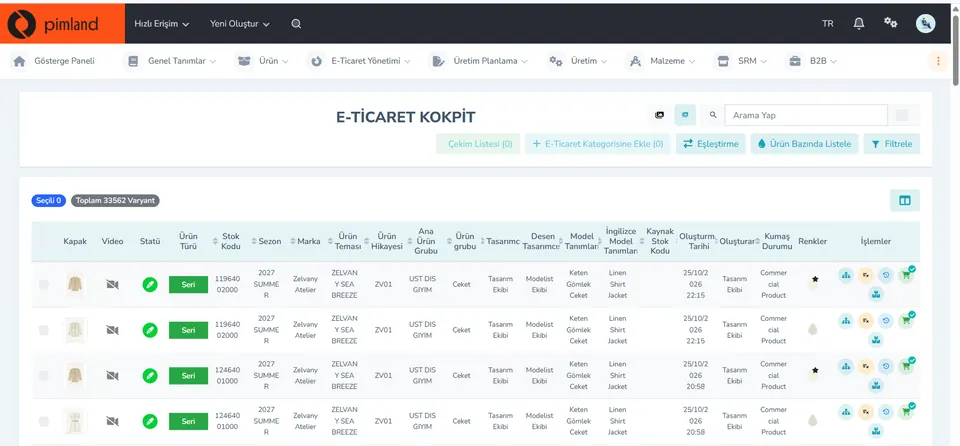
Screen from the demo environment; brands and amounts are demo data. Step 1See the collection in the variant list
The e-commerce cockpit lists products by variant: cover image, status, product type, stock code, season, brand, product theme, main product group, product group, colors. At the top are the total number of variants, a filter and a 'list by product' option.
In real working life, if every row in the line plan is linked to a product record, the gap between plan and actual stays visible throughout the season. If not, the two files drift apart as the season goes on.
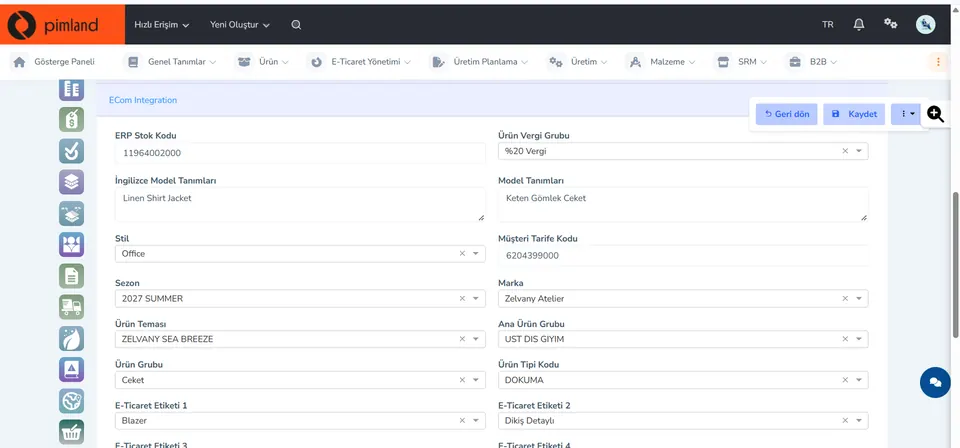
Screen from the demo environment; brands and amounts are demo data. Step 2Read the product's identity
On this tab of the product card, season, brand, product theme, main product group, product group, style and product type code sit side by side. These are the fields you use when you break down the sales report by category.
In real working life, if the same product group is entered as 'Jacket' in one place and 'Blazer' in another, your report adds up wrong. Filling in fields consistently is the merchandiser's concern too.
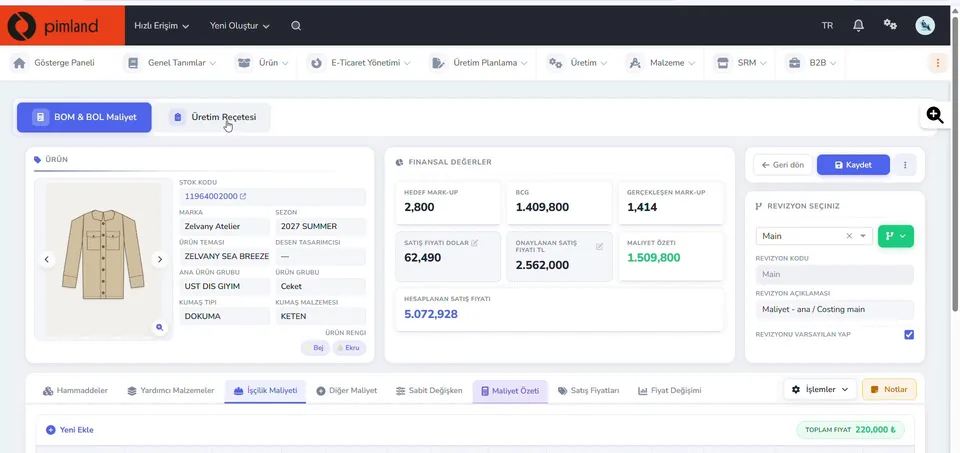
Screen from the demo environment; brands and amounts are demo data. Step 3Compare target and actual
In the financial values section of the cost screen, target mark-up and actual mark-up sit side by side. Below them are the calculated selling price and the cost summary; on the right, you choose which cost revision you're looking at.
In real working life, margin and markup are different calculations: margin divides the difference by the selling price, markup by the cost. If you don't say which one you mean in a meeting, the wrong decision comes out of it.
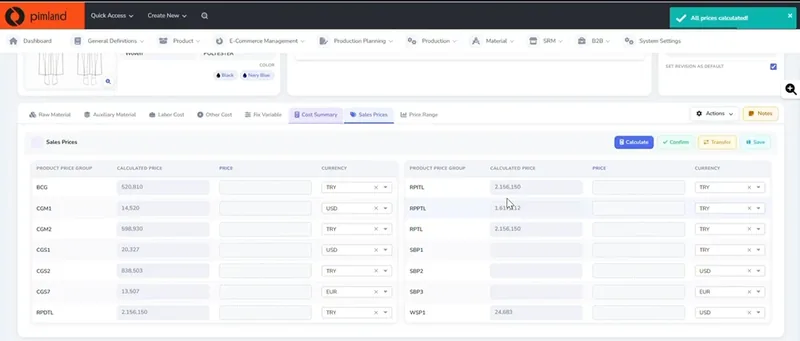
Screen from the demo environment; brands and amounts are demo data. Step 4Look at the price groups
On the selling prices tab, the calculated price, the price to enter and the currency for each product price group are on separate lines. The calculate, approve and transfer steps are at the top of the screen. This view is from the English interface.
In real working life, the same product can have several price groups in different currencies. A price isn't approved without knowing which group goes where.
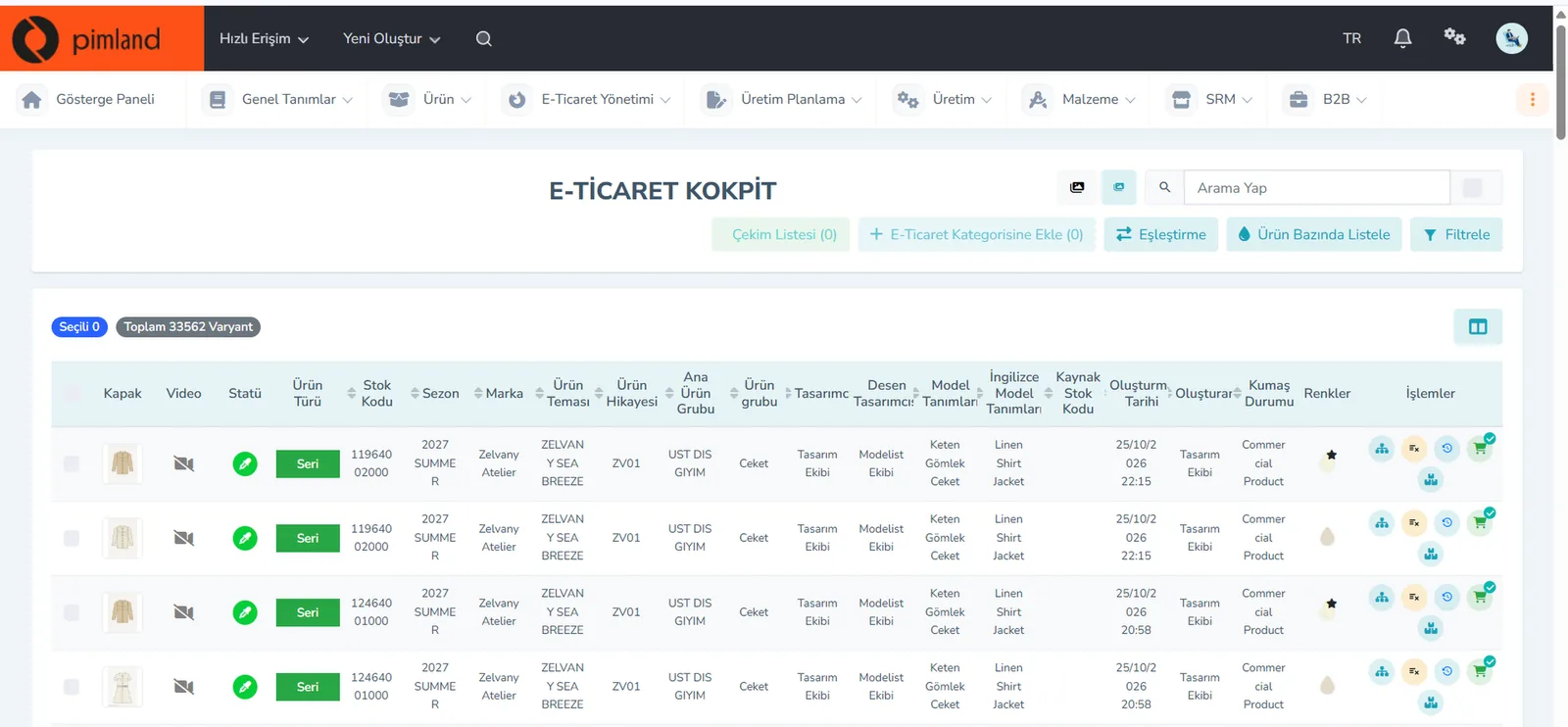


These screens are from the Pimland PIM module.
Open your card
Open your card
Read the short summary and the Pimland screens and answer at least 2 of 3 questions correctly to open the card. When all 20 cards are open, your Pimland Basic Certificate arrives in your account automatically.
How fashion, retail and manufacturing companies work, and 20 position cards
First the required reading, then the cards for 20 positions: you learn how a fashion company works.
- FirstTraining 1: How is a product born? · read to the end and complete it
- Each cardA summary of the position, audio narration and Pimland screens
- Card3 short questions at the end of each part; 2 correct answers open the next part · no time limit
- AccountWith a free account, your progress follows you on every device
- At the endOnce you complete all 20 cards, the Pimland Basic Certificate arrives in your account automatically
Certificate 1 · Pimland Basic Certificate
Reading is open to everyone; the part questions and the certificate require an Academy account.
PLM, PIM and SRM trainings
The shared language of the fashion world: PLM, PIM and SRM, with Pimland's real screens.
- OrderFirst PLM, then PIM, then SRM · one at a time
- Each training8 parts, in order · audio narration and Pimland screen
- Questions3 questions at the end of each part, 24 in total · 2 correct answers open the next part · no time limit, the questions change with every attempt
- UnlockPart questions open after your Basic certificate
- Verification14+ (date of birth in your profile); an e-Devlet education document for Turkish nationals
- At the endOnce the three trainings, ID and document are complete, Certificate 2 arrives in your account
Certificate 2 · Pimland PLM · PIM · SRM Certificate
Reading is open to everyone; the part questions and the certificate require an Academy account.
PRO · advanced training
Separate application, for selected candidates.
- WhoCandidates selected from applicants who hold both certificates
- OnlinePimland PLM software training and test
- On site1 day inside a fashion company, seeing PLM in use
- ApplicationWith “Apply for PRO training” on the PRO page; places are limited, and selected candidates hear back by email
Certificate 3 · Pimland PRO Certificate
Reading is open to everyone; the part questions and the certificate require an Academy account.
FAQMerchandiser FAQ
4 questions
The person who makes the commercial plan for the product in fashion and retail. At a brand, they plan which product goes out with how many styles, at what price and in what quantity; at an export manufacturer the title can also mean order management, and in a store, visual display.
The merchandiser plans how much will be produced and at what price. The visual merchandiser designs how the produced product will be displayed in the store and the window. One is a planning job, the other a display job.
A season's collection plan: number of styles per category, price band, number of colors, depth of quantity and delivery window. The design team fills each line with a style.
You can, but job ads for this position mostly ask for engineering, business or statistics graduates. You need to show the difference in Excel, sales analysis and product knowledge. Knowing the product is your advantage here.
· Pimland Academy team