How do you become a collection manager?
DepartmentCollection and commercial planningModulePLM
The collection manager is the person at a fashion brand who follows the season's collection from its first brief to launch day, builds the season calendar and keeps it up to date, and coordinates design, sampling and production steps so they move on time.
Long guide (in Turkish): what does a collection manager do? →
 Card: Locked · your progress is saved in this browser · save it to your account
 PIMLAND 01 · PLM
Collection manager
Collection and commercial planningCollection manager, in short
The launch date is fixed; the calendar is built backward from it, and every decision is tied to an owner and a date.
- Writes the season brief and builds the calendar backward from launch day.
- Tracks the milestones; gathers the sample, costing and calendar status of every style for the line review.
- The season's rhythm: brief and calendar, line plan, weekly meetings, line review, launch, end-of-season note.
- The most important documents are the season brief, the season calendar, the line plan and the line review decision list.
- What often gets skipped is the decision's owner and date; write every decision as a line with what, who and when.
- Evaluated on milestones closed on time and the share of styles that make the launch.
- Season brief
- Season calendar (critical path)
- Line plan
- Line review decision list
 Merchandiser
 Fashion designer
 Product development specialist
Read in detailall documents, workflow, cases
- Writes the season brief: target customer, the season's story, category mix, price level and budget.
- Builds the season calendar backward from launch day. The dates for design handover, sample rounds, approval, ordering and production start all come from it.
- Tracks milestones. Tries to catch a delay at the first link of the chain.
- Prepares the line review (collection approval): brings a continue, revise or drop proposal for each style to the table, with its sample, costing and calendar status.
- Tracks the collection's total cost and margin. Brings a style that strains the margin to the table before the decision point.
In a season
- Start of season
Brief and calendar. The launch date is fixed, and everything counts back from it.
- Plan
Line plan with the merchandiser: how many styles, which price band, how many units.
- Design and sampling
Weekly collection meetings. Late styles, fit sessions, costing discussions.
- Collection approval
Line review. Samples, costing and sales expectations side by side; a decision for every style.
- Production and launch
The question is whether orders, production, the shoot and channel preparation will make the launch.
- End of season
What sold, what was left, where the calendar slipped. The notes go into the next brief.
Who do they work with?
- Merchandiser
- Fashion designer
- Product development specialist
 Costing specialist
 Sample coordinator
 Production follow-up coordinator
 E-commerce specialist
From school to work
| What you learned at school | At work |
|---|---|
| You learn to build a single collection from start to finish: theme, color, style. | At work, you follow three seasons at once with the same skill: in the same week, one is on sale, one is in production and one is on the design table. |
| You learn to finish your collection by a deadline and present it to a jury. | At work, the target date is the shelf date. The launch date is fixed, and the calendar is built backward from it. |
| You learn to decide which styles go into the collection based on your own design ideas. | At work, the line plan comes with this decision: the number of styles, the price band and the quantity come from there. Budget and margin sit next to every decision. |
| You learn to manage time by planning your own deliverables. | At work, time turns into a chain. A fabric approved late pushes back first the sample, then the approval, and finally the launch. |
| You prepare your collection file and learn to master every detail of it. | At work, many teams look at the same file. The style count on design's list may not match sourcing's; half the meeting goes to the question 'which style is where.' |
What do job ads ask for?
From 242 fashion and retail job ads published in Turkey in August–October 2026.
Season calendar and delivery dates
It appears in 29% of the 242 fashion and retail job ads published in Turkey in August–October 2026; in office and production positions, the share is 38%. This is exactly the collection manager's main job.
Sales data and commercial sense
In 58% of the 242 job ads. The new season's decisions are made with last season's sales.
Costing and margin
In 19% of the 242 job ads. This position is expected to spot early the style that squeezes the margin.
Experience
This position didn't come up as a separate title in the sample; the work appears within product development and merchandiser job ads. People usually move up to this position after a few seasons.
The first 90 days
- Learn the season calendar by heart: which milestone is when, and on whose desk.
- Take the notes of the weekly collection meeting yourself. Write down the decisions and their owners, and check them the following week.
- Follow a style's journey from start to finish: brief, drawing, sample, approval, order. Note where it waits.
Which field of study?
There is no single required department. Fashion design, textile and fashion design, textile engineering and business administration are common starting points. You don't go straight into this position; you move up after working a few seasons in design, merchandising or product development.
Remembering the date everyone forgets and making decisions on time with incomplete information.
From the inside: documents, decisions, cases
Documents, handovers, decisions and mistakes that happen on the job.
A working day
- 09.00
You open the list of late tasks. Which of the milestones that should have closed yesterday didn't, who owns it, and whom you'll ask today: you write this down.
- 09.30
A fabric delivery date update comes in from sourcing. You find which styles use each fabric that will arrive late and flag those styles on the calendar.
- 10.30
Weekly collection meeting. Only the lines that need a decision come to the table. For each decision, you keep the 'what, who, by what date' note.
- 12.00
You send the meeting notes to the teams the same day. If the notes wait until the next day, so do the decisions.
- 14.00
You join the fit session. Here you listen not for the fit but for the calendar: if another revision round is added, will the collection approval date slip?
- 15.30
With the costing specialist, you go over the list of styles that are over target. Each style goes into the line review file with a simplification option.
- 16.30
From the weekly report on the season that's on sale, you take notes for the next brief: which category is below expectations, which delivery reached the shelf late.
- 17.30
You update the calendar and write down the three topics you'll follow up first thing tomorrow.
A sample day; hours vary by company and season.
Workflow: before you, after you
- 1Write the draft brief
- Input
- Last season's sales summary, management's season target
- Output
- Season brief
- Handover
- Merchandiser
- 2Build the calendar backward from the launch
- Input
- Launch date, material delivery dates from sourcing, capacity information from production
- Output
- Season calendar and milestone owners
- Handover
- Fashion designer
- 3Tie the sample rounds to the calendar
- Input
- Line plan, sample room capacity
- Output
- Sample dates by style
- Handover
- Sample coordinator
- 4Prepare the line review file
- Input
- Sample status, costing summary, line plan
- Output
- Style-by-style status and options table
- Handover
 Middle manager
- 5Distribute the decisions
- Input
- Line review decision list
- Output
- Approved style list
- Handover
 Sourcing / purchasing specialist
- 6Follow-up from production to launch
- Input
- Production status plan, shoot and channel preparation list
- Output
- Launch preparation list and risk note
- Handover
- E-commerce specialist
- 7Close the season
- Input
- Sales results, calendar deviations
- Output
- End-of-season review note
- Handover
- Merchandiser
Documents that pass through your hands
| Document | From | To | When | What for |
|---|---|---|---|---|
| Season brief | Collection manager (together with the merchandiser) | Design, merchandiser, product development | Start of season | The target customer, season story, category split and budget framework should be written in one place; every later discussion comes back to it. |
| Season calendar (critical path) | Collection manager | All teams | Built once the brief is clear, updated every week | Every milestone should have a clear date and owner; when one date slips, you should see which dates slip with it. |
| Line plan | Merchandiser | Collection manager | Planning period | You check whether the number of styles in the plan fits the calendar and the sample capacity. |
| Sample status list and fit comments | Sample coordinator, product development | Collection manager | Every week during the sampling period | Which style is in which round, which is waiting for approval; a style that won't make the collection approval should show up early. |
| Costing summary | Costing specialist | Collection manager | Before the line review | You see the collection's total margin and the styles over target before the decision meeting. |
| Line review decision list | Collection manager (meeting minutes) | Design, product development, sourcing, costing, production follow-up | Right after the line review | Which style continues, which is revised, which is dropped; sourcing opens orders based only on this list. |
| End-of-season review note | Collection manager | Middle manager, next season's brief | When the season closes | Where the calendar slipped and why goes into the next calendar as a lesson. |
Decisions
- Moving an interim date that doesn't affect the launch (e.g., a single style's fit date).Approved by: Your decision. You notify the teams involved in writing and update the calendar the same day.
- Bringing a late style to the line review with a 'revise' or 'drop' proposal.Approved by: The proposal is yours; the decision is made at the line review meeting, together with the middle manager.
- Changing the launch date.Approved by: Not your decision. The middle manager and the e-commerce and store teams decide; you work out its impact date by date.
- Adding a style to the collection or removing one after the line review.Approved by: The merchandiser and the middle manager approve; you prepare the budget and calendar impact.
What are you evaluated on at work?
- Milestones closed on time
- Share of styles that make the launch date
- Coming to the line review with a complete file (samples, costing and plan in the same table)
- Number of changes made after collection approval
- Meeting decisions closed by the promised date
Common mistakes on the job
Not writing the decision's owner and date in the meeting notes.
ResultThe next week, the same topic is discussed from scratch, and no one has taken on the work.
PreventionWrite every decision as a 'what, who, by when' line; start the next meeting by checking these lines.
Forgetting holiday (bayram) weeks, trade fairs and supplier shutdowns when building the calendar.
ResultA sample round or fabric shipment lands in a week when no one is working.
PreventionOn the day you build the calendar, mark public holidays, trade fairs and the holidays of suppliers abroad on it.
Keeping dates without linking them to each other.
ResultFabric approval slips, but the sample and collection approval dates stay as they were; the delay is noticed only at the last link.
PreventionWrite down what each milestone depends on; when a date slips, update the linked dates along with it.
Going into a meeting without reconciling the different teams' style lists.
ResultThe meeting is spent on 'which style is where' instead of decisions.
PreventionBefore the meeting, gather the statuses on a single style list.
Not telling sourcing about a style dropped at the line review.
ResultFabric for the canceled style gets ordered and stays in stock.
PreventionOn the day of the meeting, send the decision list separately to sourcing and product development.
Case: what would you do?
Case 1The fabric supplier reports that it has pushed back delivery because of a dye lot problem. This fabric is used in three styles, and one of them is the launch's hero product.What do you do?
A good answerFirst you list the styles that depend on this fabric and which milestones slip. With sourcing, you gather the options: partial shipment, priority for the hero product, an approved alternative fabric. You write down the impact on the launch date by date, take the decision with the options to the decision owner, and update the calendar the same day.
Passing on a delay as bare news makes the problem bigger. A delay that arrives with its impact and options ready gets a quick decision.
Case 2Two days before the line review, the costing specialist says four styles are over the target cost.What do you do?
A good answerYou don't quietly take the styles off the list. For each style, you have design and the costing specialist prepare a simplification option, and you show the impact on the collection's total margin in the same table. At the meeting, the decision becomes 'which option' instead of 'drop it or not.'
The line review is a decision meeting. A problem that arrives without options turns the meeting into a debate.
Case 3The design team wants to change the collar detail on a style at the PP sample stage, calling it 'a small change.'What do you do?
A good answerYou ask product development about the change's impact on measurements, materials and cost. If a new sample round is needed, you write down the impact on the calendar, take the decision to the decision owner, and record the outcome in the product record.
At a late stage, there is no such thing as a 'small' change. Every change means a sample round and a date.
Think of your own answer first, then open it.
How does this position work with the world?
The collection calendar is not just the brand's calendar: the holiday periods of suppliers abroad, international trade fair weeks and, if the company exports, the customer's delivery window all go into the same calendar. In meetings, English terms such as critical path, milestone, line review and drop are the common language; because the calendar, status and product record sit in the same place in PLM, the supplier abroad looks at the same date too. If the data required for the EU digital product passport (fiber composition, production facility, batch, certificate) is left until launch week, the work piles up; that's why data collection also becomes a milestone on the calendar.
What changes with PLM?
| Before | With PLM |
|---|---|
| You ask about each style's status one by one in the weekly meeting. | Status and messages sit in the product record; you go into the meeting with only the late lines. |
| The calendar lives in a spreadsheet; when a date slips, you update the linked dates one by one by hand. | Milestones are defined in the system; a delay shows up as the difference between the planned and actual dates and arrives as an alert. |
| For the line review file, sample photos, costing and the plan are gathered from different files. | Sample status, costing summary and the plan come from the same product record; instead of preparing files, there's time left to prepare options. |
Career path
- Collection assistant or merchandising assistant
- Collection manager
- Senior collection manager
- Middle manager (collection or category)
Glossary for this position
- Season (SS/AW)
- Grouping collections by selling period: Spring/Summer (SS) and Autumn/Winter (AW).
- Critical path
- A chain of linked tasks where any delay directly pushes back the launch.
- Delivery date
- The date by which a task, material or order must be delivered.
- Line plan
- The collection plan showing, for each category of a season, how many styles, which price band, how many colors and what quantity will go out.
- Line review (collection approval)
- The meeting where styles are evaluated together with their samples, costing and sales expectations, and the decision to continue, revise or drop is made.
- Sample round
- Each sample stage in which a style is sewn again with corrections: 1st round, 2nd round and so on.
- Target margin
- The target a brand aims for, expressed as the difference between selling price and cost divided by the selling price.
- Drop
- Releasing a collection for sale in parts on set dates, rather than all at once.
- Capsule collection
- A small collection of a few pieces built around a specific theme or collaboration.
- Approval flow (status flow)
- The sequence of stages a product goes through from design to bulk, and the approval at each stage.
- PLM
- Product lifecycle management: the system that keeps a product's development information, from its calendar, design, tech pack and bill of materials to its samples and costing, in a single record.
What does the work look like on screen?
The collection manager's screen is the calendar and status. In this tour, you'll look at a season's calendar, a product's status, how a delay shows up in days, and the costing summary.
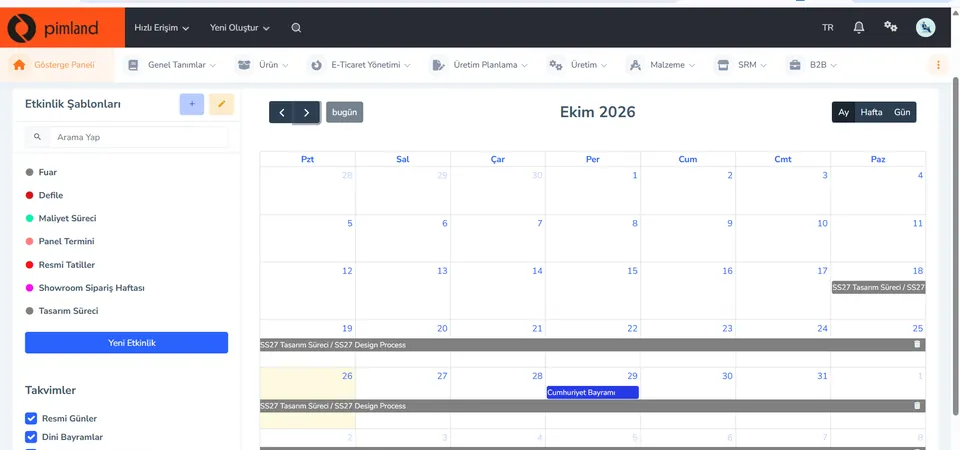
Screen from the demo environment; brands and amounts are demo data. Step 1Read the season calendar
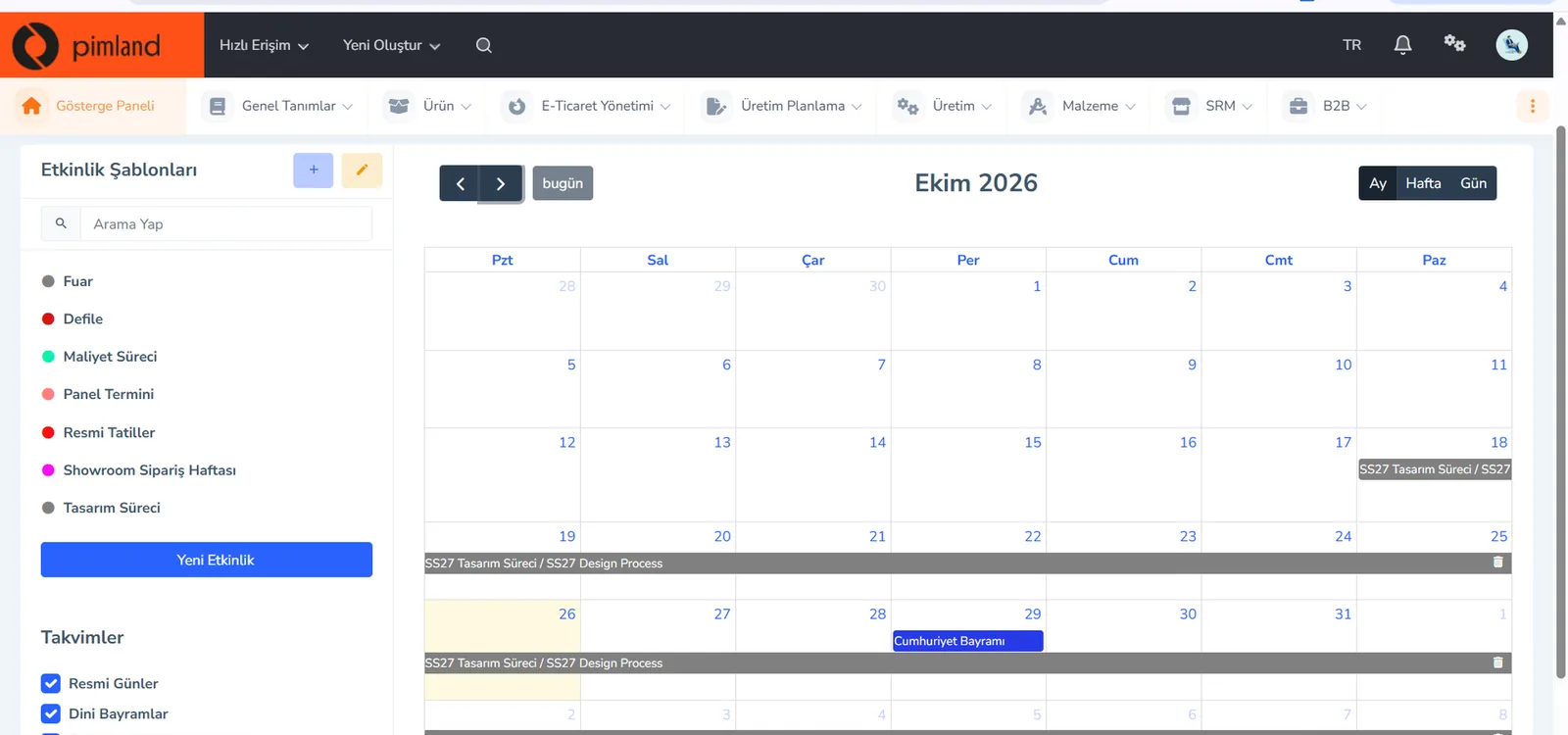
On the left are event templates: trade fair, fashion show, costing process, panel deadline, showroom order week, design process. You open the calendar in month, week or day view. In the example, the SS27 design process is a bar spread across weeks; the bayram holidays are on the same calendar too.
In real working life, the calendar is built backward from the launch date. If a holiday (bayram) week falls on a sample round, that week is lost; you need to see this when you build the calendar.
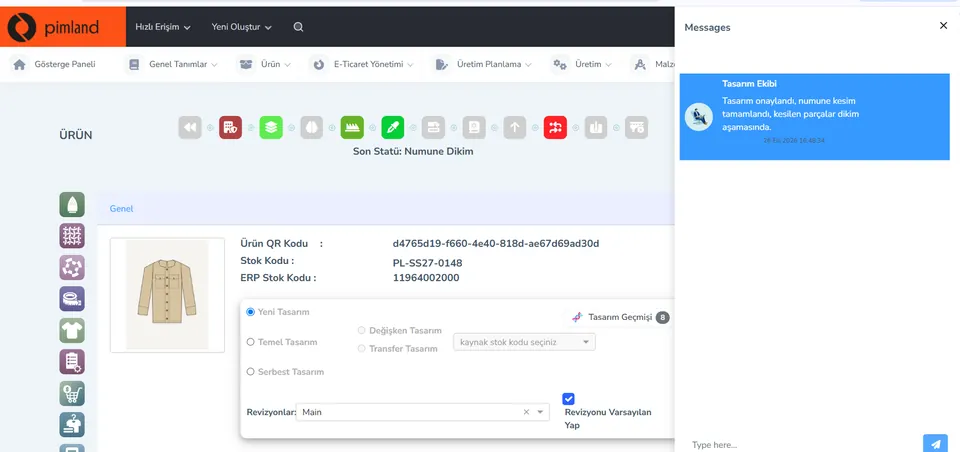
Screen from the demo environment; brands and amounts are demo data. Step 2See where a product is
The icon bar at the top of the product card is the product's journey; below it, 'Son Statü' (Latest Status) is shown. In the example, the product is at the sample sewing stage. The message panel on the right has the design team's note: design approved, sample cutting done, pieces in sewing.
In real working life, if the question 'what's the status of this style' gets asked in the meeting, the meeting turns into status gathering. If the status and messages sit on the product, the meeting is left for decisions.
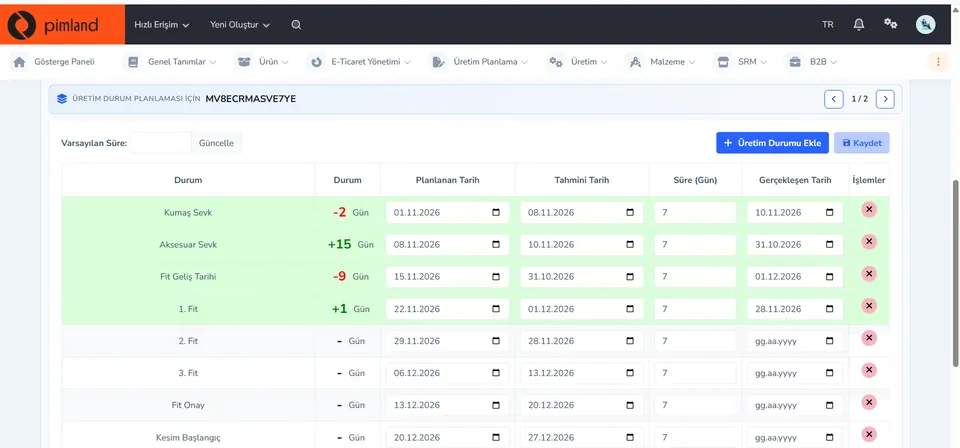
Screen from the demo environment; brands and amounts are demo data. Step 3See the delay in days
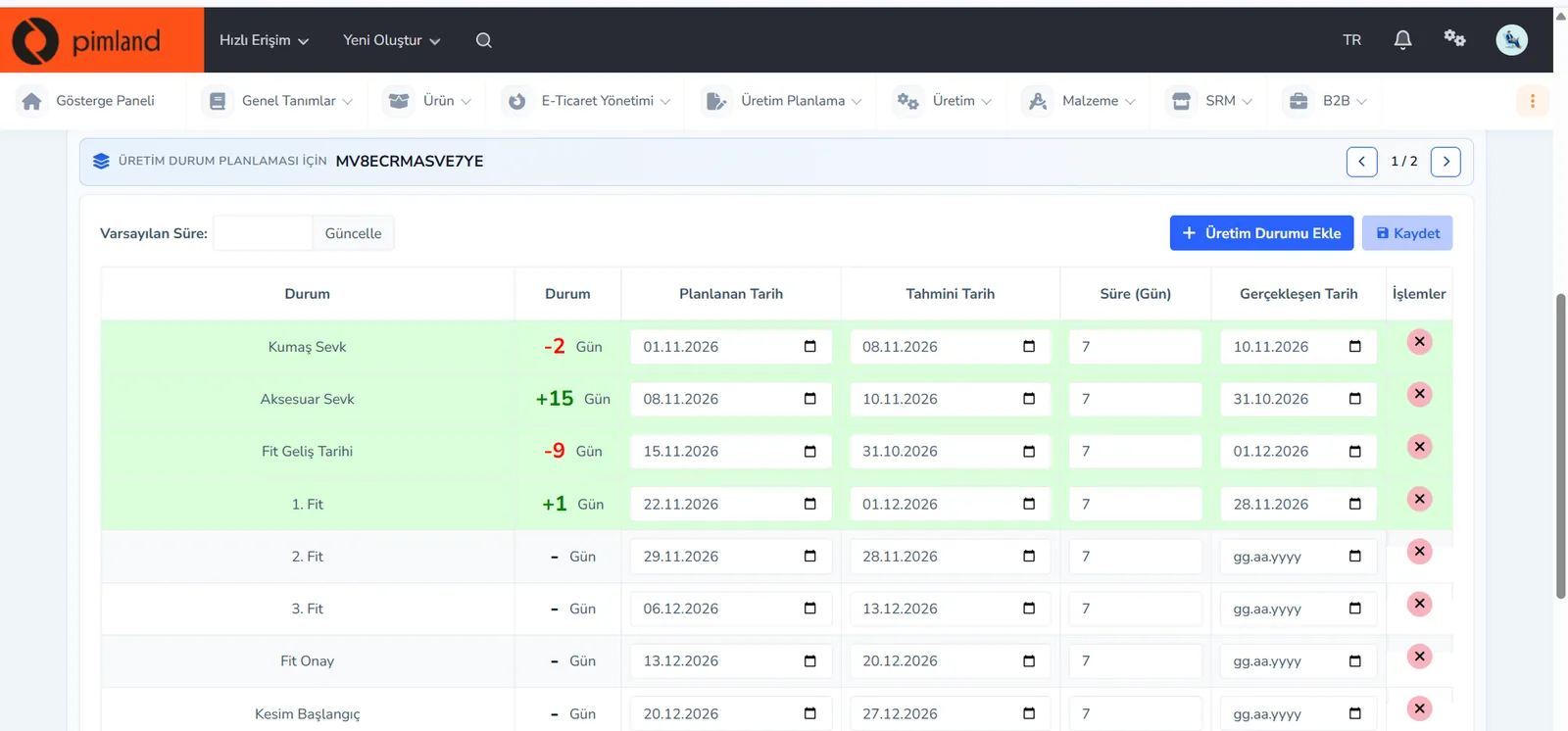
In production status planning, the planned, estimated and actual dates of each stage sit side by side. The status column shows the difference as plus or minus days. Fabric shipment, trims shipment, fit dates, fit approval and cutting start are on one list.
In real working life, the collection manager doesn't read this table line by line. They find the line whose deviation is growing and ask one question: will this push back the launch?
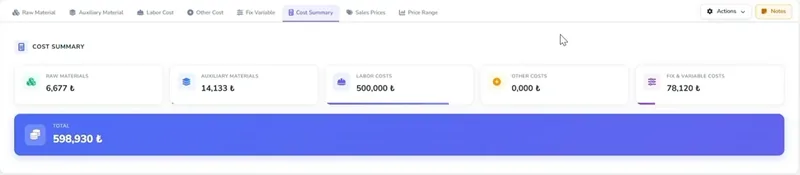
Screen from the demo environment; brands and amounts are demo data. Step 4Summarize the cost at a glance
The cost summary breaks a product's cost down into its components: raw materials, trims, labor, other costs, fixed and variable expenses; the total is at the bottom. This view is from the English interface.
In real working life, collection approval looks at the margin of the whole collection, not of a single product. If a style over target comes to the meeting with a simplification option, the decision gets easier.


These screens are from the Pimland PLM module.
Open your card
Open your card
Read the short summary and the Pimland screens and answer at least 2 of 3 questions correctly to open the card. When all 20 cards are open, your Pimland Basic Certificate arrives in your account automatically.
How fashion, retail and manufacturing companies work, and 20 position cards
First the required reading, then the cards for 20 positions: you learn how a fashion company works.
- FirstTraining 1: How is a product born? · read to the end and complete it
- Each cardA summary of the position, audio narration and Pimland screens
- Card3 short questions at the end of each part; 2 correct answers open the next part · no time limit
- AccountWith a free account, your progress follows you on every device
- At the endOnce you complete all 20 cards, the Pimland Basic Certificate arrives in your account automatically
Certificate 1 · Pimland Basic Certificate
Reading is open to everyone; the part questions and the certificate require an Academy account.
PLM, PIM and SRM trainings
The shared language of the fashion world: PLM, PIM and SRM, with Pimland's real screens.
- OrderFirst PLM, then PIM, then SRM · one at a time
- Each training8 parts, in order · audio narration and Pimland screen
- Questions3 questions at the end of each part, 24 in total · 2 correct answers open the next part · no time limit, the questions change with every attempt
- UnlockPart questions open after your Basic certificate
- Verification14+ (date of birth in your profile); an e-Devlet education document for Turkish nationals
- At the endOnce the three trainings, ID and document are complete, Certificate 2 arrives in your account
Certificate 2 · Pimland PLM · PIM · SRM Certificate
Reading is open to everyone; the part questions and the certificate require an Academy account.
PRO · advanced training
Separate application, for selected candidates.
- WhoCandidates selected from applicants who hold both certificates
- OnlinePimland PLM software training and test
- On site1 day inside a fashion company, seeing PLM in use
- ApplicationWith “Apply for PRO training” on the PRO page; places are limited, and selected candidates hear back by email
Certificate 3 · Pimland PRO Certificate
Reading is open to everyone; the part questions and the certificate require an Academy account.
FAQFrequently asked questions about the collection manager
4 questions
The merchandiser builds the collection's commercial plan: how many styles, what price, how many units. The collection manager makes sure this plan comes to life on time together with design, sampling and production. One owns the question 'how much', the other 'when and how'.
The approval meeting where the season's styles are evaluated together with their samples, costing and sales expectations. A continue, revise or drop decision is made for each style; the collection manager usually prepares the meeting: style list, sample status and costing in the same table.
People usually start as a collection or merchandising assistant; a few seasons of experience in design, product development or merchandising lead to this position. Learning the logic of calendars and milestones now will make you stand out.
At most brands, the season calendar and the style list are still kept in a spreadsheet; sales and stock reports come from the ERP. At brands that use PLM, the calendar, sample status and costing appear in the same product record.
· Pimland Academy team