How do you become a sustainability specialist?
DepartmentProduction, quality and sustainabilityModuleDPP
The sustainability specialist is the person at a textile and fashion company who monitors the environmental impact of products, tracks certificates and test documents, and makes sure sustainability claims are based on evidence.
 Card: Locked · your progress is saved in this browser · save it to your account
 PIMLAND 12 · DPP
Sustainability specialist
Production, quality and sustainabilitySustainability specialist, in brief
Every environmental claim that is made rests on a valid document linked to the product record.
- Compiles composition, place of production, chemical compliance documents and certificates.
- Matches environmental claims with documents, and explains to teams what data the EU textile rules require.
- Season rhythm: material selection, document collection, label and content matching, launch, end-of-period report.
- The most important documents are the certificate and transaction certificate, the test report, the chemical compliance declaration and the list of approved claims.
- Look for the fabric code within the certificate's scope; ask for the transaction certificate for the lot.
- Judged by whether environmental claims match documents and whether passport fields are tied to evidence.
- Fiber or production certificate and transaction certificate
- Lab test report
- Chemical compliance declaration
- List of approved environmental claims
 Sourcing / purchasing specialist
 Product development specialist
 E-commerce specialist
Read in detailall documents, workflow, cases
- Compiles each product's fiber composition, place of production, chemical compliance documents and certificates.
- Checks a supplier's certificate for its validity date, its scope and whether it really belongs to that fabric or lot.
- Matches the environmental claims on labels, product pages and campaign copy with documents; stops anything without evidence.
- Follows the EU's textile rules; explains to teams which data the company must prepare and by when.
- Provides data for company reports and for customer brands' supplier surveys; teaches teams what can be said.
In a season
- Material selection
An opinion on a new fabric and a new supplier: which documents are needed?
- Document collection
Certificates and test reports; the ones about to expire.
- Label and content
Marketing's and e-commerce's claims are matched with documents.
- Launch
Is the product data going correctly to the passport and the product page?
- End of period
Reports, surveys and long-term projects: switching to recycled fiber, chemical management, product data infrastructure.
Who do they work with?
- Sourcing / purchasing specialist
- Product development specialist
 Quality control coordinator
- E-commerce specialist
 Store sales associate
From school to work
| What you learned at school | At work |
|---|---|
| You learn sustainability as a value and a perspective. | At work, that value is backed by documents. A claim whose evidence is not in the product record does not go on the label. |
| You learn the basics of environmental impact and responsible production. | At work, evidence is required for every claim. In the EU, since 27 September 2026, undocumented 'eco-friendly' type claims and uncertified sustainability labels have been banned ((EU) 2024/825). |
| You learn what certificates mean and what they guarantee. | At work, the certificate's date, its scope and which fabric it belongs to are checked. The document you receive may turn out to belong to another fabric code, while the label printing is the next morning. |
| You get to know the basic framework of the legislation. | At work, you read EU regulations in English and tell the source apart from industry commentary. For company-specific obligations, you work with a legal advisor. |
| You learn the product life cycle and the idea of traceability. | At work, traceability has a name: the digital product passport, a record opened with the QR code on the product. In textiles, the requirement has not started yet and which data will be required has not been finalized; today's job is to map where the data sits in the company. |
What do job ads ask for?
From 242 fashion and retail job ads published in Turkey in August–October 2026.
Separate job ad
In the sample of 242 job ads in Turkey, there is 1 ad with a sustainability title, and it is at manager level. A sustainability paragraph repeated in every ad of one brand was left out of the count.
Fabric and composition knowledge
25% of the 242 ads ask for knowledge of fabric, yarn and trims. The passport's product data starts here.
Quality and testing
Quality is mentioned in 43% of the 242 ads. Test reports are this position's daily reference.
English
In 33% of the 242 ads. EU legislation and certificate documents are mostly in English.
The first 90 days
- List the certificates that are about to expire.
- Trace a product's passport data: composition in the BOM, origin on the product card, care in the tech pack.
- Match every environmental claim marketing uses with a document; flag the ones that don't match.
Which field of study?
Environmental, textile and industrial engineering, chemistry, business administration. Knowing fibers, dyeing and finishing takes the work onto the floor. The Sustainability Specialist (Level 6) standard of Turkey's Vocational Qualifications Authority (MYK) defines the profession independently of industry; textile knowledge is added on top of it.
Being able to ask a nice-sounding sentence, 'do you have a document?'
From the inside: documents, decisions, cases
Documents, handovers, decisions and mistakes that happen on the job.
A working day
- 09.00
You check the document tracking list: certificates nearing expiry, documents whose scope does not cover the new fabric. You write the renewal request to the supplier, often in English.
- 10.00
A request for an opinion on a new fabric supplier comes from sourcing. Which certificate, which test report, which chemical compliance declaration will be needed; you draw up the list.
- 11.00
A test report comes from the lab. Which fabric code and which lot it belongs to, which method it was tested with; you read it and link it to the product record.
- 13.30
You read e-commerce's new product texts and marketing's campaign draft. You put a document against every environmental claim and flag the ones you can't.
- 14.30
For products close to launch, you compare the composition in the BOM with the label text together with product development. If the fabric changed, the label changes too.
- 15.30
A supplier questionnaire arrives from an export customer brand: fiber, place of production, chemical management. You compile the answer from product and supplier records; what you don't know, you write as 'unknown'.
- 16.30
If the European Commission has a new draft or guidance on textiles, you read it from its official source. Then a short note to the teams: what changed, what didn't, what we don't know yet.
- 17.30
You update the passport data map: which field's data is in which record, in whose hands. You add any field without a clear source to the list.
A sample day; hours vary by company and season.
Workflow: before you, after you
- 1Work out the documents needed for a new material and supplier
- Input
- Sourcing's request for a new fabric or supplier
- Output
- List of required documents and tests
- Handover
- Sourcing / purchasing specialist
- 2Verify the incoming document and link it to the product record
- Input
- Certificate, transaction certificate, chemical compliance declaration
- Output
- A document linked to the product, with scope and validity checked
- Handover
- Product development specialist
- 3Request tests for risky materials
- Input
- New fabric, trim or print
- Output
- Test request and the acceptance criteria expected in the result
- Handover
- Quality control coordinator
- 4Match the product text and label claim with documents
- Input
- Product description, label text, campaign draft
- Output
- Approved, corrected or removed claims
- Handover
- E-commerce specialist
- 5Complete the passport fields
- Input
- BOM, supplier record (origin), tech pack (care), test reports
- Output
- Passport data with a clear source, tied to evidence
- Handover
- E-commerce specialist
- 6Prepare a short briefing note for the teams that talk to customers
- Input
- Approved claims and passport data
- Output
- Sourced answers to frequently asked sustainability questions
- Handover
 Customer service representative
- 7Escalate the period report and data gaps
- Input
- Document tracking list, passport data map, questionnaires
- Output
- Missing data, risky suppliers and proposed steps
- Handover
 Middle manager
Documents that pass through your hands
| Document | From | To | When | What for |
|---|---|---|---|---|
| Fiber or production certificate and the transaction certificate for the lot | Supplier (through sourcing) | Sustainability | At material approval and shipment | Showing that the claim to be written on the product really covers that fabric and that lot. |
| Lab test report | Lab, through quality control | Sustainability and product development | After sample approval, before production | Tying chemical compliance, care information and product safety to evidence. |
| Chemical compliance declaration | Fabric and trim supplier | Sustainability | At approval of a new supplier and a new material | Documenting compliance with restricted substances. |
| Bill of materials (composition) | Product development | Sustainability | At BOM approval and at every revision | The source of the composition information on the label, the product page and the passport. |
| List of approved environmental claims | Sustainability | E-commerce, marketing, store | Before launch and campaigns | Making sure teams use only claims that have evidence, in the evidence's own words. |
| Customer brand supplier questionnaire | Export customer brand | Sustainability, with the answer going to the customer | In the period the customer asks for | Providing data for the customer's own reporting and supply chain review. |
| Passport data map | Sustainability | Manager and relevant teams | Updated periodically | Showing which record each passport field comes from and where the gaps are. |
Decisions
- Using or stopping an environmental claimApproved by: You propose and, if needed, stop it; in disputed cases, your manager and the legal advisor.
- Accepting an incoming document as sufficientApproved by: You; when in doubt, you ask the issuing body or the lab.
- Whether a new supplier is suitable in terms of documentsApproved by: You give the opinion; the supplier decision lies with sourcing and its manager.
- Interpreting a company-specific legal obligationApproved by: The legal advisor; you prepare the source and the data.
What are you evaluated on at work?
- Status of products with missing or expired documents
- Environmental claims matching documents
- Passport fields filled in and tied to evidence
- Timely and accurate answers to customer questionnaires
- Keeping teams informed and speed of response to questions
Common mistakes on the job
Treating every fabric from a supplier as certified because the supplier has a certificate.
ResultAn environmental claim is written on a product the document does not cover.
PreventionLook for the fabric code within the document's scope; ask for the transaction certificate for the lot.
Not tracking expiring documents.
ResultIt is noticed after the label is printed or the product goes live.
PreventionLink the document to the product record with its validity date; put a reminder on the tracking list.
Accepting general claims such as 'nature-friendly' or 'green'.
ResultIn the EU, undocumented general environmental claims are banned; the brand loses trust.
PreventionUse only the concrete information written in the document, in the document's own words.
Assuming the composition was updated when the fabric changed.
ResultThe label, the product page and the passport are all wrong at the same time.
PreventionHave fabric changes made through a BOM revision, and have the revision reach you as a notification.
Reading legislation through second-hand commentary.
ResultA wrong date or a wrong scope spreads across teams.
PreventionCite the official text and the Commission page as the source; write what has not been finalized as 'not finalized'.
Case: what would you do?
Case 1The label printing is tomorrow morning. The organic cotton certificate the supplier sent covers a different fabric code.What do you do?
A good answerYou have the word 'organic' removed from the label, or you hold the printing for this claim only. You ask the supplier for the document for that fabric, and notify product development and sourcing in writing.
Once an undocumented claim is printed, taking it back is costly and damages trust. A product without the claim still sells.
Case 2A product page says 'eco-friendly production'. The product's file only has a document for the main fabric, which contains recycled polyester.What do you do?
A good answerYou have the general claim removed. In its place, you suggest the concrete information written in the document: which part contains recycled fiber, and the name of the document.
A concrete, evidenced claim both follows the rules and means more to the customer.
Case 3An export customer brand asks in which country a product's fiber was produced. All you have is the fabric supplier's name.What do you do?
A good answerYou don't fill the gap with a guess. Through sourcing, you ask the fabric supplier for the yarn and fiber origin information, record the answer in the product record, and tell the customer when you will get back to them.
The deeper the supply chain goes, the weaker the data gets. A wrong answer comes out in the customer's audit.
Think of your own answer first, then open it.
How does this position work with the world?
Most of this position's source texts are in English: EU regulations, Commission guidance, certificate standards, lab reports. Export customer brands ask for the same data in their own formats; terms like traceability, chain of custody and due diligence are everyday language. When the BOM and the supplier record sit in one place in PLM, the same data goes to both the customer questionnaire and the digital product passport with the same evidence.
What changes with PLM?
| Before | With PLM |
|---|---|
| Certificates sit in folders and e-mail attachments; you guess which product they belong to from the file name. | The document is linked to the product and supplier record; when you open the product, you also see its evidence. |
| You don't hear when the fabric changes; you find out after the label is printed. | The BOM's revision history shows the fabric change; a composition change does not slip through. |
| You collect the data from scratch every time, for the passport or a customer questionnaire. | Composition comes from the BOM, origin from the supplier record, care from the tech pack; you focus on the fields that are missing or lack evidence. |
Career path
- Sustainability assistant
- Sustainability specialist
- Senior sustainability specialist
- Middle manager
Glossary for this position
- DPP (digital product passport)
- A structure that links a product's identity, material, care and end-of-life information to a digital record opened by a QR code on the product.
- Composition
- Information showing which fibers a fabric or product is made of, and in what proportions.
- Origin
- Information showing the country where a product was made.
- BOM (bill of materials)
- The list of all materials needed to make a product, with quantity, unit, supplier and price.
- Tech pack
- The production package that gathers a style's technical drawing, measurement chart, materials, stitching details and instructions in one document.
- Revision
- The new version of a style, tech pack or costing after a change.
- SRM
- Supplier relationship management: the system that runs supplier cards, orders, production follow-up and quality inspections in a shared record between brand and supplier.
- PLM
- Product lifecycle management: the system that keeps a product's development information, from its calendar, design, tech pack and bill of materials to its samples and costing, in a single record.
What does the work look like on screen?
In Pimland, sustainability shows up as the digital product passport (DPP). On this tour you will see the passport's entry point, its four sections and the BOM the data comes from.
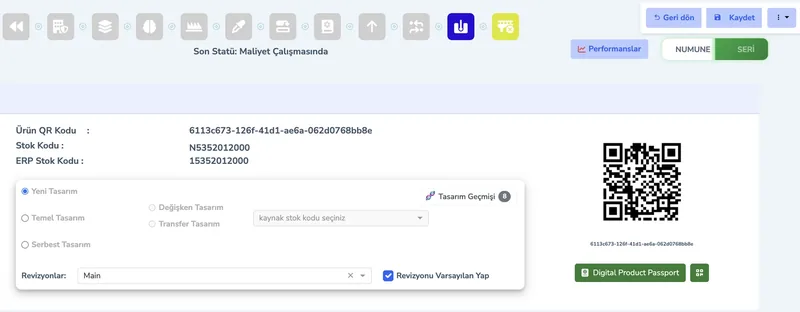
Screen from the demo environment; brands and amounts are demo data. Step 1Find the passport's entry point
On the product card, the product QR code and the 'Digital Product Passport' button sit side by side. The passport opens from the product record; it works not as a separate file but as a continuation of the record.
At work, in reality, a brand that leaves the passport until last ends up scrambling to collect data when the requirement arrives. A brand that keeps the data in the product record from today only has to publish.
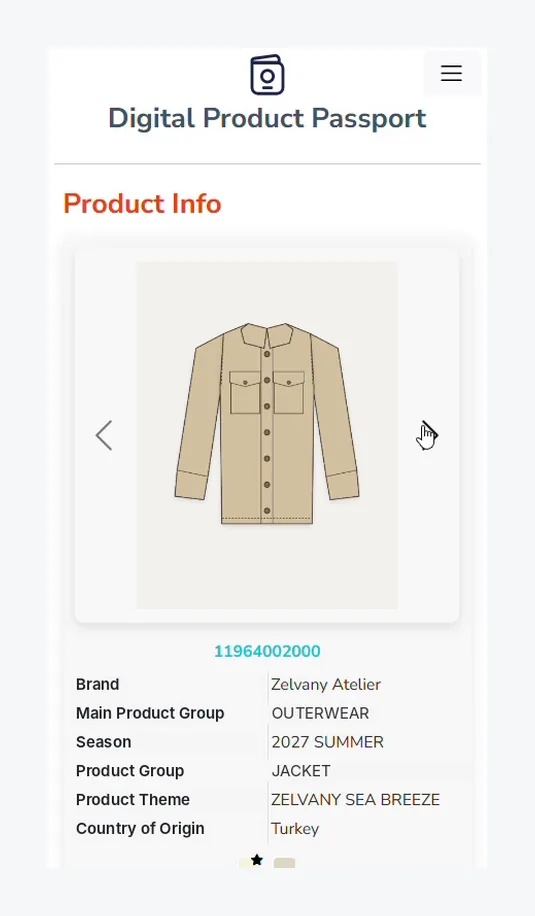
Screen from the demo environment; brands and amounts are demo data. Step 2Check the product information
The passport's first section: brand, main product group, season, product group, theme and country of origin. This is the version that opens on a phone; the interface is in English.
At work, in reality, origin information changes depending on which point in the supply chain it comes from. Don't write a value whose source you don't know.
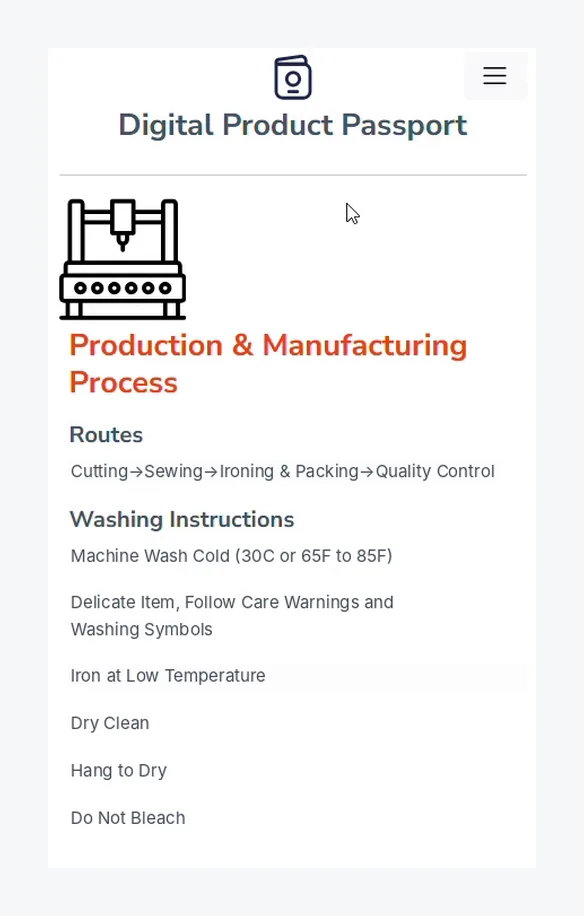
Screen from the demo environment; brands and amounts are demo data. Step 3Production route and care
In the production section, the route order: cutting, sewing, ironing and packing, quality control. Below it, the washing instructions, such as cold wash, iron at low heat, hang to dry.
At work, in reality, the source of care information is the tech pack and the lab test. The line in the passport must be the same as the line in the tech pack.
Screen from the demo environment; brands and amounts are demo data. Step 4End of use and footprint
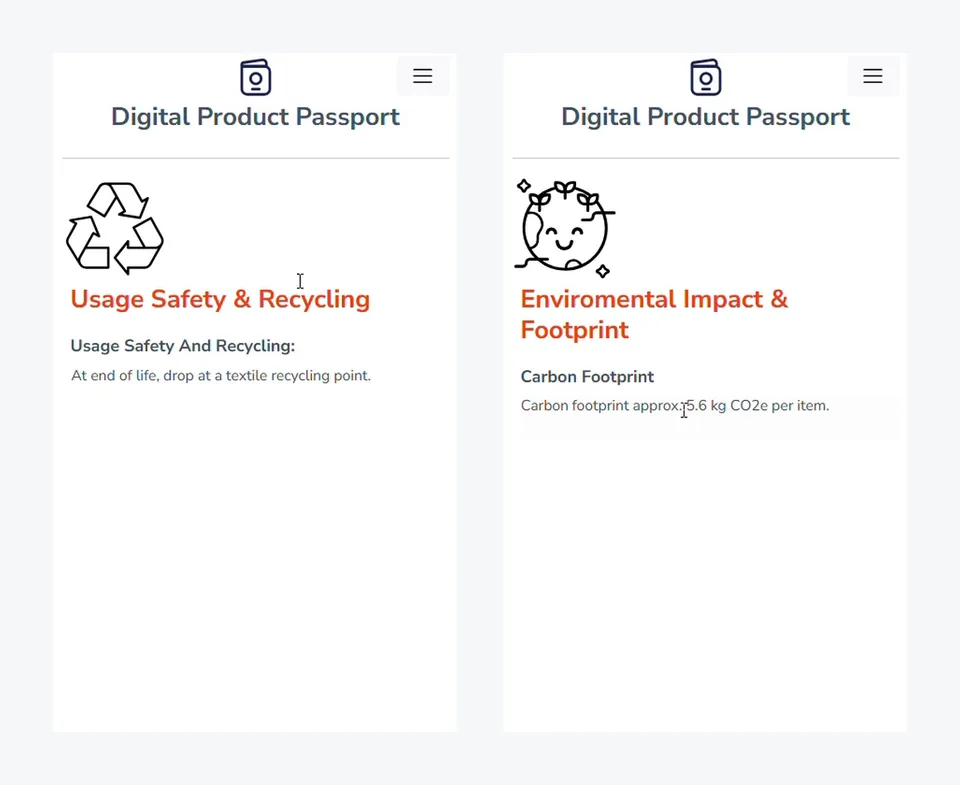
In the use safety and recycling section, guidance for the product at the end of its life; in the environmental impact section, the carbon footprint field. The value on screen is demo data.
At work, in reality, every value written in this field must have a measurement or a document behind it. Leaving the field empty is better than writing a number without evidence.
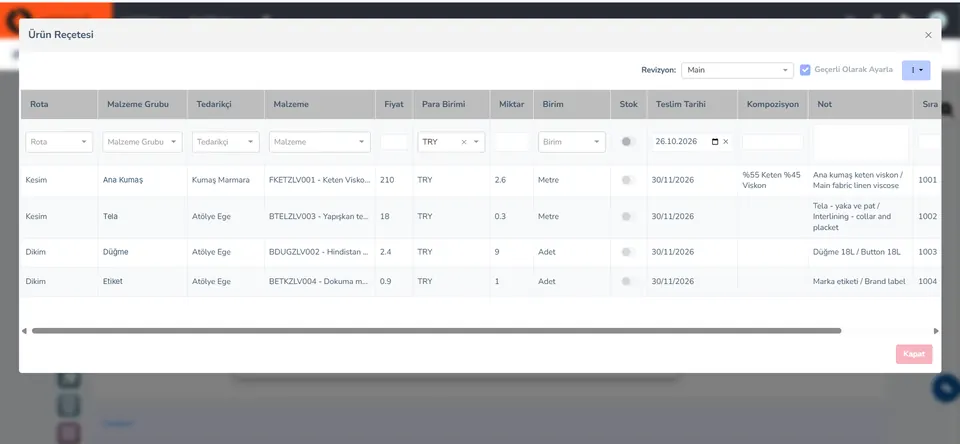
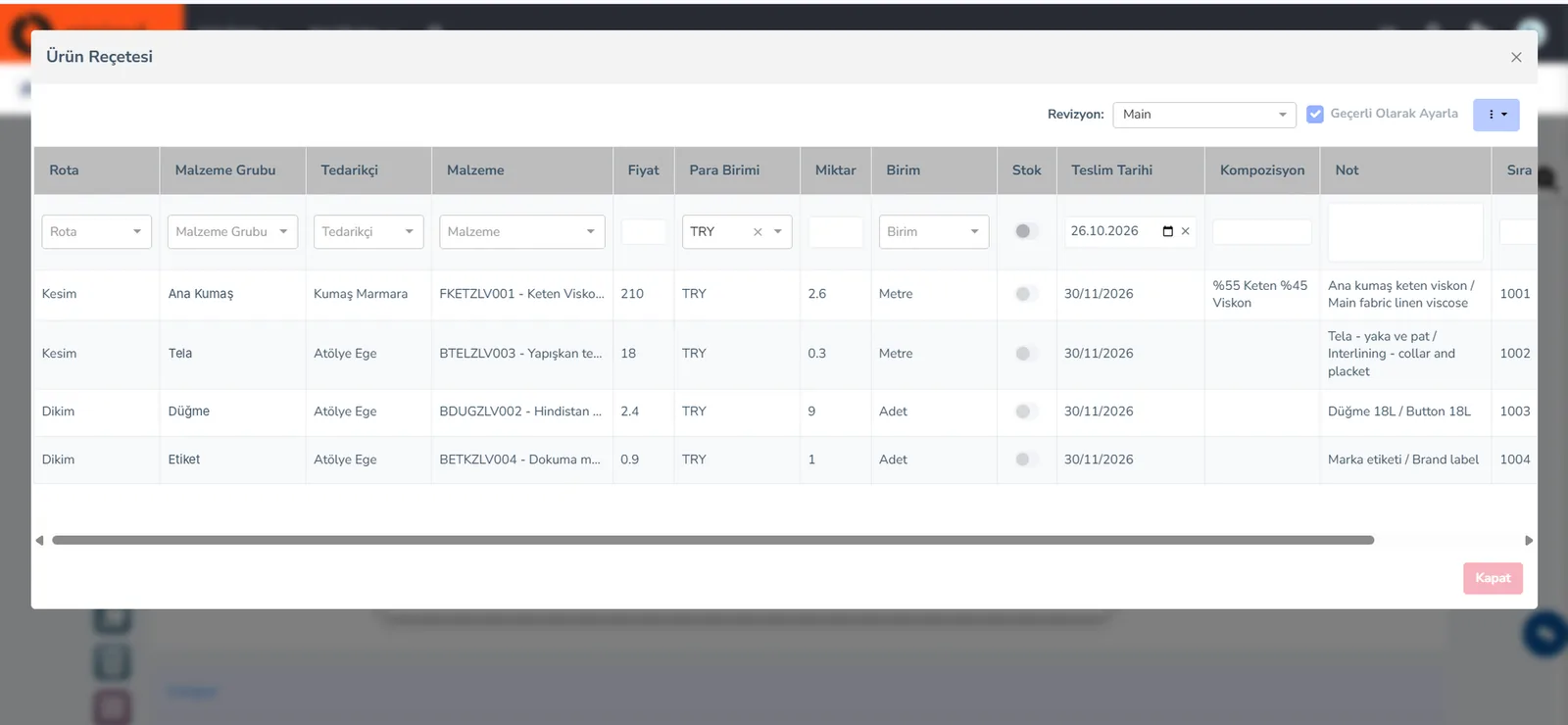
Screen from the demo environment; brands and amounts are demo data. Step 5Find the composition in the BOM
The composition column in the BOM carries the fiber percentages; in the example, the linen and viscose ratio is written for the main fabric. The BOM is the starting point of the product data in the passport.
At work, in reality, if the fabric changes and the composition is not updated, the label, the product page and the passport are all wrong at the same time.


These screens are from the Pimland DPP module.
Open your card
Open your card
Read the short summary and the Pimland screens and answer at least 2 of 3 questions correctly to open the card. When all 20 cards are open, your Pimland Basic Certificate arrives in your account automatically.
How fashion, retail and manufacturing companies work, and 20 position cards
First the required reading, then the cards for 20 positions: you learn how a fashion company works.
- FirstTraining 1: How is a product born? · read to the end and complete it
- Each cardA summary of the position, audio narration and Pimland screens
- Card3 short questions at the end of each part; 2 correct answers open the next part · no time limit
- AccountWith a free account, your progress follows you on every device
- At the endOnce you complete all 20 cards, the Pimland Basic Certificate arrives in your account automatically
Certificate 1 · Pimland Basic Certificate
Reading is open to everyone; the part questions and the certificate require an Academy account.
PLM, PIM and SRM trainings
The shared language of the fashion world: PLM, PIM and SRM, with Pimland's real screens.
- OrderFirst PLM, then PIM, then SRM · one at a time
- Each training8 parts, in order · audio narration and Pimland screen
- Questions3 questions at the end of each part, 24 in total · 2 correct answers open the next part · no time limit, the questions change with every attempt
- UnlockPart questions open after your Basic certificate
- Verification14+ (date of birth in your profile); an e-Devlet education document for Turkish nationals
- At the endOnce the three trainings, ID and document are complete, Certificate 2 arrives in your account
Certificate 2 · Pimland PLM · PIM · SRM Certificate
Reading is open to everyone; the part questions and the certificate require an Academy account.
PRO · advanced training
Separate application, for selected candidates.
- WhoCandidates selected from applicants who hold both certificates
- OnlinePimland PLM software training and test
- On site1 day inside a fashion company, seeing PLM in use
- ApplicationWith “Apply for PRO training” on the PRO page; places are limited, and selected candidates hear back by email
Certificate 3 · Pimland PRO Certificate
Reading is open to everyone; the part questions and the certificate require an Academy account.
FAQFrequently asked questions about sustainability specialists
4 questions
A structure that links a product's identity, material, care and end-of-life information to a single digital record opened by a data carrier such as a QR code on the product. Its legal basis is the EU Ecodesign Regulation (EU) 2024/1781 (ESPR).
Not yet final. According to the European Commission's textiles page, the rules specific to apparel are planned to be adopted in the last quarter of 2027; the application date has not been set and the timeline may change.
Directive (EU) 2024/825 has applied since September 27, 2026; it bans undocumented 'eco-friendly'-type claims and sustainability labels without certification. This is general information; for company-specific obligations, consult a legal advisor.
Environmental, textile and industrial engineering, chemistry and business administration are common. Reading EU legislation in English, knowing the scope of certification schemes and working with data are the skills that stand out.
· Pimland Academy team