How do you become a store sales associate?
DepartmentStore and customerModuleDPP
The store sales associate is the person in an apparel store who welcomes customers, helps them find the right product and size, completes the sale and keeps the sales floor tidy.
 Card: Locked · your progress is saved in this browser · save it to your account
 PIMLAND 18 · DPP
Store sales associate
Store and customerStore sales associate, in short
The right three questions find the right size; the right information is on the label and the QR code.
- Greets the customer and finds the right product and size with the right question.
- Runs the fitting room, checkout, returns and exchanges; keeps the sales floor and incoming shipments organized.
- The season's rhythm: season change, opening prep, peak hours, sale period, periodic stock counts.
- The most important documents are the delivery note, the visual merchandising instructions, the price and campaign list, and the return record.
- When a question is unclear, check the label and the QR code; if needed, find out and get back to the customer.
- Evaluated on sales contribution, basket size, customer satisfaction and stock accuracy.
- Delivery note and box list
- Visual merchandising instructions
- Price and promotion list
- Return and exchange record
 Merchandiser
 Visual merchandiser (VM)
 Planning specialist
Read in detailall documents, workflow, cases
- Welcomes the customer; asks what they are looking for, where they will wear it and what size they wear in this brand.
- Finds the right product and size using knowledge of fit, fabric and outfits; offers options if the item is not available.
- Runs the fitting rooms, the till, returns and exchanges according to the store's rules.
- Keeps the floor, the rails and the size order tidy; refills missing sizes from the stockroom.
- Opens incoming shipments, tags them and enters them into the system; takes part in stock counts.
In a season
- Season transition
Getting to know the new product, changing price tags, refreshing the sales floor.
- Before opening
Preparing the sales floor and fitting rooms, unpacking shipments, campaign tags.
- Peak hours
Moving between greeting, recommending, fitting rooms and checkout.
- Sales and special days
The workload rises; price changes, returns and exchanges pile up.
- Periodic stock count
Counting stock and rearranging the sales area.
Who do they work with?
- Merchandiser
 E-commerce specialist
 Sustainability specialist
 Customer service representative
- Visual merchandiser (VM)
- Planning specialist
From school to work
| What you learned at school | At work |
|---|---|
| You learn to know the product and talk about its strengths. | At work, a sale starts with the right question: what are you looking for, where will you wear it, what size do you wear in this brand? |
| You learn the basics of fabric and product knowledge. | At work, the first questions on the floor come to you: what's the fabric, will it shrink in the wash, is the fit slim? The answer was written the day the product was developed; the point is for it to reach the shelf. |
| You learn the basics of window and store layout. | At work, the store is also a warehouse: unpacking shipments, labeling, counting, refilling sizes that run low. |
| You learn to listen to the customer and understand their needs. | At work, if the product isn't in the store, it may be in the warehouse, at another store or online. You help the customer with the online ordering option the brand offers. |
| You talk about why sustainability matters. | At work, the question 'is it sustainable?' needs proof; an answer without proof is a risk for the brand. You check the certificate information, if there is any, or the product's QR code. |
What do job ads ask for?
From 242 fashion and retail job ads published in Turkey in August–October 2026.
Separate job ad
In the sample of 242 ads, store sales associate is the position with the most ads, at 40 unique ads; 36 of them have entry-level titles. An older analysis of apparel job ads also lists sales associate among the most sought-after positions (Özbek and Esmer 2018).
Communication and sales
The national occupational standard of MYK (Turkey's Vocational Qualifications Authority) defines a sales associate as someone who plans, supports and makes sales and maintains the customer relationship.
Document
MYK's Sales Associate (Level 4) vocational qualification certificate is a plus; it isn't required.
The first 90 days
- Learn the fabric, fit and care of every product group on the floor; read the labels.
- Make size recommendations with questions: which size in this brand, do they like it slim or relaxed, does the fabric stretch.
- Note every customer question you can't answer; share them with the store manager once a week.
Which field of study?
You can start after finishing high school; vocational high school and vocational school programs in retail and sales teach the basics of the job. In apparel retail it is also common for students to start part-time. Store experience is valuable later for understanding the customer in positions such as merchandising.
Helping a customer find the right size in three questions.
From the inside: documents, decisions, cases
Documents, handovers, decisions and mistakes that happen on the job.
A working day
- 09.30
A short meeting before opening: the day's campaign, the incoming shipment, yesterday's sales, the products to push. The store manager says who will be in which section.
- 10.00
Floor round: size order, missing sizes, making sure the product in the window is also on the floor. You refill what's missing from the stockroom.
- 11.00
Unpacking shipments: you compare the box list with the incoming products and scan the barcodes. You note missing or extra items and attach the security and price tags.
- 12.30
Peak hour: greeting, recommending, fitting room, checkout. You hang items returned from the fitting room back in place right away; otherwise the size looks 'out of stock' on the floor.
- 14.00
A customer asks for another size of a pair of trousers, and the store doesn't have it. You check stock at another store or online and open the order through the channel the brand offers.
- 15.30
Returns and exchanges: you check the item's condition, tag and receipt against the rules. You enter the return reason in the system with the right code; 'other' is easy but useless.
- 17.00
New visual merchandising instructions come from head office: table and wall layouts with photos. You set up the layout, take a photo and send it to head office.
- 19.00
Closing: checkout, fitting rooms, sales floor. You write the customer questions you couldn't answer during the day in a notebook; they go into the weekly note from there.
A sample day; hours vary by company and season.
Workflow: before you, after you
- 1Count the shipment, enter it into the system, report differences
- Input
- Box list and incoming products
- Output
- Products received into stock; report of missing or extra items
- Handover
- Merchandiser
- 2Put the product on the floor, set up the visual layout
- Input
- Visual merchandising instructions, price list
- Output
- Sales floor set up per the instructions, with a photo
- Handover
 Middle manager
- 3Turn a size the store doesn't have into an online order
- Input
- Customer request, stock view
- Output
- An order opened; delivery questions now go to customer service
- Handover
- Customer service representative
- 4Take a sustainability question you couldn't answer to the right place
- Input
- The customer's question, the passport opened via the QR code
- Output
- A question passed on through the store manager
- Handover
- Sustainability specialist
- 5Set aside and report a faulty item
- Input
- A faulty item the customer brought back or you found on the floor
- Output
- Item set aside; report with product code and photo
- Handover
 Quality control coordinator
- 6Write the weekly feedback
- Input
- Your end-of-day notes, return reasons
- Output
- The most asked-about, unavailable and complained-about products
- Handover
- Merchandiser
- 7Join the stock count, explain the differences
- Input
- Count list
- Output
- Count report and notes on differences
- Handover
- Middle manager
Documents that pass through your hands
| Document | From | To | When | What for |
|---|---|---|---|---|
| Delivery note and box list | Warehouse or distribution center | Store | When a shipment arrives | Counting incoming products and entering them into the system, so stock is accurate. |
| Visual merchandising instructions | Head office visual merchandising team | Store | At season change, with each new drop and campaign | Presenting the product with the same story in every store. |
| Price and promotion list | Head office and merchandiser | Store | Before campaigns and sales | Making sure the price on the tag, at the checkout and online is the same. |
| Return and exchange record | Store | Head office | At the time of the return | Passing the return reason accurately to head office; the product and quality teams learn from it. |
| Stock transfer request | Store | Another store or warehouse | When a customer can't find their size or the floor runs low | Not losing the sale. |
| Count report | Store | Head office | At periodic stock counts | Seeing the difference between the stock in the system and what's on the shelf. |
| Weekly store feedback note | Store | Merchandiser and regional manager | Weekly | Passing on to head office the products customers asked about, couldn't find and complained about. |
Decisions
- Accepting returns and exchanges that follow the rulesApproved by: You; an exception outside the rules is up to the store manager.
- Offering the customer a transfer from another store or an online orderApproved by: You.
- Pulling an item that looks faulty from the floorApproved by: You set it aside; the store manager and head office decide whether it comes off sale.
- Departing from the visual merchandising instructions because of missing sizesApproved by: The store manager.
What are you evaluated on at work?
- Contribution to personal and store sales
- Units per transaction and basket size
- Customer satisfaction and feedback
- Stock accuracy and count discrepancies
- Following the floor and visual merchandising guidelines
Common mistakes on the job
Receiving a shipment into the system without counting it.
ResultSystem stock is wrong; online orders are opened for products that aren't there.
PreventionCheck the box list against the barcodes; report any difference the same day.
Answering a question you don't know with a guess ('won't shrink', 'pure cotton').
ResultA sale based on wrong information, a return and lost trust.
PreventionCheck the label and the QR code; if the answer isn't there, say 'I'll find out and get back to you.'
Entering 'other' as the return reason.
ResultHead office can't see whether the problem is in the pattern, the fabric or production.
PreventionChoose the right code; add a one-sentence note if needed.
Letting items returned from the fitting room pile up.
ResultThe size looks out of stock on the floor; a sale is lost.
PreventionRegular fitting-room rounds, even at busy times.
Hanging a faulty item back on the rail.
ResultThe same item is sold to another customer and the complaint grows.
PreventionSet it aside, tag it, and report it with the product code and a photo.
Case: what would you do?
Case 1A customer asks whether a jacket is sustainable. The label says nothing about this.What do you do?
A good answerYou scan the QR code and pass on what the passport says. If it isn't there either, you say 'I can't see any documented information on this, but I can find out and get back to you,' and you note down the question.
An unsupported 'yes' is a risk for the brand; an honest 'I'll find out and get back to you' builds trust.
Case 2A customer wants to exchange an item bought on sale and doesn't have the receipt.What do you do?
A good answerYou explain the rule politely. If the purchase can be found in the system another way, you check; if an exception is needed, you take it to the store manager instead of making promises yourself.
The rule must apply the same way to everyone. The decision on an exception belongs to the person with the authority.
Case 3On the same day, two customers show you the same style of the same trousers coming apart at the back seam.What do you do?
A good answerYou set the items aside and check the same style on the floor. You report to the store manager and head office with the product code and photos, and you code the return reason correctly as a manufacturing defect.
This isn't a single return; it may be a signal about a whole batch. A correctly coded return reaches quality control and the supplier.
Think of your own answer first, then open it.
How does this position work with the world?
In the store, too, you are at the end of a global chain: a product on the shelf may have been designed in another country and made in Turkey or abroad, and tourist customers ask questions in English. The origin, composition and care information on the label comes from the product record; with the digital product passport, the customer can see the same information on their phone by scanning the QR code. That's why what you say has to match what the record says.
What changes with PLM?
| Before | With PLM |
|---|---|
| When asked 'What's the fabric, will it shrink?', you rely only on the label and your own experience. | Information born in the product record travels all the way to the shelf through the QR code and the passport; you read the answer from its source. |
| A quality problem you spot gets lost in a phone call or an email. | When the return reason is linked to the product code, the same problem shows up on the quality and product team's screen. |
| The store, the website and the customer service center may give different information about the same product. | When all channels are fed from a single record, the customer gets the same answer everywhere. |
Career path
- Sales associate (part-time or full-time)
- Senior sales associate or section supervisor
- Assistant store manager
- Store manager (middle manager)
Glossary for this position
- Visual merchandising
- The work of planning how the product will be displayed in the store and the window, the shelf layout and the mannequin setup.
- Barcode
- The sequence of code and bars that lets a product option be read by machine at the checkout, in the warehouse and during stock counts.
- SKU (stock keeping unit)
- The code that uniquely identifies each product option held in stock.
- Variant
- Each sellable option of the same style, distinguished by attributes such as color and size.
- Drop
- Releasing a collection for sale in parts on set dates, rather than all at once.
- Markdown (discount)
- Lowering the price of a product whose sales fall below expectations.
- Sell-through (sales rate)
- The ratio of units sold in a period to units offered for sale in the same period.
- Composition
- Information showing which fibers a fabric or product is made of, and in what proportions.
- DPP (digital product passport)
- A structure that links a product's identity, material, care and end-of-life information to a digital record opened by a QR code on the product.
What does the work look like on screen?
In the store, Pimland reaches you through the digital product passport: you or the customer scan the QR code and the product information opens.
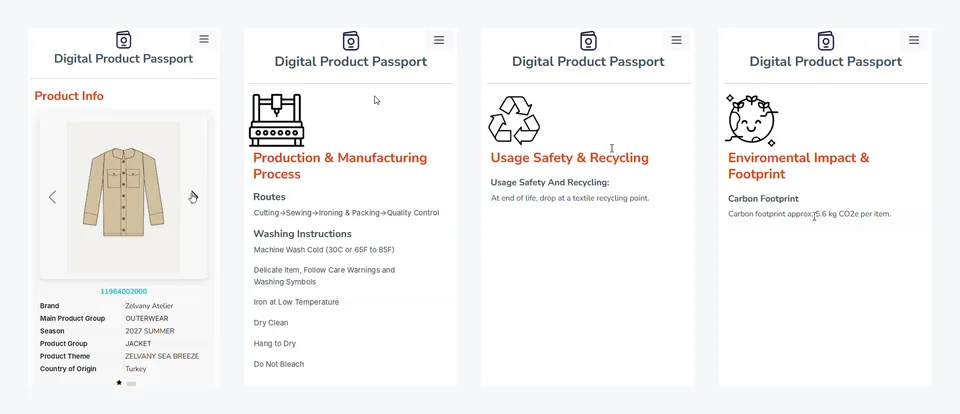
Screen from the demo environment; brands and amounts are demo data. Step 1Scan the QR, open the passport
The QR code on the product opens the digital product passport on a phone. Four sections: product information, production and care, safe use and recycling, environmental impact.
In real working life, the customer can also scan the QR code themselves. What the passport says and what you say must match.
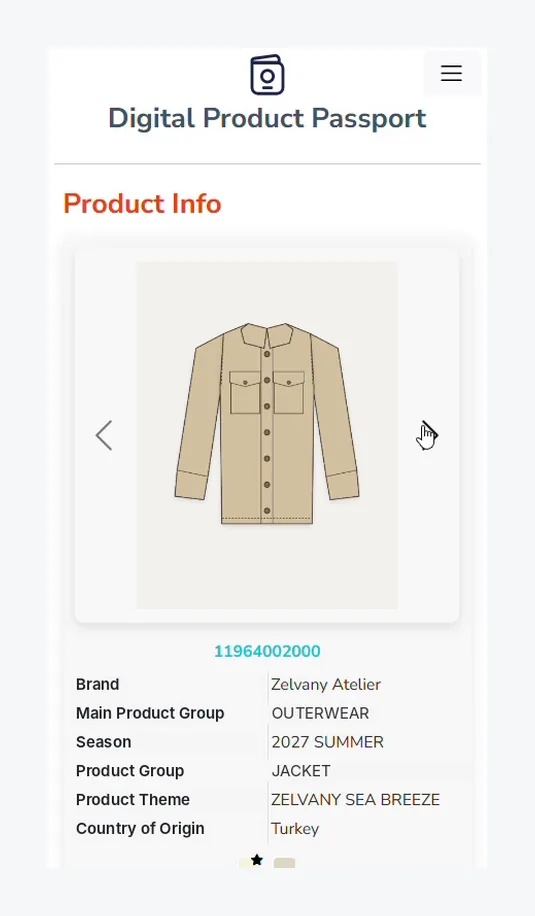
Screen from the demo environment; brands and amounts are demo data. Step 2The 'Where was it made?' question
The product information section shows the brand, main product group, season, product group, theme and country of origin. The interface is in English.
In real working life, guessing at something you don't know shakes trust. If the information is on screen, read it; if not, say 'I'll find out and get back to you.'
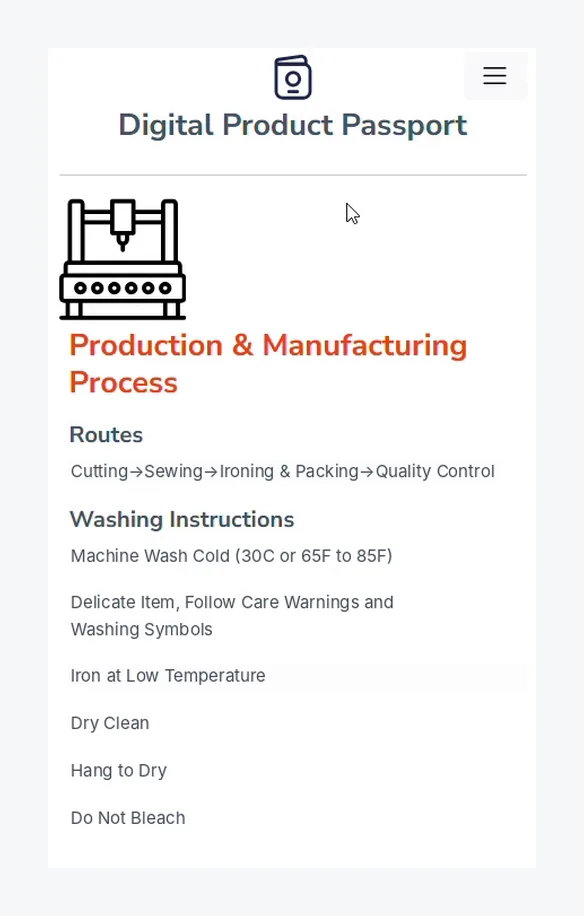
Screen from the demo environment; brands and amounts are demo data. Step 3The 'Will it shrink in the wash?' question
In the production and care section, the washing instructions are listed in order: cold wash, delicate item warning, low-temperature ironing, dry cleaning, hang to dry, do not bleach.
In real working life, care instructions don't say 'won't shrink.' The most honest answer is to recommend following the instructions; the fabric's shrinkage test result is held by the product team.


These screens are from the Pimland DPP module.
Open your card
Open your card
Read the short summary and the Pimland screens and answer at least 2 of 3 questions correctly to open the card. When all 20 cards are open, your Pimland Basic Certificate arrives in your account automatically.
How fashion, retail and manufacturing companies work, and 20 position cards
First the required reading, then the cards for 20 positions: you learn how a fashion company works.
- FirstTraining 1: How is a product born? · read to the end and complete it
- Each cardA summary of the position, audio narration and Pimland screens
- Card3 short questions at the end of each part; 2 correct answers open the next part · no time limit
- AccountWith a free account, your progress follows you on every device
- At the endOnce you complete all 20 cards, the Pimland Basic Certificate arrives in your account automatically
Certificate 1 · Pimland Basic Certificate
Reading is open to everyone; the part questions and the certificate require an Academy account.
PLM, PIM and SRM trainings
The shared language of the fashion world: PLM, PIM and SRM, with Pimland's real screens.
- OrderFirst PLM, then PIM, then SRM · one at a time
- Each training8 parts, in order · audio narration and Pimland screen
- Questions3 questions at the end of each part, 24 in total · 2 correct answers open the next part · no time limit, the questions change with every attempt
- UnlockPart questions open after your Basic certificate
- Verification14+ (date of birth in your profile); an e-Devlet education document for Turkish nationals
- At the endOnce the three trainings, ID and document are complete, Certificate 2 arrives in your account
Certificate 2 · Pimland PLM · PIM · SRM Certificate
Reading is open to everyone; the part questions and the certificate require an Academy account.
PRO · advanced training
Separate application, for selected candidates.
- WhoCandidates selected from applicants who hold both certificates
- OnlinePimland PLM software training and test
- On site1 day inside a fashion company, seeing PLM in use
- ApplicationWith “Apply for PRO training” on the PRO page; places are limited, and selected candidates hear back by email
Certificate 3 · Pimland PRO Certificate
Reading is open to everyone; the part questions and the certificate require an Academy account.
FAQStore sales associate FAQ
4 questions
You can start after finishing high school. Communication, curiosity about the product, handling till transactions without errors and staying calm when it gets busy are the skills that stand out.
The Sales Associate national occupational standard of Turkey's Vocational Qualifications Authority (MYK) has been published at Level 3 and Level 4; a vocational qualification certificate is defined for Level 4. It is one way to document your professional competence, not a requirement.
From the product label, the product record and, if there is one, the passport opened with the product's QR code. The information is written at the product development stage; the associate's job is to read it from the right source.
Yes, you can. Seeing what the customer does at the rail counts as valuable experience in positions such as merchandising. The position pages at the Academy are a map for that move.
· Pimland Academy team