How do you become a sourcing / purchasing specialist?
DepartmentCosting and purchasingModuleSRM
The sourcing / purchasing specialist is the person in textiles and apparel who sources fabric, trims and other materials at the right quality, at the right price and on time.
 Card: Locked · your progress is saved in this browser · save it to your account
 PIMLAND 09 · SRM
Sourcing / purchasing specialist
Costing and sourcingSourcing / purchasing specialist, in brief
Price, delivery date and quality are discussed at the same table; quotes are compared only after they are put on equal terms.
- Calculates material needs from the BOM and the order quantity, and adds a wastage allowance.
- Collects quotes, firms them up through negotiation, and follows the order until it enters the warehouse.
- Season rhythm: sample materials, quote comparison, ordering, delivery date follow-up, delivery and close-out.
- The most important documents are the bill of materials (BOM), the quote comparison table, the purchase order and test reports.
- Compare quotes only after the unit, currency, delivery terms and payment terms are put on equal terms.
- Judged by on-time delivery, meeting the target price, and complete test reports and certificates.
- Bill of materials (BOM)
- Quote comparison table
- Purchase order (PO)
- Test reports and certificates
 Product development specialist
 Costing specialist
 Production follow-up coordinator
Read in detailall documents, workflow, cases
- Calculates how much of each material is needed from the BOM and the order quantity, and adds the wastage allowance.
- Collects quotes from suppliers on price, delivery date and minimum order quantity (MOQ).
- Settles price, quantity, delivery date and payment terms through negotiation.
- Opens the purchase order and tracks it until the material enters the warehouse; collects test reports and certificates.
- Records each supplier's on-time delivery, quality and communication performance.
In a season
- Sampling period
Fabric yardage for samples, trim samples, swatch cards.
- Quotes
Quotes for new styles go into the comparison table; the figures go to the costing specialist.
- Ordering
Orders are placed after collection approval. Quantities come from the merchandiser, items from the BOM.
- Follow-up
Delivery date list, dye lots, delay signals.
- Delivery and close-out
The quantity received at the warehouse and the quality result are compared with the order; invoice check and supplier evaluation.
Who do they work with?
- Product development specialist
- Costing specialist
 Merchandiser
- Production follow-up coordinator
 Quality control coordinator
 Sustainability specialist
 Planning specialist
From school to work
| What you learned at school | At work |
|---|---|
| You get to know fabrics and learn to choose and buy the right fabric for a project. | In working life, fabric comes with a minimum quantity per color (MOQ), a delivery date and a dye lot. If you order below it, there may be a surcharge. |
| You learn to work with a budget and compare options by price. | In working life, price is read together with delivery date, quality and the supplier's track record. The cheapest quote becomes the most expensive on the day it misses the delivery date. |
| You get to know basic cost and price concepts. | In working life, before putting two quotes side by side you put the unit (meters or kilograms), currency, payment terms and delivery terms on equal terms; otherwise they can't be compared. |
| You learn the industry's basic terms and build a foundation in a foreign language. | In working life, communication with suppliers and subcontractors often runs in English. 33% of the 242 job ads in Turkey we reviewed ask for English. |
| You learn about color and how dye behaves on fabric. | In working life, a new dye lot can come out a shade lighter. The decision isn't yours, but you are the one who knows the latest date by which it must be made. |
What do job ads ask for?
From 242 fashion and retail job ads published in Turkey in August–October 2026.
Supplier, manufacturer and contract manufacturing coordination
In 25% of the 242 job ads; 35% in office and production positions.
Knowledge of fabric, yarn and trims
In 25% of the 242 job ads.
Costing, pricing, margin
In 19% of the 242 job ads.
Travel
17% of the 242 ads ask that you be free to travel; this is common in sourcing and quality positions.
The difference between a buyer and material purchasing
The ads we reviewed include 17 purchasing, buyer and sourcing ads. Most buyer ads were for finished-goods buying at retailers and were entirely about numbers: budget, margin, on-time delivery, sell-through. For a material sourcing specialist, fabric knowledge and negotiation come first.
Experience
Even an ad with an assistant title asked for at least 2 years of purchasing experience.
The first 90 days
- Look at the delivery date list of open orders at the same time every morning.
- Learn to read a fabric quote under seven headings: price, MOQ, delivery date, technical specs, dye lot, documents, delivery terms.
- Collect the main suppliers' on-time delivery and quality history in a table; if there isn't one, start keeping it.
Which field of study?
No specific department is required. Business administration, international trade, and industrial and textile engineering are common. Most people start as a purchasing assistant or in import-export operations; you get to know fabric on the job.
Negotiating price, delivery date and quality in the same sentence.
From the inside: documents, decisions, cases
Documents, handovers, decisions and mistakes that happen on the job.
A working day
- 09.00
You look at the delivery date list of open orders: what is due this week, who hasn't given a date, which suppliers have gone quiet.
- 09.30
You write a status e-mail in English to a fabric supplier abroad: is the ship date firm, is the dye lot ready?
- 10.30
You enter a new style's fabric quotes into the comparison table: price, currency, unit, MOQ, delivery date, width, weight, delivery terms.
- 12.00
A BOM change comes in from product development. You check whether open orders need to be revised.
- 14.00
Order quantities come in from the merchandiser. You calculate needs from the BOM: unit consumption times quantity, plus a wastage allowance.
- 15.30
Receiving information comes in from the warehouse. You compare the quantity on the delivery note with the order, and the quality control result with the acceptance criteria.
- 16.30
You compare the incoming invoice with the price and quantity on the order; if there is a difference, you ask the supplier before it goes to payment.
- 17.00
You update the supplier performance table: who delivered on time today, who slipped.
A sample day; hours vary by company and season.
Workflow: before you, after you
- 1Collect quotes
- Input
- Materials list, technical specs
- Output
- Quote comparison table
- Handover
- Costing specialist
- 2Compare needs with the MOQ
- Input
- BOM, order quantity, supplier MOQs
- Output
- List of items held up by the MOQ
- Handover
- Merchandiser
- 3Place the order
- Input
- Approved price, final needs
- Output
- Purchase order (PO)
- Handover
- Production follow-up coordinator
- 4Follow the delivery date
- Input
- Supplier notifications
- Output
- Delay notice and options
- Handover
 Collection manager
- 5Collect the documents
- Input
- Test reports, certificates
- Output
- Material document file
- Handover
- Sustainability specialist
- 6Check the delivery
- Input
- Delivery note, warehouse receipt, quality result
- Output
- Acceptance, rejection or correction request
- Handover
- Quality control coordinator
- 7Evaluate the supplier
- Input
- The season's delivery and quality records
- Output
- Supplier score
- Handover
 Middle manager
Documents that pass through your hands
| Document | From | To | When | What for |
|---|---|---|---|---|
| Bill of materials (BOM) | Product development | Purchasing | When the material choice is settled, and with every change | Which material, from which supplier, and how much is needed per unit. |
| Order quantity and assortment table | Merchandiser | Purchasing | After the line review | Quantities by style, color and size; material needs are calculated from this. |
| Quote (proforma) and quote comparison table | Suppliers | Purchasing; the summary goes to the costing specialist | Sample period and before ordering | Quotes are converted to the same unit, currency and delivery terms and put side by side. |
| Purchase order (PO) | Purchasing | The supplier; a copy goes to production follow-up | Once price and quantity are settled | Items, quantity, price, delivery date, delivery terms and acceptance conditions are in writing; in a dispute, you go back to this document. |
| Test reports and certificates | Supplier | Purchasing; passed on to quality control and the sustainability specialist | Before shipment | The fabric's technical values and declared properties are backed up by documents; export customers and passport data ask for them. |
| Delivery note, warehouse receipt and fabric inspection result | Warehouse, quality control | Purchasing | When the material is received | The quantity and quality received are compared with the order; short or faulty deliveries are caught here. |
| Invoice | Supplier | Purchasing checks it and passes it to accounting | After delivery | The price and quantity on the invoice are verified against the order. |
Decisions
- Which supplier on the approved supplier list gets the order (if price and delivery date are on target).Approved by: The proposal is yours; depending on the company, approval authority sits with the senior sourcing specialist or the middle manager.
- Working with a new supplier who is not on the list.Approved by: Quality control and the middle manager approve; no order is placed before the sample, test and document checks.
- Accepting a surcharge for an order below the MOQ.Approved by: Together with the costing specialist and the merchandiser; if it exceeds the budget, the middle manager approves.
- Accepting a dye lot with a shade difference.Approved by: Not your call; design, product development and quality decide. You bring the options and the latest date by which the decision must be made.
What are you evaluated on at work?
- On-time delivery (by supplier and by order)
- Meeting the target price
- Material rejected on delivery for quality reasons
- Complete documents (test report, certificate)
- Keeping supplier scores up to date
Common mistakes on the job
Comparing quotes without putting the unit, currency and delivery terms on equal terms.
ResultA per-meter price is compared with a per-kilogram price, or a FOB price with a DDP price; the quote that looks cheap turns out expensive.
PreventionPut the unit, currency, delivery terms and payment terms in the first columns of the table; then look at the price.
Placing an order without adding a wastage allowance.
ResultFabric runs short at cutting; the second order comes from a different dye lot and a shade difference appears.
PreventionCalculate needs from the BOM, quantity and wastage allowance; take the wastage rate from the value the company accepts.
Not reflecting a BOM change in an open order.
ResultThe old trim or the old fabric arrives.
PreventionWhen the BOM changes, check open orders the same day and, if needed, send the supplier a revised order.
Placing an order and not asking about it until its delivery date.
ResultThe delay is discovered on the delivery day; the production start slips.
PreventionRead the delivery date list at the same time every day; get written confirmation of the ship date before delivery.
Accepting a shipment without asking for test reports and certificates.
ResultBy the time the customer asks for documents, the material has already been cut.
PreventionWrite the document list into the order; don't approve shipment before the documents arrive.
Case: what would you do?
Case 1A fabric supplier abroad says it has pushed back the shipment; the production start is close.What do you do?
A good answerYou get the new date in writing and ask whether a partial shipment is possible. With production follow-up, you work out which style and color are needed first and request the partial shipment accordingly. You inform the collection manager of the impact, keep an alternative supplier option ready and log the delay in the supplier record.
You can't change the delay itself; you can put options on the table early to make its impact smaller.
Case 2There are two quotes for the same fabric: one is cheaper but has a long delivery time and a high MOQ, the other is more expensive but fast.What do you do?
A good answerYou convert both quotes to the same unit, currency and delivery terms. You factor in the long delivery time's impact on the calendar and the cost of excess fabric above the MOQ sitting in stock. You take the total impact to the costing specialist and the merchandiser.
The unit price alone is not a decision; delivery date, MOQ and delivery terms are part of the price.
Case 3The fabric received at the warehouse is less than the delivery note says; quality control reported a shade difference in one roll.What do you do?
A good answerBefore accepting, you get the quality report and photos. You notify the supplier in writing of the missing quantity and the shade difference, and ask for the balance or an invoice correction. You ask design and product development whether the shade difference can be accepted, and pass the lot information to production so different lots don't get mixed at cutting.
Written notice is the basis for the conversation with the supplier; the lot information stops two shades being sewn side by side in the same product in production.
Think of your own answer first, then open it.
How does this position work with the world?
The everyday language of purchasing is largely English: PO, proforma invoice, lead time, MOQ, FOB, DDP, shipment; 33% of the 242 fashion and retail job ads published in Turkey in August–October 2026 ask for English. Delivery terms decide what is included in the price; quotes from abroad are not compared without factoring in freight, insurance and customs. The supply data that export customers and the EU digital product passport will ask for (fiber composition, origin, production facility, lot, certificates) comes from the documents purchasing collects; a document linked to the supplier card and the order in SRM can be found again with every product.
What changes with PLM?
| Before | With PLM |
|---|---|
| Orders sit in e-mail and the delivery date list in a separate spreadsheet; to find out the status, you write to suppliers one by one. | In the order list, the status, delivery date and how many lines are complete show on one screen. |
| A BOM change reaches you by chance, or late. | The BOM and the order are linked to the same product record; you see the change in the same place. |
| Supplier evaluation is done from memory at the end of the season. | Delivery and quality records build up throughout the season; the supplier score comes from these records. |
Career path
- Purchasing assistant
- Sourcing / purchasing specialist
- Senior sourcing / purchasing specialist (sourcing specialist)
- Middle manager (purchasing or sourcing)
Glossary for this position
- BOM (bill of materials)
- The list of all materials needed to make a product, with quantity, unit, supplier and price.
- MOQ (minimum order quantity)
- The lowest order quantity a supplier accepts for an item, often per color.
- Delivery date
- The date by which a task, material or order must be delivered.
- Supplier score
- An evaluation that measures a supplier's on-time delivery, quality and communication performance.
- FOB
- The delivery term under which the seller is responsible until the goods are loaded onto the ship at the port of loading, and the buyer takes over after that.
- DDP
- The delivery term under which the seller delivers the goods to the buyer's address with taxes and customs costs already paid.
- Contract manufacturing
- A brand having work such as cutting, sewing or pressing and packing done by outside workshops.
- CMT
- Cut, make, trim: a way of working in which the workshop takes on cutting, sewing and finishing, while the fabric and materials usually come from the party placing the order.
- Lab dip
- A small color trial the dyehouse prepares in the lab to hit the target color.
- Composition
- Information showing which fibers a fabric or product is made of, and in what proportions.
- Origin
- Information showing the country where a product was made.
- SRM
- Supplier relationship management: the system that runs supplier cards, orders, production follow-up and quality inspections in a shared record between brand and supplier.
- DPP (digital product passport)
- A structure that links a product's identity, material, care and end-of-life information to a digital record opened by a QR code on the product.
What does the work look like on screen?
Purchasing's place in Pimland is SRM: supplier cards and orders. The BOM and costing screens are also part of its daily life.
Screen from the demo environment; brands and amounts are demo data. Step 1Get to know supplier cards
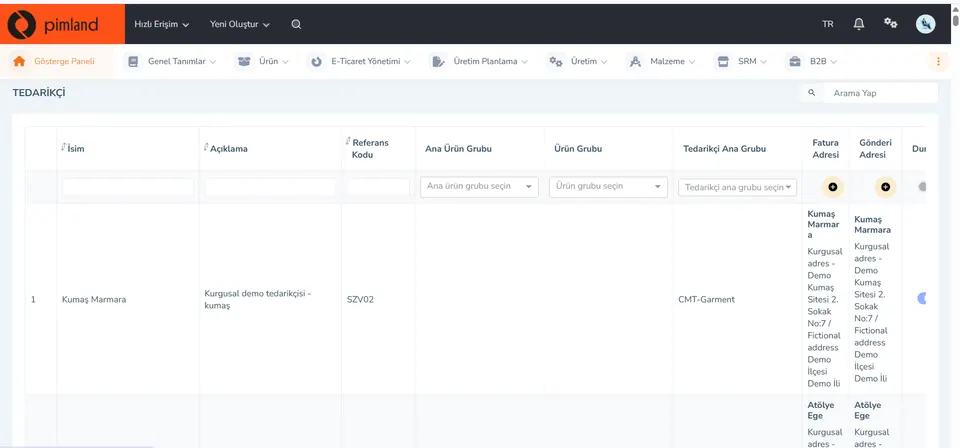
The supplier list shows each supplier's name, description, reference code, main product group, product group, supplier main group, and billing and shipping address. The names and addresses on screen are demo data.
In real working life, opening two separate cards for the same supplier splits the reports in two. Search before you open a new card.
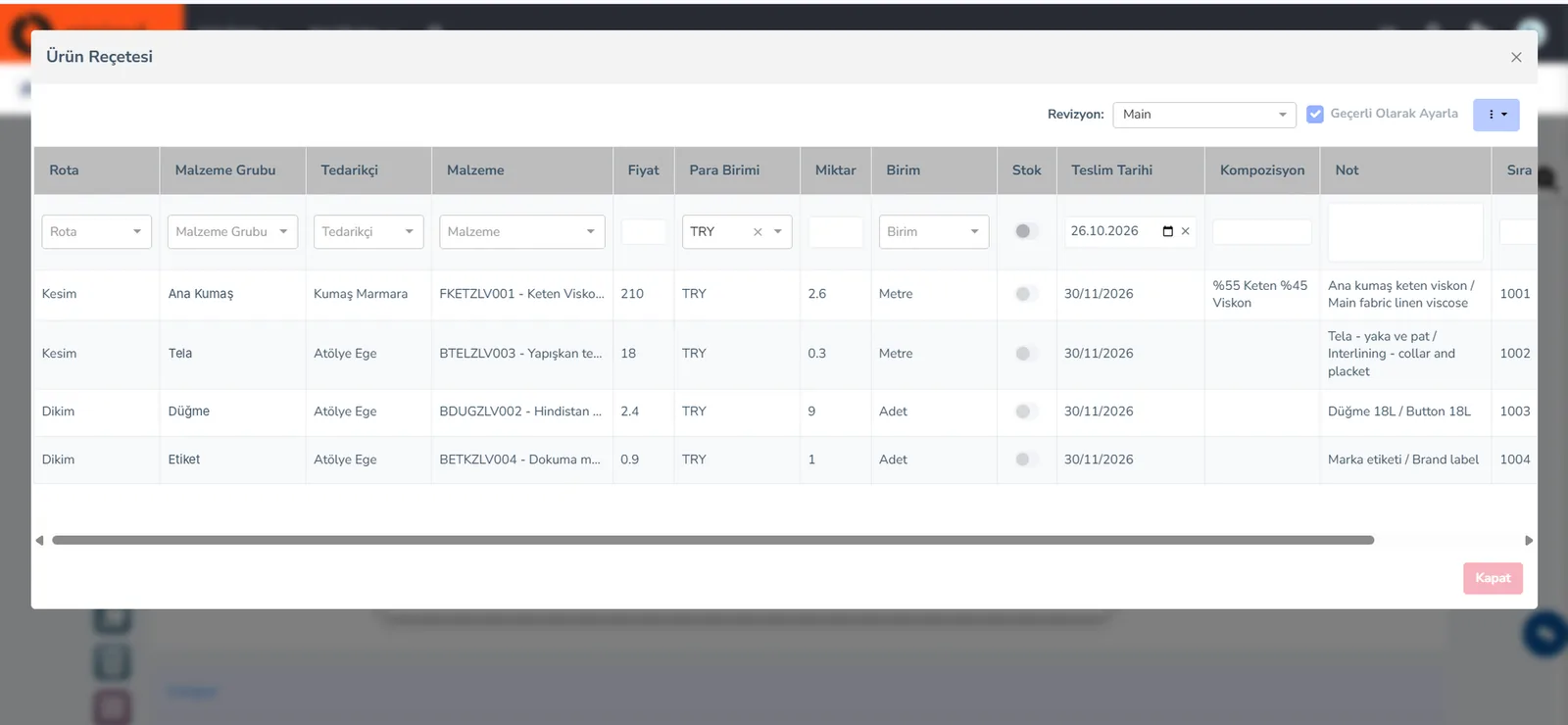
Screen from the demo environment; brands and amounts are demo data. Step 2Work out needs from the BOM
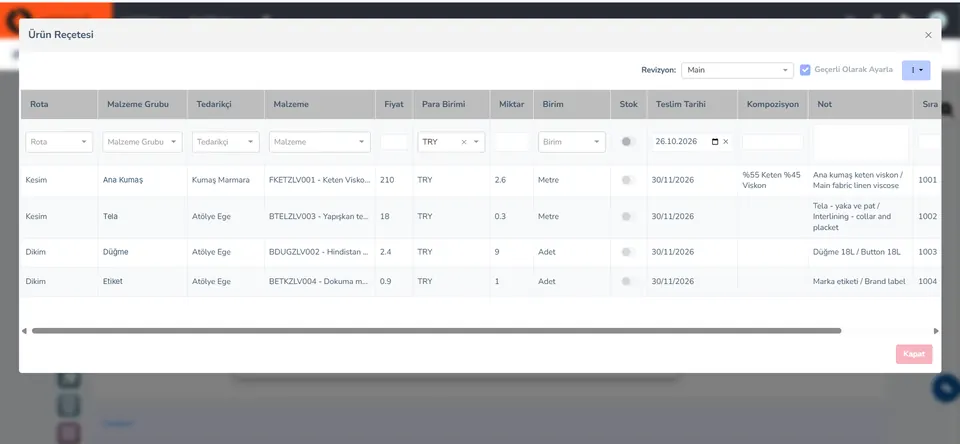
The BOM lists each material's supplier, unit price, quantity, unit and delivery date. You calculate needs from here: unit quantity times order quantity, plus a wastage allowance.
In real working life, when product development changes the BOM, open orders need to be revised too. If the change doesn't reach you, the wrong material arrives.
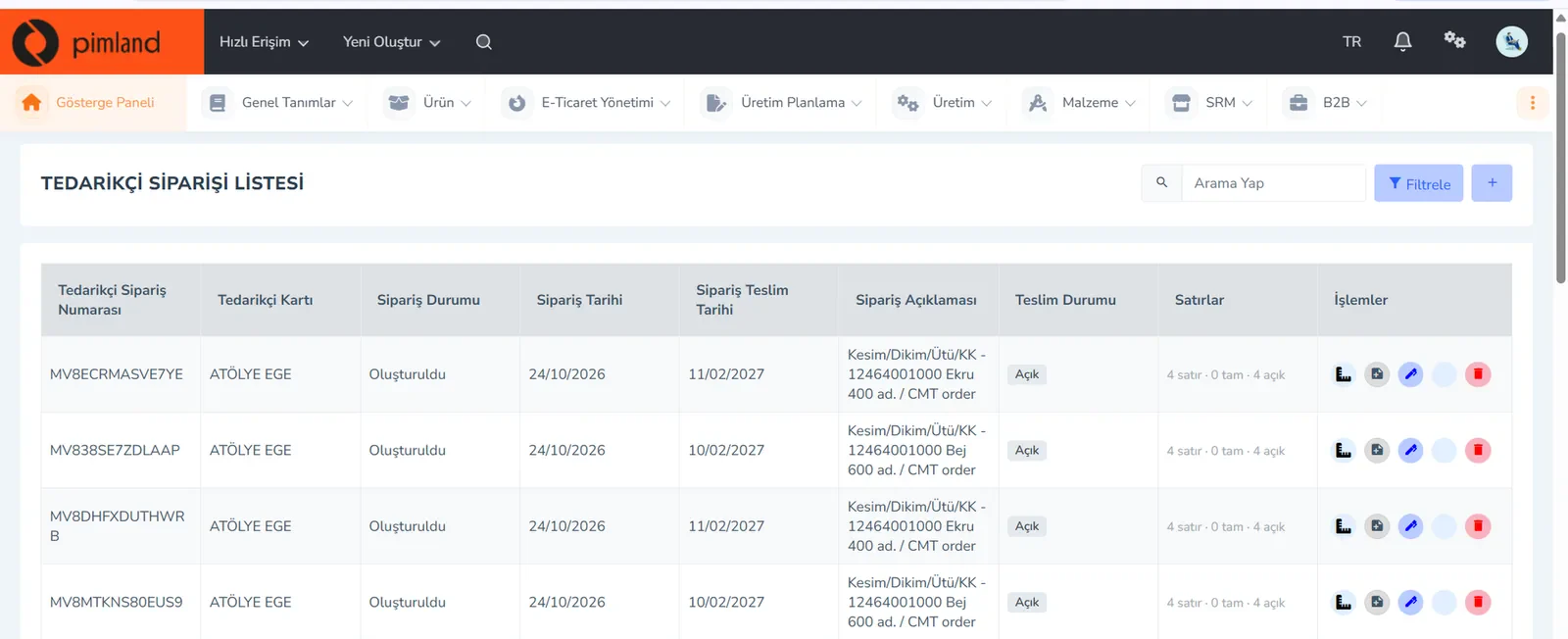
Screen from the demo environment; brands and amounts are demo data. Step 3Follow the orders
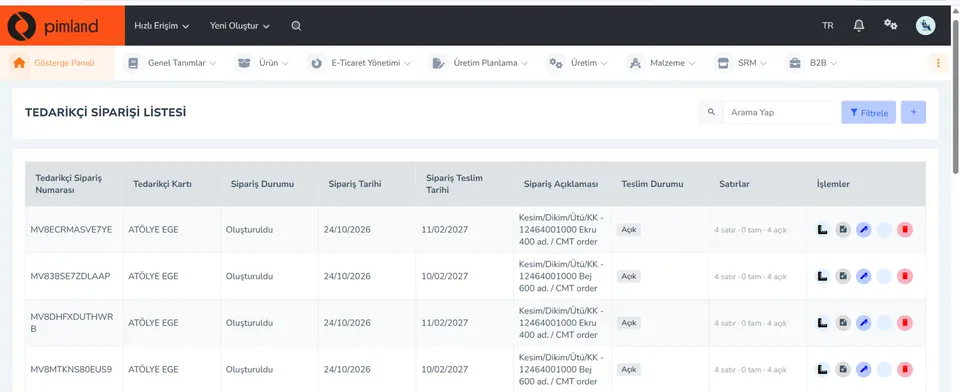
The supplier order list shows the order number, supplier card, order status, order and delivery dates, description, delivery status and lines. The lines column shows how many lines are complete and how many are still open.
In real working life, an order isn't finished just because it says 'created.' You ask about its status regularly until the delivery date; whoever flags a delay early wins.
Screen from the demo environment; brands and amounts are demo data. Step 4See what's behind the unit price
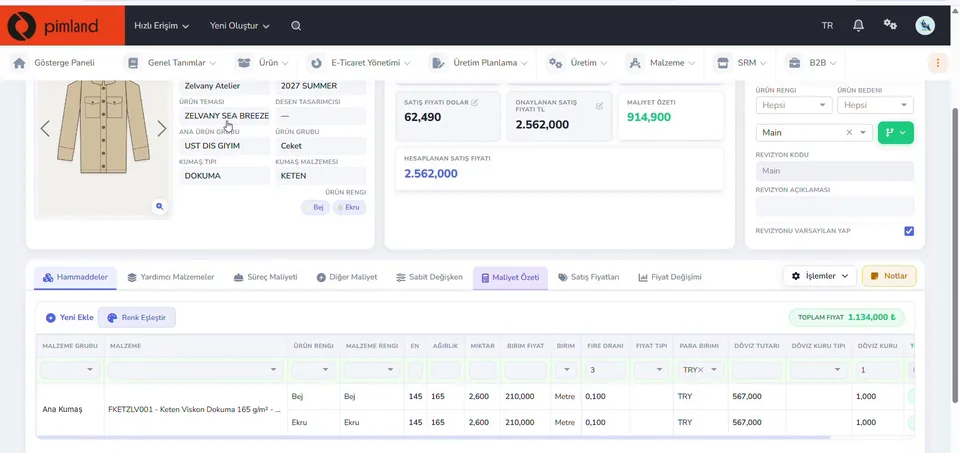
The raw material line shows the material, product color, width, weight, quantity, unit price, unit, wastage rate, currency, exchange rate and amount. 'Renk eşleştir' (match colors) opens a separate line for each color.
In real working life, the unit price from the quote goes into this line and sets the product's cost. If the currency or unit is entered wrong, the error is multiplied by the quantity.


These screens are from the Pimland SRM module.
Open your card
Open your card
Read the short summary and the Pimland screens and answer at least 2 of 3 questions correctly to open the card. When all 20 cards are open, your Pimland Basic Certificate arrives in your account automatically.
Your sourcing / purchasing specialist card is open · 0/20
Next suggestion: All position cards
How fashion, retail and manufacturing companies work, and 20 position cards
First the required reading, then the cards for 20 positions: you learn how a fashion company works.
- FirstTraining 1: How is a product born? · read to the end and complete it
- Each cardA summary of the position, audio narration and Pimland screens
- Card3 short questions at the end of each part; 2 correct answers open the next part · no time limit
- AccountWith a free account, your progress follows you on every device
- At the endOnce you complete all 20 cards, the Pimland Basic Certificate arrives in your account automatically
Certificate 1 · Pimland Basic Certificate
Reading is open to everyone; the part questions and the certificate require an Academy account.
PLM, PIM and SRM trainings
The shared language of the fashion world: PLM, PIM and SRM, with Pimland's real screens.
- OrderFirst PLM, then PIM, then SRM · one at a time
- Each training8 parts, in order · audio narration and Pimland screen
- Questions3 questions at the end of each part, 24 in total · 2 correct answers open the next part · no time limit, the questions change with every attempt
- UnlockPart questions open after your Basic certificate
- Verification14+ (date of birth in your profile); an e-Devlet education document for Turkish nationals
- At the endOnce the three trainings, ID and document are complete, Certificate 2 arrives in your account
Certificate 2 · Pimland PLM · PIM · SRM Certificate
Reading is open to everyone; the part questions and the certificate require an Academy account.
PRO · advanced training
Separate application, for selected candidates.
- WhoCandidates selected from applicants who hold both certificates
- OnlinePimland PLM software training and test
- On site1 day inside a fashion company, seeing PLM in use
- ApplicationWith “Apply for PRO training” on the PRO page; places are limited, and selected candidates hear back by email
Certificate 3 · Pimland PRO Certificate
Reading is open to everyone; the part questions and the certificate require an Academy account.
FAQFrequently asked questions about sourcing / purchasing specialists
4 questions
A buyer or buying specialist at a retailer usually buys finished products and works with sales, budget and margin targets. A sourcing / purchasing specialist in textiles sources fabric, trims and other materials.
Minimum order quantity: the lowest quantity a supplier accepts for an item, often per color. If you order below it, you may face an extra charge or a refusal.
Companies that work with suppliers abroad look for a good level of English. 33% of the 242 job ads we reviewed ask for English.
No specific department is required. Business administration, international trade, and industrial and textile engineering are common starting points. Fabric and trim knowledge is learned on the job.
· Pimland Academy team