How do you become a sample coordinator?
DepartmentDesign and product developmentModulePLM
The sample coordinator is the person in the sample room of a fashion brand or an apparel manufacturer who takes charge of preparing samples with the right pattern, the right materials and on time, and of tracking and delivering them.
 Card: Locked · your progress is saved in this browser · save it to your account
 PIMLAND 07 · PLM
Sample coordinator
Design and product developmentSample coordinator, in brief
Every sample carries on it which request, which round and which pattern version it belongs to.
- Sorts sample requests by due date and priority, and checks the materials.
- Hands out the pattern and sewing instructions, measures the sewn sample and compares it with the tech pack.
- Season rhythm: proto, fit and revision, size set, salesman and photo samples, PP sample.
- The most important documents are the sample request form, the current tech pack, the sample measurement form and the approved sample tag.
- Every sample leaves the room with its round and pattern version on its hang tag.
- Judged by on-time delivery, sewing that matches the tech pack the first time, and traceable samples.
- Sample request form
- Tech pack and size chart (current version)
- Sample measurement form
- Approved sample tag
 Pattern maker
 Product development specialist
 Fashion designer
Read in detailall documents, workflow, cases
- Ranks sample requests coming from design, product development and sales by delivery date and priority.
- Checks that fabric, lining, interlining and trims are complete; reports anything missing to purchasing.
- Hands out the pattern, the cutting information and the sewing instructions to the cutter and the sample machinist.
- Measures the sewn sample before delivery and compares it with the tech pack.
- Records which request, which pattern version and which round each sample belongs to; archives the approved ones.
In a season
- After the first pattern
Proto sample: the design is made up in fabric for the first time.
- Pattern corrections
Fit and revision samples; each round with its own tag.
- After grading
Size set: is the grading right in every size?
- Around collection approval
Salesman and photo samples; the ones that must be ready for the shoot come first.
- Before and at the start of production
PP sample in production fabric; the first piece off production is compared with the approved sample.
Who do they work with?
- Pattern maker
- Fashion designer
- Product development specialist
 Sourcing / purchasing specialist
 Quality control coordinator
 Stylist
 Production follow-up coordinator
From school to work
| What you learned at school | At work |
|---|---|
| You learn to sew a sample from start to finish. | In working life, the same style has proto, fit, revision, size set, photo and PP samples. When they hang side by side on the rail and the tag doesn't tell you which is which, you find out by measuring. |
| You learn to finish your own work in order and on time. | In working life, incoming requests exceed the room's daily capacity. You decide which sample gets cut today. |
| You learn the flow from pattern to cutting, and from cutting to sewing. | In working life, this flow starts with a request form; no fabric is cut without one: request number, style code, sample type, round, pattern and tech pack version, materials, size, due date. |
| You learn to spot and fix mistakes by trying. | In working life, the impact of a mistake goes beyond the room: if the wrong sample goes to a photo shoot, the whole studio waits. |
| You learn what a sample is for and the basic sample concepts. | In working life, fit, PPS and proto become part of everyday language. 19% of the 242 job ads in Turkey we reviewed ask you to know this flow; searches like 'what is a pps sample' and 'what is a fit sample' come from the same need. |
What do job ads ask for?
From 242 fashion and retail job ads published in Turkey in August–October 2026.
Sample process (proto, fit, SMS, PPS)
In 19% of the 242 job ads.
Measurement chart, fit, fittings
In 24% of the 242 job ads.
Quality standards
In 43% of the 242 ads; the second most common requirement in the ads. Measuring the sample before delivery is what it means day to day.
Separate job ad
None of the ads we reviewed had the title sample coordinator; sample work appears inside pattern maker, merchandiser and product development ads. 'Sample coordinator job ads' does come up in searches, though. People usually come to this position from sample machinist work, cutting or assistant pattern making.
The first 90 days
- Learn the sample types and their order; write down whose approval each one goes to.
- Build the habit of writing the request number, pattern version and round on every sample's hang tag.
- Measure every finished sample before delivery and compare it with the tech pack.
Which field of study?
People usually move up from inside the sample room: sample machinist, cutter or assistant pattern maker. At school, the matching paths are the fashion design technologies field of vocational and technical Anatolian high schools and the garment production programs of vocational schools.
Finding order in the chaos: what gets cut today, what can wait.
From the inside: documents, decisions, cases
Documents, handovers, decisions and mistakes that happen on the job.
A working day
- 08.30
You measure the samples finished last night. You check whether the hang tag shows the request number, sample type, round and pattern version.
- 09.00
Daily sample plan: you sort new requests by due date and by what they need to be ready for. Those going to a fit session, a shoot or being shipped to a customer move to the front.
- 10.00
Material check: fabric, lining, interlining, buttons, zipper, labels. If something is missing, you write to purchasing; if a stand-in material will be used, you get the requester's approval.
- 11.00
Send to cutting: the pattern, cutting information and sewing instructions go to the cutter, then to the sample machinist. Before cutting, you confirm which version of the tech pack is being used.
- 13.30
You take the sample to the fit session. The values you measured go into the fit column, and you check that the comments from the session are recorded.
- 15.00
The sales team wants a salesman sample (SMS) for an export customer. You pin down the color and size breakdown and the day the shipment goes out.
- 16.30
You compare the finished sample with the tech pack and hand it over. Every sample leaving the room goes into the outgoing log: to whom, for what and when.
- 17.30
You prepare the next day's cutting order and write each sample's latest status on the product card.
A sample day; hours vary by company and season.
Workflow: before you, after you
- 1Check the request form, report missing materials.
- Input
- Sample request form, BOM
- Output
- Missing materials list
- Handover
- Sourcing / purchasing specialist
- 2Run cutting and sewing, measure the sample before delivery.
- Input
- Pattern, sewing instructions, current version of the tech pack
- Output
- Measured sample and measurement form
- Handover
- Pattern maker
- 3Record the fit session, open the new round.
- Input
- Fit comment
- Output
- Revision sample request and round tag
- Handover
- Pattern maker
- 4Sew and measure the size set.
- Input
- Graded pattern set
- Output
- Measured size set
- Handover
- Product development specialist
- 5Prepare the shoot samples and hang them with their variant code.
- Input
- Shot list
- Output
- Tagged shoot samples
- Handover
- Stylist
- 6Prepare salesman samples (SMS) for the export customer.
- Input
- SMS request, color and size breakdown
- Output
- Packed SMS and outgoing log
- Handover
 Merchandiser
- 7Sew the PP sample with production materials, archive the approved one.
- Input
- Production fabric and trims, latest version of the tech pack
- Output
- Approved (sealed) sample
- Handover
- Production follow-up coordinator
- 8Give a reference copy of the approved sample to quality.
- Input
- Approved sample
- Output
- Reference sample for quality
- Handover
- Quality control coordinator
Documents that pass through your hands
| Document | From | To | When | What for |
|---|---|---|---|---|
| Sample request form | Design, product development or sales | Sample coordinator | Before a sample is requested | Request number, style code, sample type, round, pattern and tech pack version, materials, size, quantity and due date. If the form is incomplete, no fabric is cut. |
| Tech pack and size chart (current version) | Product development | Sample room | Before cutting | What the sample is sewn to and what it is measured against. If an old printout stays in the room, the wrong sample gets sewn. |
| Sample pattern and sewing instructions | Pattern maker | Cutter and sample machinist | Every round | Pieces, notches, sewing order. The sample's pattern version comes from this document. |
| Bill of materials (BOM) and trim card | Product development and purchasing | Sample room | Before cutting | Which fabric, lining, interlining, buttons and labels will be used. If a stand-in material was used, you note the difference against it. |
| Sample measurement form | Sample coordinator | Pattern maker and product development | Before delivery | The actual values at the sample's measurement points. You see the difference before the fit session. |
| Sample outgoing and shipping log | Sample coordinator | Sales, stylist, export customer | When the sample leaves the room | Which sample went to whom, for what purpose and with which tracking number. A lost sample is traced from here. |
| Approved sample tag (approved / sealed sample) | Product development or customer approval | Sample archive, production follow-up, quality | When the PP sample is approved | Marks the sample that is the reference for production and quality control. The approved sample does not leave the archive without permission. |
Decisions
- The day's cutting and sewing order.Approved by: Your call; if two urgent requests clash, the requesters and the collection manager set the priority, and you show the capacity.
- Sewing a sample with a stand-in material in place of a missing one.Approved by: The requester approves; 'stand-in material' is written on the tag and in the record. Stand-in materials are not used in the PP sample.
- Delivering a sample that is out of tolerance with a note, or having it re-sewn.Approved by: Together with the pattern maker and product development.
- Moving the due date when a request exceeds the room's capacity.Approved by: The requester; the collection manager if it affects the calendar.
What are you evaluated on at work?
- Samples delivered on the requested date
- Samples sewn to the tech pack the first time
- Fewer samples that have to be re-sewn
- Knowing where each sample is and which round it is in
- Waiting time between request and delivery
Common mistakes on the job
Not writing the round and pattern version on the hang tag.
ResultAn old round goes to the fit session or the shoot; decisions are made on the wrong sample.
PreventionA rule that no untagged sample leaves the room.
Sewing from an old tech pack printout left in the room.
ResultA round is wasted; fabric and machine time are lost.
PreventionBefore cutting, compare the tech pack's version number with the request form, and collect old printouts.
Sending a sample sewn with stand-in material without a note.
ResultThe requester or the customer thinks the color and texture are approved; a difference shows up in production.
PreventionWrite the stand-in material clearly on the tag and in the outgoing log.
Delivering a sample without measuring it.
ResultThe measurement difference comes out in the fit session, and everyone's time is lost.
PreventionFill in the measurement form before delivery and note the difference.
Not keeping a record of a shipped sample.
ResultThe customer says 'we didn't get it,' the sample is lost and has to be sewn again.
PreventionLog every outgoing sample with its tracking number.
Case: what would you do?
Case 1Two urgent requests come in the same morning: one is a proto for tomorrow's collection approval (line review), the other an SMS to be shipped to an export customer this week. The room can't finish both on the same day.What do you do?
A good answerYou write the same message to both requesters: the capacity, how long each job takes and what can be ready at what time. You take the priority decision to the collection manager; until the decision comes, you prepare both jobs (materials, pattern).
Setting the order is your job, but when two jobs collide, priority is a business decision. Making the clash visible is better than quietly choosing one.
Case 2The zipper that arrived for tomorrow's fit sample is the wrong color. The right one will come next week.What do you do?
A good answerA fit sample is for checking fit; you ask the requester and sew it with a stand-in zipper. You write 'stand-in trim' on the tag and in the fit record. If the same thing happened with the PP sample, you wouldn't sew it.
Missing a fit round pushes the calendar back. The PP sample, however, is the reference for production; it has to be sewn with production materials.
Case 3The salesman samples sent to an export customer have arrived. The customer writes that the shade is different from the approved lab dip.What do you do?
A good answerYou check the record for which fabric lot the sample was cut from and compare it with the approved lab dip in the archive. You share the finding with the merchandiser and purchasing, and ask for a check on whether the same lot will be used in production.
A color difference in the sample is an early warning for production. If the source isn't found, the same difference shows up across the whole production run.
Think of your own answer first, then open it.
How does this position work with the world?
At a manufacturer that exports, the sample room works to the overseas customer's calendar: the names proto, fit, SMS and PPS stay in English, samples go by courier, comments arrive by e-mail in English, and the approved sample is kept as the 'approved sample' or 'sealed sample.' Because the request, round, measurements and bilingual fit comments sit under the same sample number in PLM, the sample room in Turkey and the customer abroad are talking about the same sample. Sewing the PP sample with production materials also means that the composition and material information going into the EU digital product passport comes from the right chain.
What changes with PLM?
| Before | With PLM |
|---|---|
| All day the phone rings with 'what's the status of that sample?' | The sample's status and the team's note are on the product card; whoever asks looks there first. |
| Requests come verbally or by message, and it is unclear which tech pack version to sew to. | The request is on record and linked to the pattern and tech pack version. |
| Fit comments are scattered across e-mail, paper and the margins of the tech pack. | The fit round's measurements and comments are in one list; the next sample is sewn to this list. |
Career path
- Sample machinist, cutter or assistant pattern maker
- Sample coordinator
- Senior sample coordinator
- Middle manager (sample room or product development)
Glossary for this position
- Proto sample
- The first sample, where the design is put into fabric for the first time, sewn to see proportions and the overall look.
- Fit sample
- The sample on which the garment's fit and measurements are checked on a mannequin or a live fit model.
- Fit comment
- The written list of corrections from a fit session, tied to measurement point and round.
- Sample round
- Each sample stage in which a style is sewn again with corrections: 1st round, 2nd round and so on.
- SMS (salesman sample)
- The sample prepared for the showroom, catalog, sales presentations and photo shoots.
- PPS (PP) sample
- The last approval sample before bulk production, sewn with the fabric and trims that will be used in production.
- Tech pack
- The production package that gathers a style's technical drawing, measurement chart, materials, stitching details and instructions in one document.
- Measurement chart
- A chart showing the target value of each measurement point of a style, size by size.
- BOM (bill of materials)
- The list of all materials needed to make a product, with quantity, unit, supplier and price.
- Revision
- The new version of a style, tech pack or costing after a change.
- Lab dip
- A small color trial the dyehouse prepares in the lab to hit the target color.
- Approval flow (status flow)
- The sequence of stages a product goes through from design to bulk, and the approval at each stage.
- Line review (collection approval)
- The meeting where styles are evaluated together with their samples, costing and sales expectations, and the decision to continue, revise or drop is made.
What does the work look like on screen?
A sample's trail in Pimland is in three places: the product's status, the fit dates, and the fit round's measurements and comments.
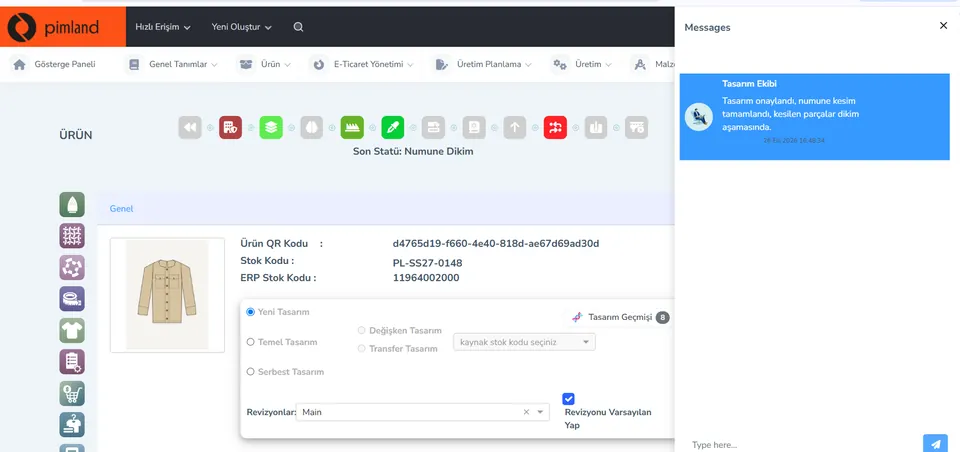
Screen from the demo environment; brands and amounts are demo data. Step 1See the sample's status
Below the status bar at the top of the product card it says 'Son Statü: Numune Dikim' (latest status: sample sewing). In the message panel on the right is the team's note: design approved, sample cutting done, cut pieces in sewing.
In real working life, the sample room gets calls all day asking 'what's the status of which one.' If the status and messages sit on the product, the calls drop.
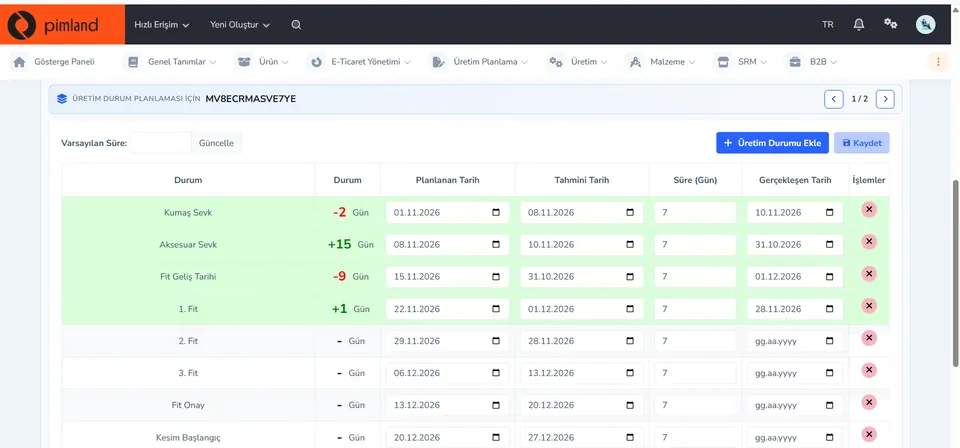
Screen from the demo environment; brands and amounts are demo data. Step 2Plan the fit dates
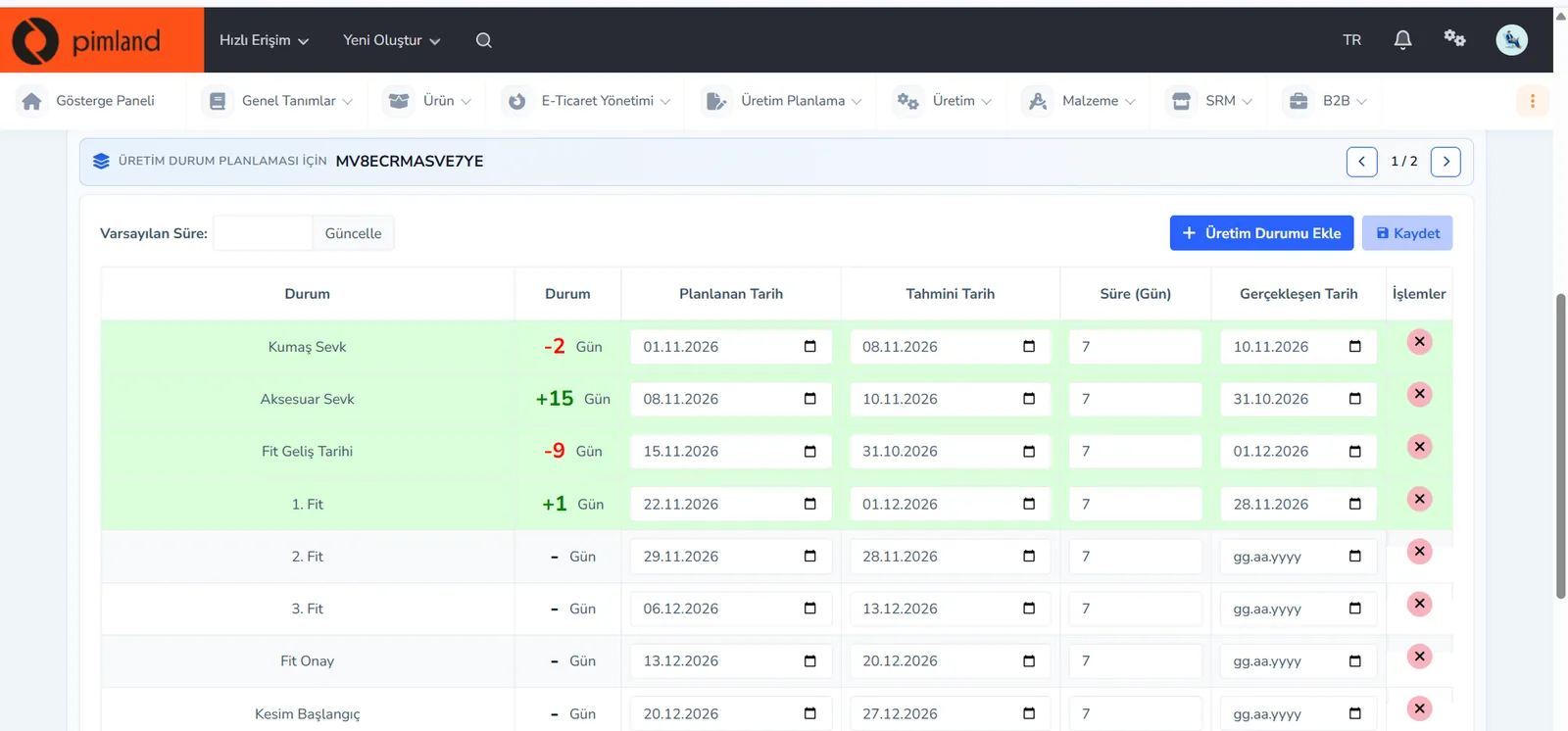
In status planning, fit arrival date, 1st fit, 2nd fit, 3rd fit and fit approval are separate rows. The planned, estimated and actual dates of each, and the difference in days, sit side by side.
In real working life, if a fit round slips, everything behind it slips: fit approval, cutting, shipment.
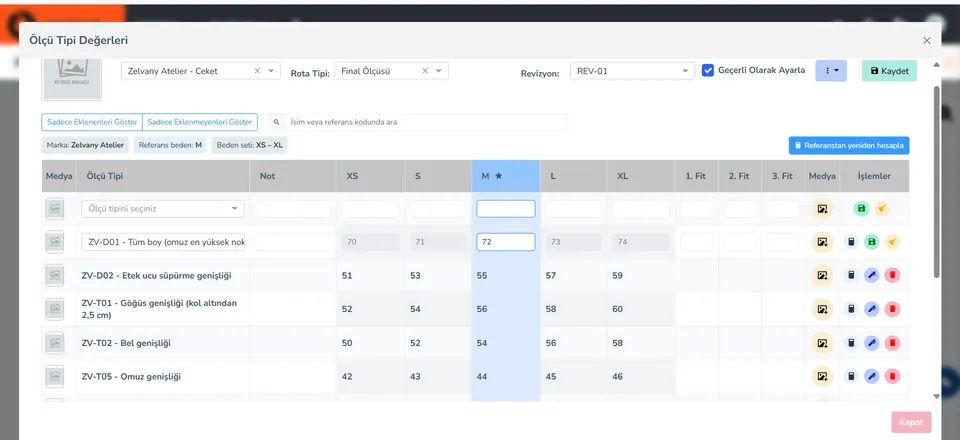
Screen from the demo environment; brands and amounts are demo data. Step 3Write the measurements in the fit round
In the size chart, next to the sizes there are 1st, 2nd and 3rd fit columns. The value you measure on the sample goes next to the target value in the chart.
In real working life, delivering a sample without measuring it just moves the problem to the fit session. See the measurement difference first.
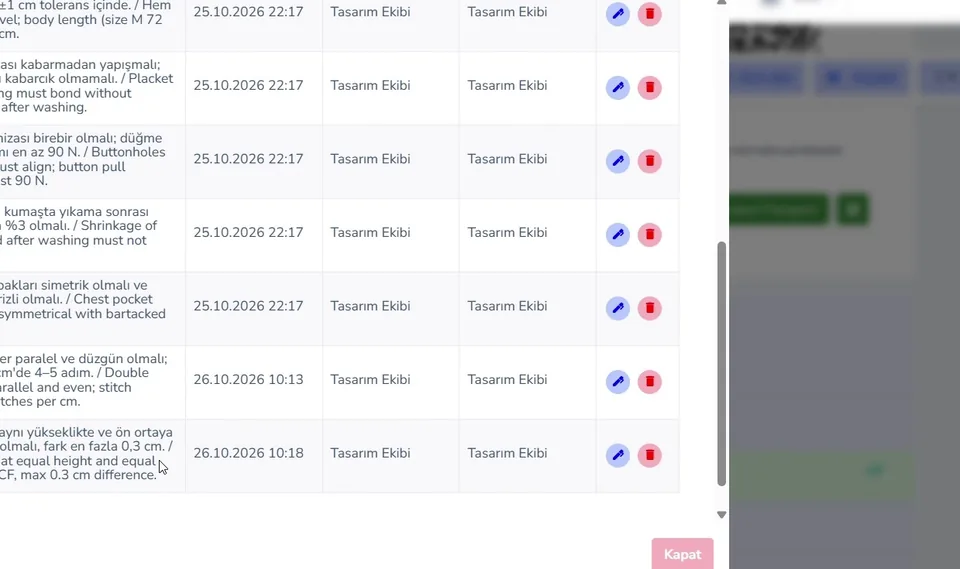
Screen from the demo environment; brands and amounts are demo data. Step 4Record the fit comment
In the fit comments list, every correction is recorded with its description, the team that added it and the date. The next sample is sewn to this list.
In real working life, if comments stay scattered across e-mail, messages and the margins of the tech pack, it becomes unclear which one is valid. One list, one truth.



These screens are from the Pimland PLM module.
Open your card
Open your card
Read the short summary and the Pimland screens and answer at least 2 of 3 questions correctly to open the card. When all 20 cards are open, your Pimland Basic Certificate arrives in your account automatically.
How fashion, retail and manufacturing companies work, and 20 position cards
First the required reading, then the cards for 20 positions: you learn how a fashion company works.
- FirstTraining 1: How is a product born? · read to the end and complete it
- Each cardA summary of the position, audio narration and Pimland screens
- Card3 short questions at the end of each part; 2 correct answers open the next part · no time limit
- AccountWith a free account, your progress follows you on every device
- At the endOnce you complete all 20 cards, the Pimland Basic Certificate arrives in your account automatically
Certificate 1 · Pimland Basic Certificate
Reading is open to everyone; the part questions and the certificate require an Academy account.
PLM, PIM and SRM trainings
The shared language of the fashion world: PLM, PIM and SRM, with Pimland's real screens.
- OrderFirst PLM, then PIM, then SRM · one at a time
- Each training8 parts, in order · audio narration and Pimland screen
- Questions3 questions at the end of each part, 24 in total · 2 correct answers open the next part · no time limit, the questions change with every attempt
- UnlockPart questions open after your Basic certificate
- Verification14+ (date of birth in your profile); an e-Devlet education document for Turkish nationals
- At the endOnce the three trainings, ID and document are complete, Certificate 2 arrives in your account
Certificate 2 · Pimland PLM · PIM · SRM Certificate
Reading is open to everyone; the part questions and the certificate require an Academy account.
PRO · advanced training
Separate application, for selected candidates.
- WhoCandidates selected from applicants who hold both certificates
- OnlinePimland PLM software training and test
- On site1 day inside a fashion company, seeing PLM in use
- ApplicationWith “Apply for PRO training” on the PRO page; places are limited, and selected candidates hear back by email
Certificate 3 · Pimland PRO Certificate
Reading is open to everyone; the part questions and the certificate require an Academy account.
FAQFrequently asked questions about sample coordinators
4 questions
The sample on which the garment's fit and measurements are checked on a mannequin or a live fit model. It is made after pattern corrections; the comments from the fit session go into the next round.
Pre-production sample. It is sewn with the fabric and trims that will be used in production; bulk production doesn't start until its full conformity with the tech pack is approved.
The sample where the design is put into fabric for the first time. You see the proportions and the overall look; the details settle in the following rounds.
The pattern maker prepares the pattern and the sewing instructions. The sample coordinator tracks the cutting and sewing of that pattern, its place in the queue, its check and its delivery.
· Pimland Academy team