How do you become a quality control coordinator?
DepartmentProduction, quality and sustainabilityModuleSRM
The quality control coordinator is the person in fashion and apparel production who checks whether the fabric, the product in production and the finished lot conform to the approved sample, the tech pack and the measurement chart.
 Card: Locked · your progress is saved in this browser · save it to your account
 PIMLAND 11 · SRM
Quality control coordinator
Production, quality and sustainabilityQuality control coordinator, in short
Decisions rest on rules agreed in advance; reports rest on photos and measurements.
- Plans the inspection points: fabric intake, cutting, mid-production inspection, final and pre-shipment.
- Inspects a sample, bases the decision on the AQL rule, and writes clear reports with photos.
- The season's rhythm: fabric intake, cutting, mid-production inspection, final inspection, carton check, workshop quality history.
- The most important documents are the inspection plan, the approved sample and the current tech pack, the final AQL report and the CAPA request.
- Draw the sample at random from different cartons and layers; write the cartons you opened in the report.
- Evaluated on batches accepted at first inspection and on recurring defects closed with corrective action.
- Inspection plan
- Approved sample and the current version of the tech pack
- Final inspection report (AQL)
- Corrective action request (CAPA)
 Production follow-up coordinator
 Product development specialist
 Sourcing / purchasing specialist
Read in detailall documents, workflow, cases
- Plans the checkpoints: fabric intake, cutting, inline (mid-production) inspection during sewing, final inspection, pre-shipment inspection.
- Looks at a sample, not the whole lot; bases the accept or reject decision on a rule agreed in advance (AQL).
- Classifies defects as critical, major and minor; checks measurements, appearance, labels and pressing.
- Writes a clear report with photos: accept, reject, or re-inspection after repair.
- Asks for corrective action on recurring defects and keeps the workshops' quality history.
In a season
- Fabric intake
Weaving or knitting defects, width, shade differences; samples for the lab.
- Cutting
Whether pieces match the pattern, shade separation, cut quantity.
- Sewing
Mid-production inspection: at regular intervals starting from the first pieces, before a defect spreads across the bulk.
- After pressing and packing
Final inspection: sample, defect classes, decision.
- Pre-shipment
Quantity, assortment, carton labels, packing instructions.
- End of season
Workshops' quality history feeds into supplier evaluation.
Who do they work with?
- Production follow-up coordinator
 Pattern maker
- Product development specialist
- Sourcing / purchasing specialist
 Stylist
 Customer service representative
From school to work
| What you learned at school | At work |
|---|---|
| You learn to look at a finished product and judge its quality. | At work, quality is a set of inspection points built throughout production. If it starts at final inspection, it's already too late. |
| You learn to examine a product carefully and in detail. | At work, you look at a sample, not the whole batch. How many pieces to check and how many defects are acceptable are read from AQL tables. |
| You learn to spot stitching and workmanship defects. | At work, you classify defects: critical, major, minor. The report is clear enough that someone who didn't do the inspection would reach the same decision. |
| You learn to take measurements and compare them with the sample. | At work, the right measurement is the one in the current version of the tech pack. The workshop says 'the sample was like this'; knowing which one is the latest version is your job. |
| You learn that quality must be objective and measurable. | At work, you protect that objectivity under pressure; with the truck waiting at the door, this is the hardest part of the job. You defend your decision with photos and measurements. |
What do job ads ask for?
From 242 fashion and retail job ads published in Turkey in August–October 2026.
Quality standards and quality control
In 43% of the 242 job ads; second on the list. Because 'quality' is a general word, this share may be slightly inflated.
Knowledge of fabric, yarn and sewing
25% of the 242 job ads ask for knowledge of fabrics and trims; inspector ads also list sewing techniques and measurement standards.
Travel and driver's license
Inspector ads ask for frequent travel and a class B driver's license.
Entry point
4 of the 14 quality job ads in the sample have entry-level titles; one is looking for a fabric quality control worker who is 'experienced or to be trained.' Starting as an inspector in the field and moving up to a coordinator role is a common path.
The first 90 days
- Every morning, keep the approved sample of the styles you'll inspect and the current version of the tech pack with you.
- Standardize how you measure: measure the same point the same way as everyone else.
- Write every report with photos, defect classes and a decision.
Which field of study?
Textile and apparel vocational high schools, the textile and garment production programs of vocational schools, textile engineering. The laboratory side is defined by the Textile Lab Technician (Level 4) standard of Turkey's Vocational Qualifications Authority (MYK).
Saying 'no' under pressure and showing the reason with photos.
From the inside: documents, decisions, cases
Documents, handovers, decisions and mistakes that happen on the job.
A working day
- 08.00
The day's inspection list: which workshop has an inline inspection and which has a final. With production follow-up, you confirm the times and whether the workshops are ready.
- 08.30
You pack your bag: the current version of the tech pack, the approved sample or its photo, the measurement chart, tape measure, AQL table, inspection form, color card.
- 09.30
Inline inspection at the workshop: you take the first pieces off the line, measure the measurement points, and check stitch density, puckering and symmetry. You show the defect right next to the machine operator.
- 11.30
On the fabric side: you check whether the intake inspection result and the lab report of the newly arrived fabric lot match the right lot.
- 13.30
Final inspection: you draw a random sample from different cartons. Measurements, appearance, pressing, labels (composition, care instructions, origin), trims and packing are checked.
- 15.30
You count defects by class and make the decision based on the AQL rule. If there's a rejection or repair, you leave the workshop a repair list with photos and set the time for re-inspection.
- 17.00
You write the reports and add the photos to the inspection record. You share recurring defects with product development and production follow-up.
A sample day; hours vary by company and season.
Workflow: before you, after you
- 1Build the inspection calendar around the orders.
- Input
- Order and production calendar
- Output
- Inline and final inspection dates
- Handover
- Production follow-up coordinator
- 2Evaluate the fabric intake and lab results.
- Input
- Fabric intake report, test report
- Output
- Acceptance or rejection of the fabric lot
- Handover
- Sourcing / purchasing specialist
- 3Do an inline inspection on the first pieces.
- Input
- First pieces off the line, tech pack, measurement chart
- Output
- Inline report and correction on the line
- Handover
- Production follow-up coordinator
- 4Ask where the measurement deviation comes from: the pattern or the sewing?
- Input
- Out-of-tolerance measurements
- Output
- Diagnosis request
- Handover
- Pattern maker
- 5Decide with a sample at final inspection.
- Input
- Batch out of pressing and packing, AQL rule
- Output
- Decision to accept, reject or re-inspect after repair
- Handover
- Production follow-up coordinator
- 6Request corrective action for a recurring defect.
- Input
- Inspection reports
- Output
- Corrective action request
- Handover
- Product development specialist
- 7Find the source of a quality complaint from a customer.
- Input
- Complaint and return records from customer service
- Output
- Root cause and the inspection record of the related order
- Handover
- Product development specialist
- 8Gather the workshops' quality history at the end of the season.
- Input
- Inspection results
- Output
- Workshop quality evaluation
- Handover
- Sourcing / purchasing specialist
Documents that pass through your hands
| Document | From | To | When | What for |
|---|---|---|---|---|
| Inspection plan | Production follow-up | Quality control | When the order is opened | Which inspection (cutting, inline, final, pre-shipment) takes place on which order, and when. |
| Approved sample and the current version of the tech pack | Sample room and product development | Quality control | Before production starts | The reference for the inspection. Measuring with an old tech pack printout means rejecting the right product or accepting the wrong one. |
| Fabric intake report and lab test report | Fabric supplier or textile lab | Quality control | Before cutting | Fabric defects, width, shade; colorfastness and dimensional change results. You check which fabric lot the report belongs to. |
| Inline (mid-production) inspection report | Quality control | Workshop and production follow-up | While sewing is underway | Defects and measurement deviations found in the first pieces, which operation they occurred in, and whether they were fixed. |
| Final inspection report (AQL) | Quality control | Production follow-up, sourcing; for exports, the customer | After pressing and packing | Batch and sample size, defect counts by class, out-of-tolerance measurements, photos and the decision. |
| Corrective action request (CAPA) | Quality control | Workshop or supplier | When a defect recurs | The defect's root cause, the action to be taken, who owns it and by when. Whether it is closed is tracked on the next order. |
| Pre-shipment carton checklist | Quality control | Warehouse and production follow-up | Before the cartons are sealed | Compliance with quantity, assortment, carton labels and packing instructions. |
Decisions
- The class of a defect: critical, major or minor.Approved by: You decide, based on the company's or the customer's written defect definitions.
- Acceptance or rejection of the batch.Approved by: You decide, based on the AQL rule agreed in advance. If 'conditional acceptance' is requested after a rejection, product development and the manager approve it in writing, and for exports, the customer does.
- After a rejection, repair and re-inspect, or sort by checking every piece one by one.Approved by: You propose it; because it affects cost and the delivery date, the decision is made together with production follow-up and the manager.
- A deviation permit for a measurement that is out of tolerance but doesn't spoil the look.Approved by: Product development; on an export order, the customer. It isn't valid unless it's in writing.
What are you evaluated on at work?
- Batches accepted at first inspection
- Products returned by customers for quality reasons
- Inline inspections done at the planned time
- Reports that are complete, with photos and on time
- Recurring defects closed with corrective action
Common mistakes on the job
Always drawing the sample from the top or nearest cartons.
ResultThe sample doesn't represent the batch; defective cartons get missed.
PreventionDraw at random from different cartons and different layers; write which cartons you opened in the report.
Measuring with an old tech pack printout.
ResultThe right product is rejected or the wrong one is accepted; trust with the workshop is shaken.
PreventionCheck the current revision of the tech pack every morning and write the version number in the report.
Inspectors classifying the same defect differently.
ResultThe same batch is accepted one day and rejected the next.
PreventionWork with a shared defect definition list with photos.
Writing a report without photos.
ResultThe workshop doesn't accept the defect, and the decision turns into a negotiation.
PreventionPhotograph at least one example from each defect class and write the measurement value next to the photo.
Checking the measurements and skipping the label.
ResultIf the composition, care instructions or origin are wrong, the product is legally sold with wrong information; on exports, the batch may be rejected.
PreventionAt every final inspection, compare the label with the composition and origin information in the tech pack.
Case: what would you do?
Case 1At an inline inspection, you see puckering on the side seam of the first pieces. The line keeps running.What do you do?
A good answerYou have that operation stopped, not the whole line. You have the machine setting and the thread checked, and the pieces sewn so far set aside. After the adjustment, you check new pieces again and write the finding in the inline report with photos.
The aim of inline inspection is to catch a defect before it spreads across the bulk. The same defect found at final inspection sends the whole batch to repair.
Case 2At final inspection, the composition label on the sampled pieces doesn't list elastane; the tech pack and the fabric report do.What do you do?
A good answerYou classify the defect as serious; you don't accept the batch with this label. You request a label change and re-inspection. With sourcing and product development, you find out what information the label order was printed with.
A wrong composition declaration means giving the customer wrong information and a regulatory problem. If the source isn't found, it happens again on the next order.
Case 3At the final inspection of an export order, the number of minor defects exceeds the acceptance limit. The truck arrives tomorrow morning. Production follow-up says, 'They're just minor defects, let it pass.'What do you do?
A good answerYou record the decision as a rejection under the AQL rule, but you also propose a solution: the workshop sorts and repairs the batch, and you schedule the re-inspection right away. If the batch still has to ship, that takes a written deviation permit from the customer; you don't let it pass on verbal approval.
The rule was agreed before production. If it turns into a negotiation on shipment day, there is no rule left for the next order.
Think of your own answer first, then open it.
How does this position work with the world?
In exports, the language of quality is English and standardized: AQL, ISO 2859-1 sampling tables, critical, major and minor defects, inline, final and pre-shipment inspection, CAPA. Customers abroad send their own quality manuals, and sometimes an independent inspection company does the inspection; your report needs to speak the same language as theirs. In PLM and SRM, the inspection criteria sit in Turkish and English in the same record, and test reports and inspection results are linked to the order; this record is also the proof of composition and test information for the EU digital product passport and labeling rules.
What changes with PLM?
| Before | With PLM |
|---|---|
| The report is in Word or Excel, the photos are on a phone; which photo belongs to which order gets searched for later. | The inspection record is linked to the order; the product inspection, the order and the result are in one place, with the photos inside the record. |
| The acceptance criteria are in the experienced inspector's head. | The criteria (tolerance, shrinkage limit, stitch density) are written down and bilingual; a newcomer works to the same standard. |
| Workshops' quality history lives in scattered files and in people's memory. | Inspection results flow into the supplier score; workshop selection is based on the record. |
Career path
- Quality inspector (fabric, line or final)
- Quality control coordinator
- Senior quality control coordinator or inspector
- Middle manager (quality assurance)
Glossary for this position
- Inline (mid-production) inspection
- The quality check made at regular intervals while sewing is under way, starting with the first pieces, that catches a defect before it repeats across bulk.
- Final inspection
- The last inspection, made on a sample drawn from the lot after pressing and packing are complete, that gives an accept or reject decision.
- AQL
- Acceptable quality limit: a method based on the ISO 2859-1 tables that lets you decide from a sample instead of the whole lot.
- Tech pack
- The production package that gathers a style's technical drawing, measurement chart, materials, stitching details and instructions in one document.
- Measurement chart
- A chart showing the target value of each measurement point of a style, size by size.
- PPS (PP) sample
- The last approval sample before bulk production, sewn with the fabric and trims that will be used in production.
- Composition
- Information showing which fibers a fabric or product is made of, and in what proportions.
- Origin
- Information showing the country where a product was made.
- Lab dip
- A small color trial the dyehouse prepares in the lab to hit the target color.
- Contract manufacturing
- A brand having work such as cutting, sewing or pressing and packing done by outside workshops.
- Supplier score
- An evaluation that measures a supplier's on-time delivery, quality and communication performance.
- SRM
- Supplier relationship management: the system that runs supplier cards, orders, production follow-up and quality inspections in a shared record between brand and supplier.
- DPP (digital product passport)
- A structure that links a product's identity, material, care and end-of-life information to a digital record opened by a QR code on the product.
What does the work look like on screen?
In Pimland, quality control lives in the SRM inspections: which inspection on which order, who has it, and what status it's in. The criteria are the critical points and the measurement chart in PLM.
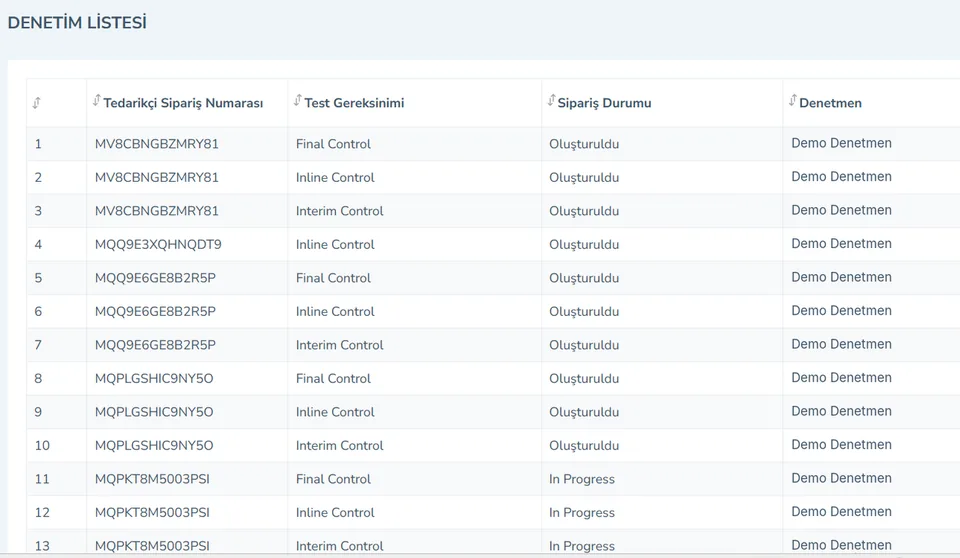
Screen from the demo environment; brands and amounts are demo data. Step 1Read the inspection list
Each row is an inspection: supplier order number, test requirement (final, inline or interim inspection), order status and inspector. The inline, interim and final inspections of the same order are planned on separate rows.
In real working life, an order whose mid-production inspection is skipped brings a surprise at final. Question any order with no inline row on the list.
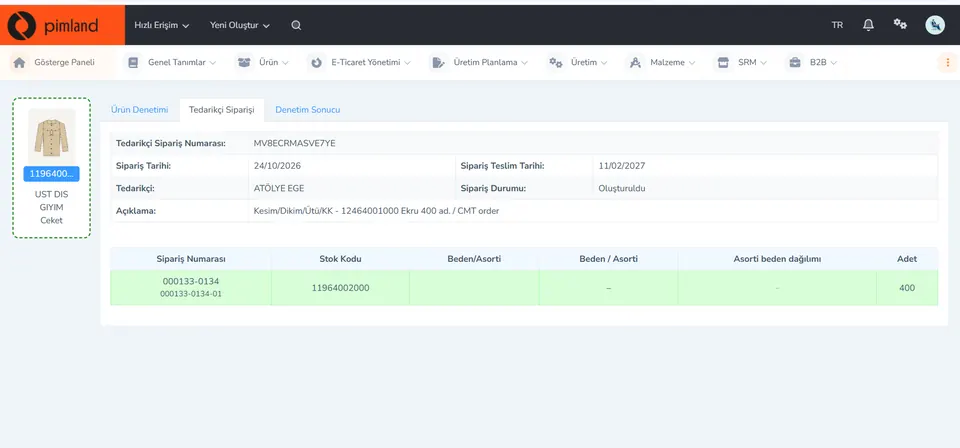
Screen from the demo environment; brands and amounts are demo data. Step 2Look at the inspection's order
The tabs of the inspection record: product inspection, supplier order, inspection result. The order tab shows the delivery date, description, stock code, size and assortment breakdown, and quantity. This is where you set the sample from the batch size.
In real working life, the sample size changes with the batch quantity. Without knowing the quantity, you can't know how many pieces to check.
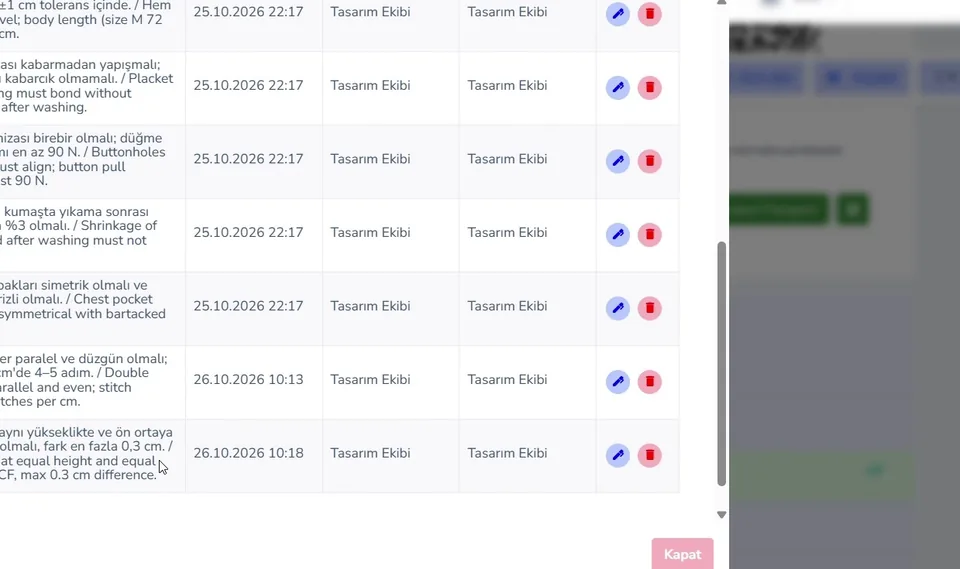
Screen from the demo environment; brands and amounts are demo data. Step 3Learn the inspection criteria
The list of critical points spells out criteria such as measurement tolerance, shrinkage limit after washing, buttonhole and button alignment, pocket symmetry and stitch density; each in Turkish and English.
In real working life, without written criteria, acceptance and rejection turn into a negotiation on shipment day. The rule is written before production.
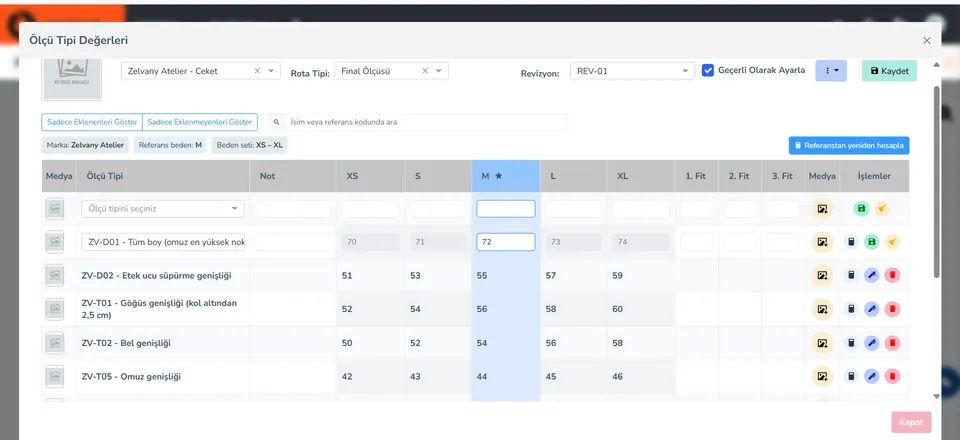
Screen from the demo environment; brands and amounts are demo data. Step 4Compare the measurement with the current revision
This chart is the reference for the measurement check: measurement points, sizes and the revision marked 'geçerli olarak ayarla' (set as current). You compare the value you measure with the target in this revision.
In real working life, measuring with an old tech pack printout means rejecting the right product or accepting the wrong one.


These screens are from the Pimland SRM module.
Open your card
Open your card
Read the short summary and the Pimland screens and answer at least 2 of 3 questions correctly to open the card. When all 20 cards are open, your Pimland Basic Certificate arrives in your account automatically.
How fashion, retail and manufacturing companies work, and 20 position cards
First the required reading, then the cards for 20 positions: you learn how a fashion company works.
- FirstTraining 1: How is a product born? · read to the end and complete it
- Each cardA summary of the position, audio narration and Pimland screens
- Card3 short questions at the end of each part; 2 correct answers open the next part · no time limit
- AccountWith a free account, your progress follows you on every device
- At the endOnce you complete all 20 cards, the Pimland Basic Certificate arrives in your account automatically
Certificate 1 · Pimland Basic Certificate
Reading is open to everyone; the part questions and the certificate require an Academy account.
PLM, PIM and SRM trainings
The shared language of the fashion world: PLM, PIM and SRM, with Pimland's real screens.
- OrderFirst PLM, then PIM, then SRM · one at a time
- Each training8 parts, in order · audio narration and Pimland screen
- Questions3 questions at the end of each part, 24 in total · 2 correct answers open the next part · no time limit, the questions change with every attempt
- UnlockPart questions open after your Basic certificate
- Verification14+ (date of birth in your profile); an e-Devlet education document for Turkish nationals
- At the endOnce the three trainings, ID and document are complete, Certificate 2 arrives in your account
Certificate 2 · Pimland PLM · PIM · SRM Certificate
Reading is open to everyone; the part questions and the certificate require an Academy account.
PRO · advanced training
Separate application, for selected candidates.
- WhoCandidates selected from applicants who hold both certificates
- OnlinePimland PLM software training and test
- On site1 day inside a fashion company, seeing PLM in use
- ApplicationWith “Apply for PRO training” on the PRO page; places are limited, and selected candidates hear back by email
Certificate 3 · Pimland PRO Certificate
Reading is open to everyone; the part questions and the certificate require an Academy account.
FAQFrequently asked questions about the quality control coordinator
4 questions
Acceptance quality limit, also known as acceptable quality limit. Instead of looking at every product in the lot, it lets you decide from a sample; how many products to inspect and up to how many defects to accept are read from the ISO 2859-1 sampling tables.
Inline (mid-production) inspection is done while sewing is under way, starting with the first pieces; it catches a defect before it repeats across bulk. Final inspection gives an accept or reject decision from a sample after pressing and packing are finished.
Order, style and color; workshop and date; inspection stage and tech pack version; lot and sample size; number of defects by defect class; measurements over tolerance; photos; decision and corrective action.
Textile and apparel vocational high schools, textile and garment production associate degree programs and textile engineering are the closest education paths. Starting on the floor as an inspector and moving up is also common.
· Pimland Academy team