How do you become a product development specialist?
DepartmentDesign and product developmentModulePLM
The product development specialist is the person who turns the design into a producible product with the tech pack and the bill of materials (BOM), and runs material approvals and sample rounds.
 Card: Locked · your progress is saved in this browser · save it to your account
 PIMLAND 05 · PLM
Product development specialist
Design and product developmentProduct development specialist, in brief
One tech pack, one BOM, one valid version: everything that goes to production comes from the approved record.
- Prepares the tech pack: drawing, measurement chart, stitching details, label and packing instructions.
- Builds the BOM, records material and fit approvals, runs the sample rounds.
- Season rhythm: design handover, material approvals, proto and fit rounds, PPS approval, handover to production.
- The most important documents are the tech pack, the bill of materials (BOM), the fit comment list and the PPS approval record.
- Write the version and date on every page of the tech pack; check that it is the latest version before you send it.
- Judged by sample rounds per style, tech pack accuracy and a complete handover to production.
- Tech pack
- Bill of materials (BOM)
- Fit comment list
- PPS approval record and latest tech pack
 Fashion designer
 Pattern maker
 Sourcing / purchasing specialist
Read in detailall documents, workflow, cases
- Prepares the tech pack: technical drawing, measurement chart, stitching details, label and packing instructions.
- Builds the BOM: fabric, lining, interlining, trims, labels and packaging, with quantities and suppliers.
- Follows fabric, color (lab dip), print (strike-off), trim and fit approvals, and records each approval.
- Runs the sample rounds; compares each incoming sample with the tech pack and writes comments.
- Once the pre-production sample is approved, hands the up-to-date tech pack and BOM over to production complete.
In a season
- Design handover
The drawing arrives; the tech pack and BOM are opened, materials are sourced.
- Approvals
Fabric, lab dip, print and trim approvals. A production sample is not requested with unapproved materials.
- Sample rounds
Proto, fit, revision. A comment list at every round, a tech pack update for every comment.
- Pre-production
PP sample approval. The latest version of the tech pack and BOM goes to production.
- Production
Answering technical questions from the field with the right version.
Who do they work with?
- Fashion designer
- Pattern maker
 Sample coordinator
- Sourcing / purchasing specialist
 Costing specialist
 Quality control coordinator
 Production follow-up coordinator
From school to work
| What you learned at school | At work |
|---|---|
| You learn technical drawing and put a style on paper with its measurements. | At work, a technical drawing becomes a contract. The factory sews whatever it sees in the drawing; there should be no room for interpretation. |
| You learn to prepare and hand in a style's tech pack. | At work, tech packs have versions. If the pocket detail changed last week and the new tech pack did not go to the supplier, the sample arrives according to the old tech pack. |
| You learn to look at a sample and see what needs fixing. | At work, you turn this into measurements: instead of 'the sleeve is long' you write 'sleeve length to be shortened by 1 cm', mark up the photo and tie the comment to a measurement point. A clear comment means fewer sample rounds. |
| You get to know fabric types and their basic properties. | At work, questions are added on top of this knowledge: you are the one who asks about the fabric's weight, width, shrinkage and test results. |
| You learn that a sample brings a style to life. | At work, there are types of samples: proto, fit, revision, size set, PP. Each has a different purpose and a different approver; 19% of the 242 ads in Turkey we reviewed want you to know this flow. |
What do job ads ask for?
From 242 fashion and retail job ads published in Turkey in August–October 2026.
Sample flow (proto, fit, SMS, PPS)
In 19% of the 242 job ads.
Knowledge of fabric, yarn and trims
In 25% of the 242 job ads.
Measurement chart, fit and fittings
In 24% of the 242 job ads.
Tech pack
In 10% of the 242 ads.
English
In 33% of the 242 ads; for corresponding with suppliers and customers abroad.
Experience
The 7 product development and garment technologist ads in the sample are for mid-level and senior titles. People usually enter this position as an assistant.
The first 90 days
- Read a tech pack from start to finish; learn who each section comes from.
- For every incoming sample, write the comments tied to measurement points, and mark up the photo.
- Get to know the approved materials in the fabric library: weight, width, composition.
Which field of study?
Textile engineering, garment production technology, fashion design, textile and fashion design. Sample room or workshop experience matters as much as your department; most specialists start as a product development assistant.
Bringing the gap between the idea in the drawing and the product that leaves the factory close to zero.
From the inside: documents, decisions, cases
Documents, handovers, decisions and mistakes that happen on the job.
A working day
- 09.00
You read the supplier e-mails that came in overnight: lab dip dispatch, fabric test report, sample shipping notice. You link each one to the relevant product record.
- 09.30
You compare the incoming sample with the tech pack. The sample coordinator measures the points on the measurement chart; you compare the deviations with the tolerance.
- 11.00
You prepare for the afternoon fit session: which of the previous round's comments are closed, and which are still open?
- 13.30
Fit session. The designer, the pattern maker and you. You tie each comment to a measurement point and mark up the sample's photo.
- 15.00
You update the tech pack and write the new version number and date. You send only the new version to the supplier, together with the comment list.
- 16.00
After the fit, a trim changed in the BOM. You tell the costing specialist and sourcing the same day.
- 17.00
You go through the checklist for styles whose pre-production sample (PPS) is coming up: are fabric, color, trim, fit and test approvals all recorded?
A sample day; hours vary by company and season.
Workflow: before you, after you
- 1Open the tech pack
- Input
- Technical drawing, design notes
- Output
- Draft tech pack and measurement chart
- Handover
- Pattern maker
- 2Build the BOM
- Input
- Tech pack, material selection
- Output
- Bill of materials (BOM)
- Handover
- Sourcing / purchasing specialist
- 3Run the material approvals
- Input
- Lab dips, strike-offs, trim samples, test reports
- Output
- Approved materials list
- Handover
- Sourcing / purchasing specialist
- 4Request a sample
- Input
- Tech pack, pattern
- Output
- Sample request
- Handover
- Sample coordinator
- 5Evaluate the sample
- Input
- Sample, measurement results
- Output
- Fit comments and current tech pack version
- Handover
- Pattern maker
- 6Report the cost of the change
- Input
- BOM change
- Output
- Current BOM
- Handover
- Costing specialist
- 7Pass on the checkpoints
- Input
- Tolerances and critical measurements in the tech pack
- Output
- Quality control checkpoints
- Handover
- Quality control coordinator
- 8Hand over to production
- Input
- Approved PPS sample
- Output
- Latest tech pack and BOM
- Handover
- Production follow-up coordinator
Documents that pass through your hands
| Document | From | To | When | What for |
|---|---|---|---|---|
| Technical drawing and design notes | Fashion designer | Product development | On the drawing due date | The starting point of the tech pack; missing details are asked about here, not at the sample. |
| Tech pack | Product development | Pattern maker, sample room, supplier or subcontractor | Opened before the proto sample, updated at every round | Measurements, stitching, materials, label and packing instructions in a single document; the factory sews according to this document. |
| Bill of materials (BOM) | Product development | Sourcing, costing specialist | As the material selection becomes clear | The quantity, supplier and unit of each material; sourcing gets its requirements and the costing specialist the cost from here. |
| Lab dip, strike-off and trim approval cards | Supplier | Product development (with design approval), then back to the supplier | During the material approval period | So that it is on record which material was approved, on which date and by whom. |
| Fabric test report | Supplier or test lab | Product development, quality control | Before fabric approval | Results such as shrinkage after washing and color fastness; if there is a problem, you go back to the pattern or the supplier. |
| Fit comment list | Product development | Pattern maker, supplier | After each fit session | Corrections tied to measurement points, with photos; the next sample is checked against this list. |
| PPS approval record and latest tech pack | Product development | Production follow-up, quality control | When the pre-production sample is approved | The single correct version going to production; quality control inspects against this version. |
Decisions
- Accepting a measurement deviation within the tolerance written in the tech pack.Approved by: Your decision; you write the measurement and the decision into the fit list.
- Approving a deviation that is out of tolerance but visually acceptable.Approved by: Together with design and quality control; for an export order, the customer's approval is needed.
- Having a sample sewn with materials whose approval is not complete.Approved by: Normally not done. Under calendar pressure, only if it is clearly labeled as a 'reference sample' and the collection manager is informed.
- Changing a trim or its supplier.Approved by: Together with sourcing and the costing specialist; if it changes the look, design approves.
What are you evaluated on at work?
- Sample rounds per style
- Material approvals closing on schedule
- Tech pack accuracy: technical questions and version errors coming from production
- PPS sample approved in the first round
- Complete handover to production (latest tech pack, BOM and approval records)
Common mistakes on the job
Updating the tech pack and sending the old version to the supplier.
ResultThe sample arrives according to the old tech pack; a round and a week are lost.
PreventionPut the version number and date on every page of the tech pack; check that it is the latest version before you send it.
Writing a comment without measurements ('the sleeve is long').
ResultThe supplier guesses how much to shorten it; the next sample doesn't fit either.
PreventionTie every comment to a measurement point and a value, and mark up the photo.
Not telling the costing specialist about a change in the BOM.
ResultThe margin changes without anyone noticing; it comes out at the order stage.
PreventionOn the day you touch the BOM, write to the costing specialist and sourcing.
Approving the PPS without waiting for the test report.
ResultThe fabric shrinks in the wash; measurements don't hold in bulk production.
PreventionPut the test report on the PPS checklist as a mandatory item.
Not writing the tolerance in the measurement chart.
ResultEvery deviation turns into an argument; quality control doesn't know what to base its decision on.
PreventionWrite a plus-minus tolerance for every measurement point.
Case: what would you do?
Case 1On the second fit sample from the supplier, the pocket detail is still in its old form. It was changed in the tech pack last week.What do you do?
A good answerFirst you ask the supplier which tech pack version they are working with, and you check the version history. You resend the correct version and still write up the sample's other deviations with measurements. Then you find out why the version didn't reach them: the distribution list, or an old e-mail thread?
A wrong version means an error once in the sample and once again in production. If you don't find the cause, it happens again with the next style.
Case 2The fabric's shrinkage-after-washing result came out above tolerance. The PPS date is close.What do you do?
A good answerYou inform quality control and sourcing the same day. You ask the supplier whether a treatment that reduces the fabric's shrinkage is possible, and you talk with the pattern maker about adding a shrinkage allowance to the pattern. You write to the collection manager about how the options affect the calendar, and you don't approve the PPS until the test result is fixed.
A shrinkage problem is small in a sample and big across the whole bulk run. Waiting for approval costs a week; carrying the problem into production costs a whole lot.
Case 3After the fit session, the designer asks for a collar change in the hallway.What do you do?
A good answerYou turn the change into a written revision request. You work out its impact on the tech pack, BOM, cost and calendar, and notify the costing specialist and the collection manager. Once the decision is made, you open a new version of the tech pack.
A verbal change doesn't get on record; three weeks later, nobody remembers why it changed.
Think of your own answer first, then open it.
How does this position work with the world?
The language of product development is international: terms like tech pack, BOM, fit comment, tolerance, PPS and garment technologist also appear in the ads we reviewed, and tech packs for suppliers abroad are often written in English. At a manufacturer that exports, the customer may bring its own tech pack template and its own PLM system; the same measurement points and version logic work on both sides. The fiber composition, material and production facility information that will be required for the EU digital product passport is fed from the BOM; if the BOM is not correct and current, the passport data will be wrong too.
What changes with PLM?
| Before | With PLM |
|---|---|
| The tech pack is a spreadsheet or a PDF file; people try to tell which version it is from the file name. | The tech pack is generated from the product record; which pages and which version went to the supplier is on record. |
| You notify the costing specialist and sourcing of a BOM change separately by e-mail. | Costing and sourcing look at the same BOM; a change shows up in the activity log along with who made it. |
| Fit results sit separately in a photo folder and a measurement spreadsheet. | In the measurement chart, the fit rounds are side-by-side columns; the critical points are listed in the same record. |
Career path
- Product development assistant
- Product development specialist
- Senior product development specialist (garment technologist)
- Middle manager (product development or technical)
Glossary for this position
- Tech pack
- The production package that gathers a style's technical drawing, measurement chart, materials, stitching details and instructions in one document.
- BOM (bill of materials)
- The list of all materials needed to make a product, with quantity, unit, supplier and price.
- Measurement chart
- A chart showing the target value of each measurement point of a style, size by size.
- Proto sample
- The first sample, where the design is put into fabric for the first time, sewn to see proportions and the overall look.
- Fit sample
- The sample on which the garment's fit and measurements are checked on a mannequin or a live fit model.
- Fit comment
- The written list of corrections from a fit session, tied to measurement point and round.
- SMS (salesman sample)
- The sample prepared for the showroom, catalog, sales presentations and photo shoots.
- PPS (PP) sample
- The last approval sample before bulk production, sewn with the fabric and trims that will be used in production.
- Sample round
- Each sample stage in which a style is sewn again with corrections: 1st round, 2nd round and so on.
- Lab dip
- A small color trial the dyehouse prepares in the lab to hit the target color.
- Composition
- Information showing which fibers a fabric or product is made of, and in what proportions.
- Revision
- The new version of a style, tech pack or costing after a change.
- Approval flow (status flow)
- The sequence of stages a product goes through from design to bulk, and the approval at each stage.
What does the work look like on screen?
In Pimland, product development's three documents sit in the same product record: the tech pack, the BOM and the measurement chart. Plus a log that traces every change.
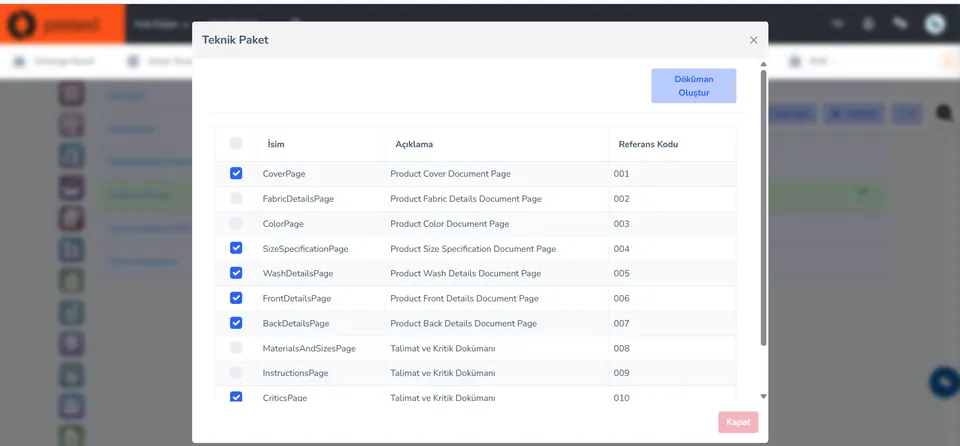
Screen from the demo environment; brands and amounts are demo data. Step 1Create the tech pack
The tech pack window lists its pages: cover, fabric details, color, measurement chart, washing details, front and back details, materials and sizes, instructions, critical points. You tick the pages you want and click 'Create Document'.
At work, in reality, the same pages may not go out for every style. But which pages and which version went to the supplier must be on record.
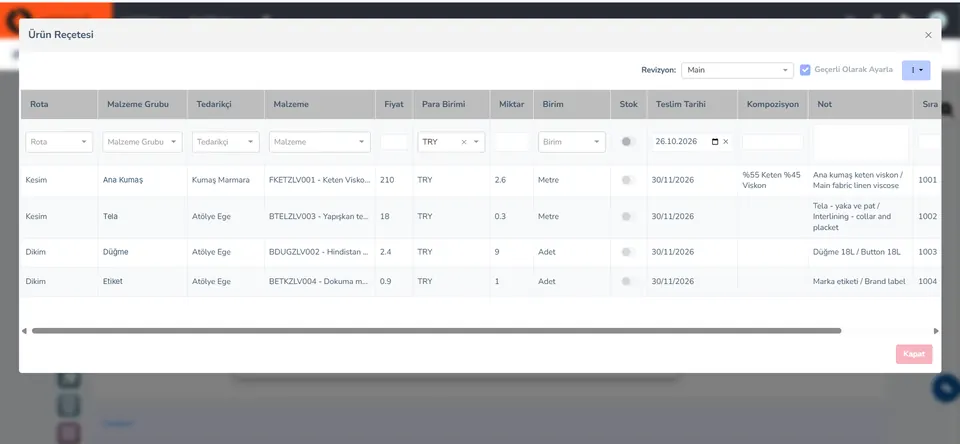
Screen from the demo environment; brands and amounts are demo data. Step 2Read the BOM line by line
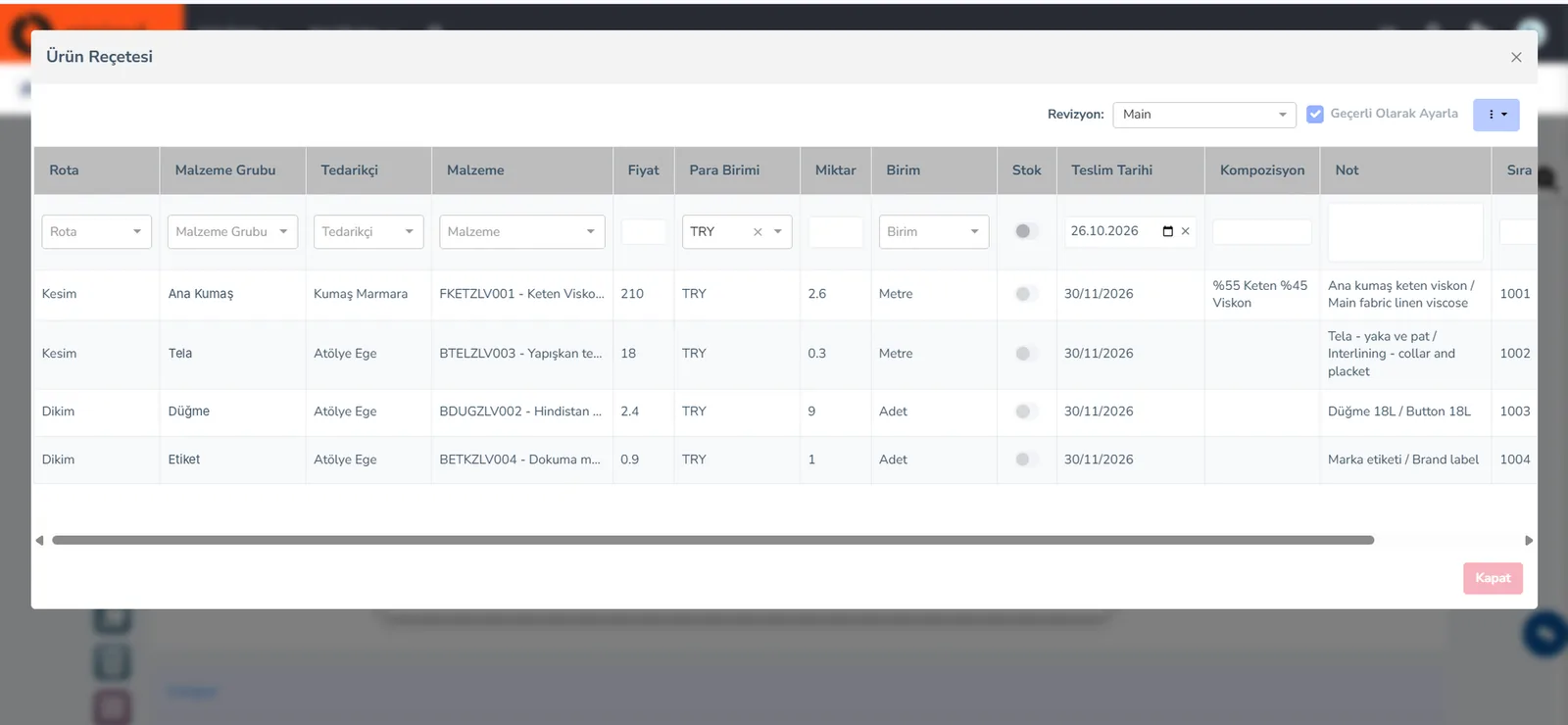
In the bill of materials, each line is a material: route (cutting, sewing), material group (main fabric, interlining, button, label), supplier, material code, price, currency, quantity, unit, delivery date, composition and note. At the top, the revision selection and the 'set as current' box.
At work, in reality, if a trim changes in the BOM and the cost is not updated, the margin quietly changes. When you change the BOM, tell the costing specialist.
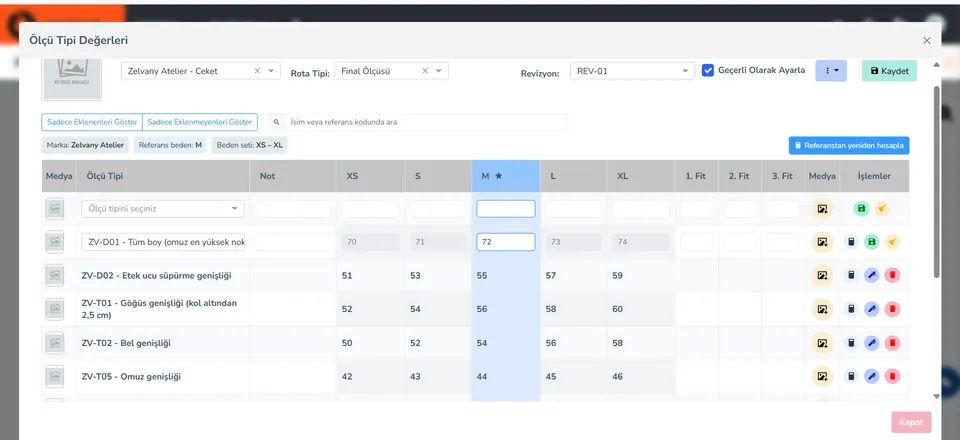
Screen from the demo environment; brands and amounts are demo data. Step 3Track the measurement chart and fit rounds
On the measurement type values screen, the size set is XS–XL and the reference size is M. Each measurement point (length, hem, chest, waist, shoulder) is written size by size, with the 1st, 2nd and 3rd fit columns next to it. Route type and revision are at the top, and the 'recalculate from reference' button is here too.
At work, in reality, if the value measured in a fit round deviates from the chart, the tolerance is checked first. If no tolerance is written, the arguing starts.
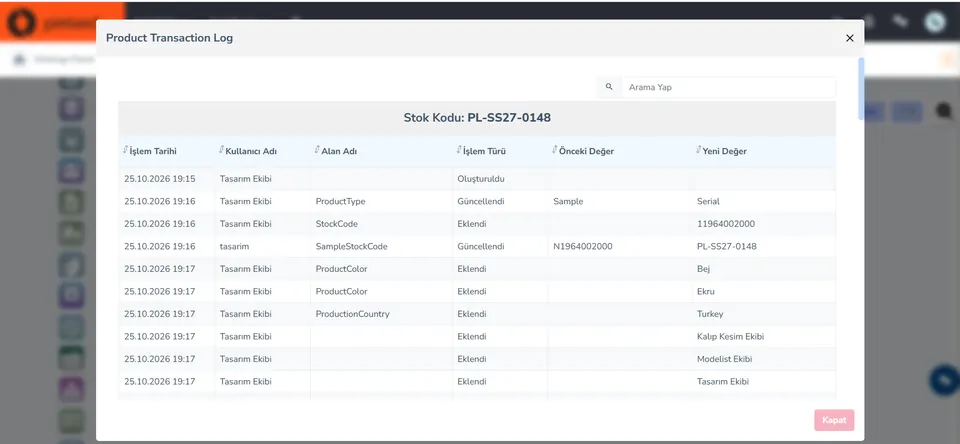
Screen from the demo environment; brands and amounts are demo data. Step 4Find out who changed what
The product activity log keeps every change line by line: date, user, field name, action type (created, updated, added), previous and new value. In the example, the product type moved from sample to bulk, and colors and the country of production were added.
At work, in reality, the 'I didn't change it' argument ends in the log. A wrong version means a whole wrong lot at the factory.



These screens are from the Pimland PLM module.
Open your card
Open your card
Read the short summary and the Pimland screens and answer at least 2 of 3 questions correctly to open the card. When all 20 cards are open, your Pimland Basic Certificate arrives in your account automatically.
Your Product development specialist card is open · 0/20
Next suggestion: All position cards
How fashion, retail and manufacturing companies work, and 20 position cards
First the required reading, then the cards for 20 positions: you learn how a fashion company works.
- FirstTraining 1: How is a product born? · read to the end and complete it
- Each cardA summary of the position, audio narration and Pimland screens
- Card3 short questions at the end of each part; 2 correct answers open the next part · no time limit
- AccountWith a free account, your progress follows you on every device
- At the endOnce you complete all 20 cards, the Pimland Basic Certificate arrives in your account automatically
Certificate 1 · Pimland Basic Certificate
Reading is open to everyone; the part questions and the certificate require an Academy account.
PLM, PIM and SRM trainings
The shared language of the fashion world: PLM, PIM and SRM, with Pimland's real screens.
- OrderFirst PLM, then PIM, then SRM · one at a time
- Each training8 parts, in order · audio narration and Pimland screen
- Questions3 questions at the end of each part, 24 in total · 2 correct answers open the next part · no time limit, the questions change with every attempt
- UnlockPart questions open after your Basic certificate
- Verification14+ (date of birth in your profile); an e-Devlet education document for Turkish nationals
- At the endOnce the three trainings, ID and document are complete, Certificate 2 arrives in your account
Certificate 2 · Pimland PLM · PIM · SRM Certificate
Reading is open to everyone; the part questions and the certificate require an Academy account.
PRO · advanced training
Separate application, for selected candidates.
- WhoCandidates selected from applicants who hold both certificates
- OnlinePimland PLM software training and test
- On site1 day inside a fashion company, seeing PLM in use
- ApplicationWith “Apply for PRO training” on the PRO page; places are limited, and selected candidates hear back by email
Certificate 3 · Pimland PRO Certificate
Reading is open to everyone; the part questions and the certificate require an Academy account.
FAQFrequently asked questions about product development specialists
4 questions
Design decides how the product will look; product development decides how it will be made. The designer sets the silhouette, color and details; the product development specialist turns them into measurements, materials and workshop instructions.
Usually the product development specialist prepares and updates it. The designer adds the drawing, the pattern maker the measurement and pattern information, purchasing the materials and suppliers, and the quality team the tolerances and checkpoints.
The English job title of the specialist who looks after the technical side of the garment (fit, measurements, sewing and material suitability). It largely overlaps with product development work; some companies call it product technologist.
A small color trial the dyehouse prepares in the lab to hit the target color. Design and product development compare it with the target color; the approved trial becomes the reference for production dyeing.
· Pimland Academy team