How do you become a pattern maker?
DepartmentDesign and product developmentModulePLM
The pattern maker is the person in fashion and apparel who turns a garment's drawing into a pattern according to the measurement chart, corrects the fit in the fit session and grades the pattern across sizes to get it ready for production.
 Card: Locked · your progress is saved in this browser · save it to your account
 PIMLAND 06 · PLM
Pattern maker
Design and product developmentPattern maker, in short
Every fit comment is worked into the pattern, and every pattern version carries the same name as the version in the tech pack.
- Draws the style's pattern and sets the seam and ease allowances according to how the fabric behaves.
- Reads the fit at the fit session, works the correction into the pattern and grades the base size to all sizes.
- Season rhythm: new patterns, sample pattern, fit rounds, grading, marker plan and consumption.
- The key documents are the tech pack, the size chart, the fit comment and the marker plan.
- Close out the fit comment point by point; once every point is worked in, give the pattern to the sample room.
- You're evaluated on the number of fit rounds, grading that works on the first try, and pattern version accuracy.
- Tech pack
- Size chart (size spec)
- Fit comment
- Marker plan and unit consumption (marker)
 Product development specialist
 Sample coordinator
 Fashion designer
Read in detailall documents, workflow, cases
- Drafts the style's pattern from the base block; works in details such as darts, pockets and collars.
- Adds seam and ease allowances and adjusts them for the fabric's shrinkage and stretch.
- Gives the sample pattern and the sewing instructions to the sample room.
- Evaluates the fit in the fit session and works the correction into the pattern.
- Grades the approved base size to all sizes and produces the marker plan and the fabric consumption.
In a season
- New styles
Preparing a pattern or adapting a similar pattern from the archive.
- Sample
The sample pattern and sewing instructions go to the sample room.
- Fit sessions
1st fit, 2nd fit, 3rd fit. Each round's corrections are worked into the pattern.
- After approval
Grading and size set.
- Into production
Marker plan; the finalized fabric consumption goes to costing and purchasing.
Who do they work with?
- Fashion designer
- Product development specialist
- Sample coordinator
 Costing specialist
 Quality control coordinator
From school to work
| What you learned at school | At work |
|---|---|
| You learn to draw a pattern from start to finish in a single size. | In working life, you get the base size approved and grade it to all sizes according to the size chart. A small measurement difference carries through the whole size set. |
| You learn the basics of hand pattern making with paper, pencil and ruler. | In working life, many companies do pattern making, grading and markers in computerized pattern software. But it's hand pattern knowledge that diagnoses the problem at the fit session; employers look for both together. |
| You learn how the pattern determines a garment's look and fit. | In working life, the pattern also determines fabric consumption, and therefore cost. A small gain in the marker plan grows once it's multiplied by the quantity. |
| You learn to do fittings and read a garment on the body. | In working life, fit sessions come in rounds. A new sample isn't requested until one round's corrections are worked into the pattern. |
| You build a solid foundation over several semesters of pattern courses. | In working life, that foundation deepens in the workshop, next to an experienced pattern maker. In a study with graduates working in the industry, the most common position was pattern maker (Çınar 2022). |
What do job ads ask for?
From 242 fashion and retail job ads published in Turkey in August–October 2026.
Computerized pattern software (CAD)
Decisive in pattern maker ads; one ad calls it 'our basic expectation'. Only 5% across the whole sample, because it appears almost only in pattern maker ads.
Pattern knowledge
In 12% of the 242 job ads.
Measurement chart, fit, fittings
In 24% of the 242 job ads. Pattern maker ads also ask you to read tech packs, size charts and fit comments.
Sample flow
In 19% of the 242 job ads: proto, fit, SMS, PPS.
Experience
The sample has 16 pattern maker and assistant pattern maker ads; 2 have entry-level titles. On the search side, people look for 'assistant pattern maker job ads with no experience' and 'pattern maker intern ads': the way in is as an assistant.
The first 90 days
- Get to know the workshop's pattern archive: which pattern comes from which style, which version.
- At every fit session, work the correction into the pattern and record it together with the sample's round.
- Try a style's marker plan with two different layouts and note the difference in consumption.
Which field of study?
The fashion design technologies field of vocational and technical Anatolian high schools, the garment production technology and fashion design programs of vocational schools, vocational courses. The Pattern Maker (Level 4) national qualification of Turkey's Vocational Qualifications Authority (MYK) is one way to certify your pattern and sample skills by exam.
Looking at a flat piece of paper and seeing how it will sit on the body.
From the inside: documents, decisions, cases
Documents, handovers, decisions and mistakes that happen on the job.
A working day
- 08.30
Yesterday's samples arrive from the sample room. You match the request number, round and pattern version on the hang tag against your own list; a sample whose version doesn't match doesn't go into the fit session.
- 09.30
Fit session: you're at the fit model with the designer, product development and the sample coordinator. The points of measure are measured, you read the fit, and every correction is written into the fit comment with the piece name.
- 11.00
You work the fit comments into the pattern. You note how much you moved each piece and raise the pattern version; if a change affects the size chart, you also write to product development separately.
- 12.30
The sample machinist calls: the notches on the collar don't line up. You open the pattern, compare the seam lengths of the collar and the neckline, and find out whether the error is in the pattern or in the cutting.
- 14.00
New style: the technical drawing, a draft size chart and the fabric's shrinkage test result are on your desk. You open a similar pattern from the archive, check its version and adapt it to the new style.
- 15.30
You grade a style whose base size has been approved. You apply the grading rules and separately check the proportion of the armhole and the neckline in the smallest and largest sizes.
- 16.30
Marker trial: you try the same pattern with two different layouts, work out the unit consumption while keeping the print and nap direction, and report it to the costing specialist.
- 17.30
You save the day's pattern files to the archive with the style code and version number, and send the list of open fit corrections to product development.
A sample day; hours vary by company and season.
Workflow: before you, after you
- 1Read the tech pack, size chart and technical drawing; ask about any missing or conflicting information.
- Input
- Tech pack, size chart, technical drawing
- Output
- List of questions or approved starting information
- Handover
- Product development specialist
- 2Prepare the pattern or adapt one from the archive; add the shrinkage allowance.
- Input
- Finalized tech pack, fabric test result
- Output
- Sample pattern and sewing instructions
- Handover
- Sample coordinator
- 3Assess the fit at the fit session; state each correction with the piece name.
- Input
- Fit sample, the sample's measurement results
- Output
- Fit comment and correction list
- Handover
- Product development specialist
- 4Work the corrections into the pattern and raise the pattern version.
- Input
- Fit comment
- Output
- Revised pattern and version note
- Handover
- Sample coordinator
- 5Grade the approved base size to all sizes.
- Input
- Approved base size pattern, size chart
- Output
- Size set patterns
- Handover
- Sample coordinator
- 6Build the marker plan and work out the unit consumption.
- Input
- Graded pattern, fabric width, the order's size and color split
- Output
- Marker plan and unit consumption
- Handover
- Costing specialist
- 7Release the production pattern to cutting with a version note.
- Input
- Approved PP sample, current pattern version
- Output
- Pattern file and version note for cutting
- Handover
 Production follow-up coordinator
- 8Diagnose a measurement deviation in production: pattern or sewing?
- Input
- Inline or final inspection report
- Output
- Diagnosis and, if needed, a pattern correction
- Handover
- Quality control coordinator
Documents that pass through your hands
| Document | From | To | When | What for |
|---|---|---|---|---|
| Tech pack | Product development | Pattern maker | Before the pattern starts | Describes what the pattern will be, with the technical drawing, detail measurements, stitch types and material information. If a detail is missing, you ask before starting the pattern. |
| Size chart (size spec) | Product development or, for exports, the customer's technical team | Pattern maker | Before the pattern and at every fit round | Gives the target value and tolerance for each point of measure (POM). You build the pattern to this chart and know that measurements at the fit round are read against it. |
| Fabric shrinkage and stretch test result | Quality or purchasing (lab report) | Pattern maker | Before the pattern, once the fabric is decided | Tells you how much the fabric changes in length and width after washing. You add the shrinkage allowance to the pattern based on this result. |
| Sample pattern and sewing instructions | Pattern maker | Sample room | At proto and every revision round | The list of pieces, notches, seam allowances and sewing sequence. The sample machinist sews the sample following these instructions. |
| Fit comment | Fit session (usually written up by product development) or the export customer | Pattern maker | After every fit round | Tells you what to correct at which point. A comment not worked into the pattern means the same problem at the next round. |
| Graded pattern set (grading) | Pattern maker | Sample room and cutting room | After base size approval | Patterns for all sizes and the grading rules. The size set sample and production cutting are based on them. |
| Marker plan and unit consumption (marker) | Pattern maker | Costing specialist, purchasing, cutting room | At the start of production | The layout of the pattern pieces on the fabric and the amount of fabric per product. Costing and the fabric order are based on this value. |
Decisions
- Whether a fit problem comes from the pattern or the sewing, and which piece of the pattern to correct.Approved by: Your technical decision; product development records it in the fit comment.
- A correction that changes the ease or the silhouette.Approved by: Because it changes the product's look, the designer and product development approve it.
- A change to a target value or tolerance in the size chart.Approved by: Product development; for an export order, the customer's technical team.
- Compromising on print or nap direction to save fabric in the marker.Approved by: You propose it; because it affects the look, it isn't applied without approval from the designer and quality.
What are you evaluated on at work?
- How many fit rounds it takes to approve a style
- Grading that works on the first try in the size set
- Marker efficiency and unit consumption in line with costing
- Whether any production defects come from the pattern
- Order in the pattern archive and version accuracy
Common mistakes on the job
Releasing a new sample pattern without working part of the fit comment into the pattern.
ResultThe same problem comes back at the next round, a fit round is wasted and the calendar slips.
PreventionClose out the fit comment point by point; don't send the pattern to the sample room until every point is worked in.
Saving the pattern file with names like 'final', 'final2'.
ResultThe cutting room opens the old pattern; fabric that's been cut doesn't come back.
PreventionStyle code, version number and date. The pattern version must match the version in the tech pack.
Finishing the pattern without waiting for the fabric's shrinkage test result.
ResultAfter washing, the length or width shrinks and the product is out of tolerance at final inspection.
PreventionAsk for the test result before the pattern; if it hasn't arrived, release the pattern with an 'awaiting shrinkage allowance' note.
Checking only the base size when grading.
ResultIn the extreme sizes, the armhole, collar or pocket placement ends up out of proportion; it shows up in the size set sample or in production.
PreventionAfter grading, measure the smallest and largest sizes separately, and always ask for the size set sample.
Skipping the marker direction rule on printed or napped fabric.
ResultPieces look like different shades, and checks and stripes don't meet at the seams.
PreventionWrite the direction and print-matching note on the marker plan, and tell the cutting room separately.
Case: what would you do?
Case 1At the second fit round, a pair of tailored trousers shows tension in the back crotch and diagonal wrinkles below the seat. The measurements are within tolerance. The designer says 'let's cut it one size bigger'.What do you do?
A good answerYou don't size up; the problem isn't ease, it's fit. You propose correcting the depth of the back crotch curve and the back waist height. The correction is written into the fit comment with the piece name and worked into the pattern, and you check that it doesn't change the size chart.
Sizing up breaks the size chart and the whole size set, and it doesn't remove the wrinkles either.
Case 2Before starting to cut an export order, the cutting room calls: on their pattern printout, the collar piece looks different from the drawing in the tech pack. The archive has two pattern versions of this style.What do you do?
A good answerYou ask them not to start cutting. Taking the current version of the tech pack and the approved PP sample as the reference, you find out which pattern version was approved. You send the right file with a version note, mark the old one as invalid in the archive and let production follow-up know.
Fabric cut with the wrong version doesn't come back; a few minutes of checking saves the whole batch.
Case 3The fabric's shrinkage test comes in after the proto sample of a knit dress has been sewn: it shrinks more in length after washing than expected.What do you do?
A good answerYou add the shrinkage value to the pattern separately in the length and width directions. You share the result with product development and quality, and ask for the next fit sample to be measured after washing.
A measurement approved on an unwashed sample changes at the customer's first wash.
Think of your own answer first, then open it.
How does this position work with the world?
In export orders, the size chart (size spec), points of measure (POM), tolerances and fit comments often come from the foreign customer's technical team in English; terms such as pattern, grading, marker and ease are part of everyday language. In PLM, point-of-measure codes and fit comments sit in Turkish and English in the same record, so the customer, product development and you all read the same version. As long as fabric information and consumption stay linked to the product record, the material data required by regulations such as the EU digital product passport is fed from this record too, not from scattered files.
What changes with PLM?
| Before | With PLM |
|---|---|
| The fit comment sits in an email, the photo on a phone, and the correction is handwritten in the margin of the tech pack. | Each fit round's measurements and comments sit next to the size chart; which correction was requested at which round is visible in a single record. |
| The size chart is in Excel, with a separate copy in each team; people ask which one is current. | One size chart and a revision marked 'current'; the tech pack is printed from this chart. |
| Unit consumption is passed to costing and purchasing by message; if it changes later, no one notices. | Consumption goes into the bill of materials (BOM); costing and purchasing see the same up-to-date value. |
Career path
- Assistant pattern maker
- Pattern maker
- Senior pattern maker
- Middle manager (pattern room or product development)
Glossary for this position
- Tech pack
- The production package that gathers a style's technical drawing, measurement chart, materials, stitching details and instructions in one document.
- Measurement chart
- A chart showing the target value of each measurement point of a style, size by size.
- Proto sample
- The first sample, where the design is put into fabric for the first time, sewn to see proportions and the overall look.
- Fit sample
- The sample on which the garment's fit and measurements are checked on a mannequin or a live fit model.
- Fit comment
- The written list of corrections from a fit session, tied to measurement point and round.
- Sample round
- Each sample stage in which a style is sewn again with corrections: 1st round, 2nd round and so on.
- Revision
- The new version of a style, tech pack or costing after a change.
- Marker plan
- The cutting plan in which pattern pieces are laid on the fabric in the most efficient way; the fabric consumption per unit comes from it.
- BOM (bill of materials)
- The list of all materials needed to make a product, with quantity, unit, supplier and price.
- PPS (PP) sample
- The last approval sample before bulk production, sewn with the fabric and trims that will be used in production.
- PLM
- Product lifecycle management: the system that keeps a product's development information, from its calendar, design, tech pack and bill of materials to its samples and costing, in a single record.
What does the work look like on screen?
A pattern maker's main screen in Pimland is the size chart. In this tour, you'll see the sizes, the fit rounds, the fit comments and how measurements get into the tech pack.
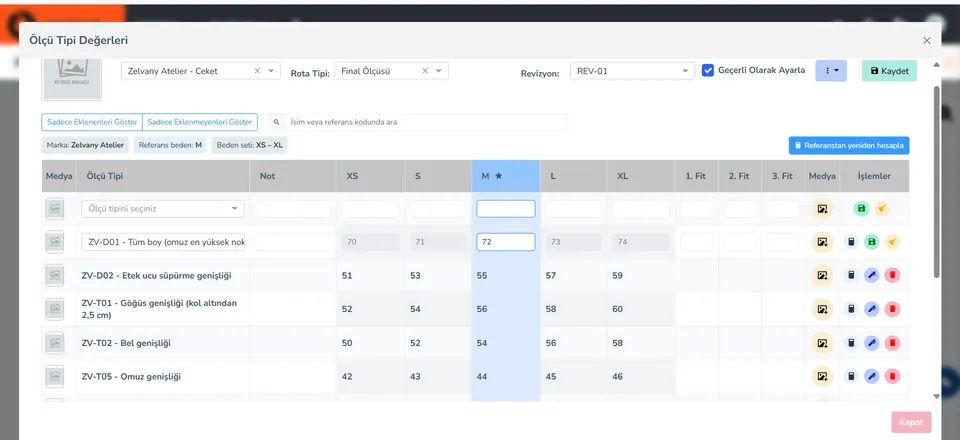
Screen from the demo environment; brands and amounts are demo data. Step 1Read the size chart
A jacket's measurement type values: size set XS–XL, with reference size M marked with a star. Each point of measure (full length, hem width, chest, waist, shoulder) is written size by size, with 1st, 2nd and 3rd fit columns next to it. The 'Recalculate from reference' button is here too.
In real working life, if you change the reference size, the whole size set is affected. Don't touch the other sizes without knowing the grading rule.
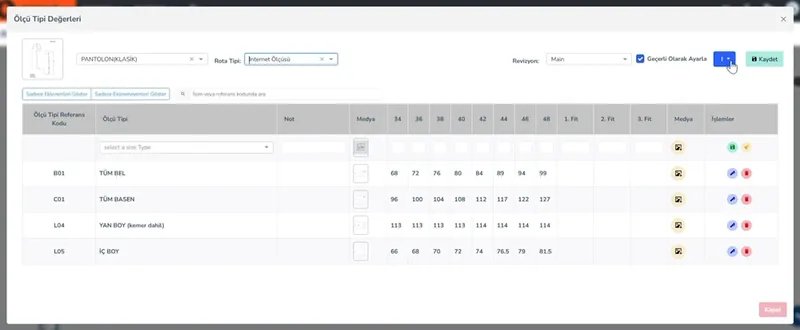
Screen from the demo environment; brands and amounts are demo data. Step 2Read the measurements of a pair of trousers
The measurements of classic trousers from 34 to 48: full waist, full hip, side length (including waistband), inseam. Each measurement has a reference code. In the route type field, 'Online Measurement' is selected; different measurement sets can be kept separately for the same product.
In real working life, the measurement shown to the customer and the pattern measurement aren't the same thing. Don't enter a value without checking which set is selected.
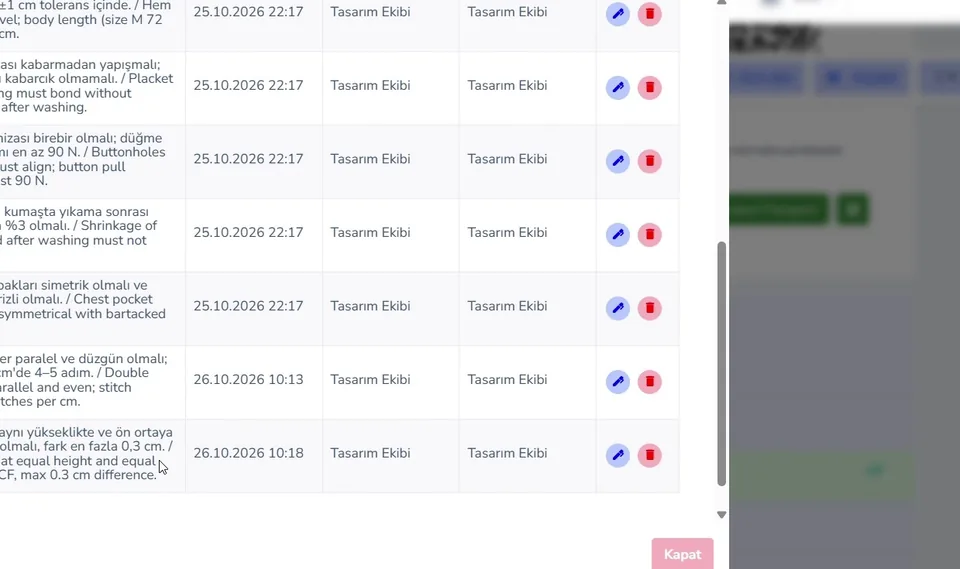
Screen from the demo environment; brands and amounts are demo data. Step 3Turn fit comments into pattern changes
The comments list for the fit round: criteria such as measurement tolerance, shrinkage after washing, pocket symmetry and stitch density, with Turkish and English descriptions, the team that added them and the date.
In real working life, the output of a fit session isn't a photo and a sentence; it's a correction worked into the pattern.
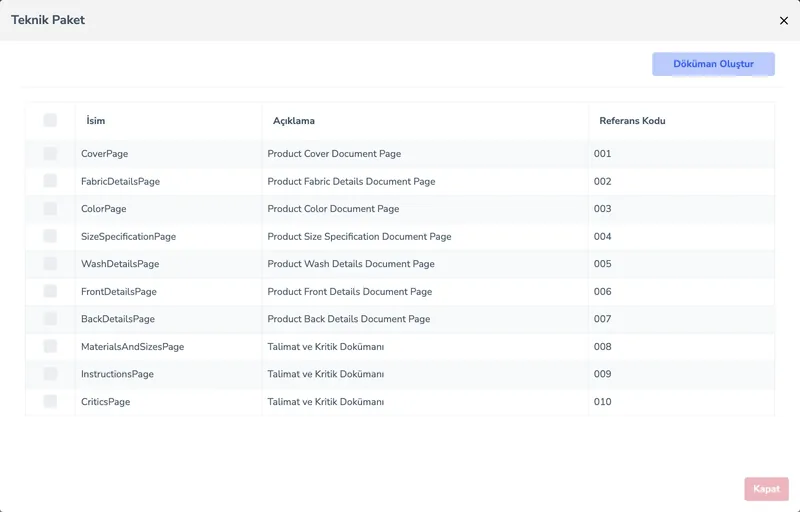
Screen from the demo environment; brands and amounts are demo data. Step 4Put the measurement page into the tech pack
In the tech pack window, the size chart page (Size Specification) is selected as a separate page. This is where the pattern maker's size chart enters the tech pack.
In real working life, if the size chart in the tech pack and the pattern are not the same version, the cutting room works with the wrong measurements.


These screens are from the Pimland PLM module.
Open your card
Open your card
Read the short summary and the Pimland screens and answer at least 2 of 3 questions correctly to open the card. When all 20 cards are open, your Pimland Basic Certificate arrives in your account automatically.
How fashion, retail and manufacturing companies work, and 20 position cards
First the required reading, then the cards for 20 positions: you learn how a fashion company works.
- FirstTraining 1: How is a product born? · read to the end and complete it
- Each cardA summary of the position, audio narration and Pimland screens
- Card3 short questions at the end of each part; 2 correct answers open the next part · no time limit
- AccountWith a free account, your progress follows you on every device
- At the endOnce you complete all 20 cards, the Pimland Basic Certificate arrives in your account automatically
Certificate 1 · Pimland Basic Certificate
Reading is open to everyone; the part questions and the certificate require an Academy account.
PLM, PIM and SRM trainings
The shared language of the fashion world: PLM, PIM and SRM, with Pimland's real screens.
- OrderFirst PLM, then PIM, then SRM · one at a time
- Each training8 parts, in order · audio narration and Pimland screen
- Questions3 questions at the end of each part, 24 in total · 2 correct answers open the next part · no time limit, the questions change with every attempt
- UnlockPart questions open after your Basic certificate
- Verification14+ (date of birth in your profile); an e-Devlet education document for Turkish nationals
- At the endOnce the three trainings, ID and document are complete, Certificate 2 arrives in your account
Certificate 2 · Pimland PLM · PIM · SRM Certificate
Reading is open to everyone; the part questions and the certificate require an Academy account.
PRO · advanced training
Separate application, for selected candidates.
- WhoCandidates selected from applicants who hold both certificates
- OnlinePimland PLM software training and test
- On site1 day inside a fashion company, seeing PLM in use
- ApplicationWith “Apply for PRO training” on the PRO page; places are limited, and selected candidates hear back by email
Certificate 3 · Pimland PRO Certificate
Reading is open to everyone; the part questions and the certificate require an Academy account.
FAQFrequently asked questions about pattern makers
4 questions
The person who turns the garment's drawing into a pattern, describes how the sample will be sewn, corrects the fit in the fit session and grades the pattern across sizes. In workshops they are also called a pattern cutter.
The pattern maker prepares the pattern and makes sure the garment fits the body. The stylist, on the other hand, sets up how the product will look in the brand's shoot and builds outfits. In Turkey the designer can also be called a 'stilist', so the words get mixed up.
Works alongside the pattern maker and helps with pattern and sample work. The job description varies by company, but an important part of the profession is learned during this period of working alongside someone.
It isn't required. The Pattern Maker (Level 4) national qualification of Turkey's Vocational Qualifications Authority (MYK), with its units on occupational health and safety, preparing garment patterns and having garment samples made, is one way to certify your skills by exam.
· Pimland Academy team