How do you become a fashion designer?
DepartmentDesign and product developmentModulePLM
The fashion designer is the person who defines the silhouette, color, fabric and details of a garment or a collection and turns them into drawings that can be produced.
 Card: Locked · your progress is saved in this browser · save it to your account
 PIMLAND 04 · PLM
Fashion designer
Design and product developmentFashion designer, in short
Good design is design the factory understands correctly on the first read: coded colors, measured drawings, written comments.
- Researches trends, last season's sales and customer feedback.
- Turns the season into a moodboard and a coded color palette, and the sketch into a measured technical drawing.
- Season rhythm: research, drawing after the line plan, samples and fit, collection approval presentation.
- The key documents are the moodboard and color palette, the technical drawing, the lab dip card and the fit comment list.
- Write every color with its color card code and enter it once in the product record.
- You're evaluated on delivering drawings on time, on how well the first sample matches the design, and on staying within target cost.
- Moodboard and coded color palette
- Technical drawing (flat)
- Lab dip and strike-off approval card
- Fit comment list
 Merchandiser
 Product development specialist
 Pattern maker
Read in detailall documents, workflow, cases
- Researches trends, last season's sales and customer feedback.
- Turns the season's story into a moodboard and its mood into a coded color palette.
- Sets the direction for fabric, pattern, print and embroidery; selects from supplier swatch cards.
- Turns the sketch into a technical drawing with measurements and details.
- Attends fit sessions, evaluates the sample against the design and gives revision notes.
In a season
- Research
Trend reports, the street, last season's sales. Moodboard and color palette.
- After the line plan
Drawings and fabric selection for the empty slots in the plan.
- Sampling period
Fit sessions, revisions. Simplifying details on styles that come out too expensive.
- Collection approval
Presenting styles with their story and applying the decisions that come out of it.
- All the time
Drawing the new season while evaluating the previous season's samples.
Who do they work with?
- Merchandiser
 Collection manager
- Product development specialist
- Pattern maker
 Sample coordinator
 Sourcing / purchasing specialist
 Stylist
From school to work
| What you learned at school | At work |
|---|---|
| You learn to use your imagination freely and find your own design language. | In working life, that language works inside the line plan: the number of styles, the price band and the target cost are written in advance. Job ads look for designers who can turn trends into a commercial collection. |
| You learn to see color, build palettes and tell shades apart. | In working life, that color travels with a color card code. A color described with an adjective is interpreted differently at the supplier, and the error shows up in the first sample. |
| You start with prints, technical drawing and illustration in Illustrator. | In working life, variants, outfits and collection files are added to that. In a study of the course content of 27 universities, variants appear in 11, collection building in 6 and outfit combinations in 2 (Çırpıcı 2025). |
| You learn the basics of pattern making and sewing, and see how a garment is constructed. | In working life, that foundation is useful every day: the industry looks for designers who think about design and manufacturability together. Graduates describe an adjustment period on the pattern side when moving from school to work (Aygül and Özüdoğru 2014). |
| You learn to present your collection to a jury and defend your idea. | In working life, the last stop for a design is the shelf. Job ads also expect designers to analyze the previous season's sales performance. |
What do job ads ask for?
From 242 fashion and retail job ads published in Turkey in August–October 2026.
Illustrator and Photoshop
In 9–10% of the 242 job ads; almost standard in designer ads.
Tech pack and technical drawing
In 10% of the 242 job ads; common in designer ads.
Trend and market research
In 39% of the 242 job ads.
Commercial and analytical thinking
It carries weight in designer ads: analyzing the previous season's sales and working with the product team on the cost of the designed product.
3D design software
In 5 ads (2%) across the whole sample. Some designer ads from large brands ask for it.
Experience
The sample has 19 designer ads. Experience matters for mid-level titles such as specialist and designer: 53% of the ads that state years ask for at least 5 years. One of the entry doors was a paid fashion design internship at a workshop, asking for basic knowledge of pattern making, sewing and fabrics.
The first 90 days
- Look at the brand's sales results for the last two seasons; find what the best-selling styles have in common.
- Write every color and fabric decision with a code. Stop describing them with adjectives.
- Sit in on fit sessions. Note what the pattern maker and product development say; next time, say something yourself.
Which field of study?
The most common path is fashion design or textile and fashion design. There are also associate degrees at vocational schools and the fashion design technologies field at vocational high schools. In hiring, your portfolio and your knowledge of fabric and patterns count at least as much as your department.
Turning a feeling into a drawing the factory can read.
From the inside: documents, decisions, cases
Documents, handovers, decisions and mistakes that happen on the job.
A working day
- 09.00
You look at the fabric color cards and lab dips from the supplier. You judge color not in office light but under the light source agreed with product development (in the light box).
- 10.00
You draw for the empty slots in the line plan. Next to each drawing, you write the color code and the fabric reference.
- 11.30
You hand the finished technical drawing over to product development: front and back views, detail notes, stitching and trim information.
- 13.30
You sit in on the fit session. The pattern maker talks about fit, product development about measurements; you look at silhouette and proportion and give your comment with a point of measure.
- 15.00
A style that's over target comes in from the costing specialist. You think about where else you can simplify while keeping the detail that is the style's signature.
- 16.30
You look at the previous season's sales report: what do the best-selling styles have in common, which color or fit should come back?
- 17.30
You update the presentation board for line review: each style with its story, colors and fabric.
A sample day; hours vary by company and season.
Workflow: before you, after you
- 1Research and set the direction
- Input
- Brief, trend sources, last season's sales
- Output
- Moodboard
- Handover
- Collection manager
- 2Code the color palette
- Input
- Moodboard, supplier color cards
- Output
- Coded color palette
- Handover
- Sourcing / purchasing specialist
- 3Draw the line plan slots
- Input
- Line plan, approved direction
- Output
- Technical drawing
- Handover
- Product development specialist
- 4Approve color and print
- Input
- Lab dip, strike-off
- Output
- Approval or rejection note
- Handover
- Product development specialist
- 5Comment at the fit session
- Input
- Sample, comments from the previous round
- Output
- Design comment
- Handover
- Pattern maker
- 6Simplify for cost
- Input
- Cost feedback
- Output
- Revised drawing and options
- Handover
 Costing specialist
- 7Present at line review
- Input
- Samples, drawings
- Output
- Presentation and decision notes
- Handover
- Collection manager
- 8Get the product ready to be presented
- Input
- Approved style, outfit idea
- Output
- Style story and outfit suggestion
- Handover
- Stylist
Documents that pass through your hands
| Document | From | To | When | What for |
|---|---|---|---|---|
| Season brief and line plan | Collection manager, merchandiser | Designer | Start of season | How many styles, which price band, which target cost: design works inside this frame. |
| Moodboard and coded color palette | Designer | Product development, purchasing, collection manager | Start of the design period | The season's feeling lives on the board, the measurable decision in the palette; every color travels with a color card code. |
| Technical drawing (flat) | Designer | Product development, pattern maker | On the drawing due date | The drawing the factory will read: front and back views, details, measurement and stitching notes. |
| Lab dip and print trial (strike-off) approval card | Supplier, via product development | The designer approves or rejects; product development records it | During the material approval period | The team decides whether the target color and print are matched; the approved trial becomes the reference for production. |
| Fit comment list | Product development (from the fit session) | The designer adds comments; the list goes to the pattern maker and the supplier | After every sample round | Every correction mentioned in the session becomes a line; the next sample is checked against this list. |
| Cost feedback | Costing specialist | Designer | After pre-costing and before the line review | Which style is above target, which line item is driving up the cost; simplification starts here. |
| Line review presentation file | Designer | Collection manager | Before collection approval | Styles are presented with their story; the decisions made are applied to the drawing and the product record. |
Decisions
- Approving or rejecting a lab dip from a design point of view.Approved by: The design approval is yours (with the senior designer); product development records it and notifies the supplier.
- Which detail stays in a cost simplification.Approved by: The proposal is yours; it's discussed with the costing specialist and the merchandiser, and the final decision is made at the line review.
- Changing the fabric on a style.Approved by: Sourcing decides together with product development, taking the cost impact into account; the collection manager is informed.
- Proposing a new style that isn't in the line plan.Approved by: The merchandiser and the collection manager approve; if there's no empty slot, it takes the place of another style.
What are you evaluated on at work?
- Delivering drawings on the date in the calendar
- How well the first sample matches the design, and sample rounds per style
- Share of styles that stay within the target cost
- Sales performance of the styles designed
- Clarity of revision notes (written with measurements and codes)
Common mistakes on the job
Describing a color with an adjective instead of a code ('warm beige').
ResultThe supplier dyes the color by their own interpretation; the error shows up in the first sample and a round is lost.
PreventionWrite every color with its color card code and enter it once in the product record.
Approving a lab dip under office lighting.
ResultThe color looks different under store lighting or daylight; the approved color turns out different on the shelf.
PreventionEvaluate the color under the light source the team has agreed on, next to the target reference.
Leaving measurements and detail notes out of the technical drawing.
ResultThe factory fills the gaps with its own interpretation; the sample doesn't look like the drawing.
PreventionBefore handing in the drawing, check it with product development: are the pocket size, stitch type and trim placement written down?
Not putting what you said at the fit session in writing.
ResultThe same correction gets discussed again at the next sample.
PreventionBefore you leave the session, check that your comment is a line on the fit list.
Sharing the old drawing after a revision.
ResultThe supplier sews the sample to the old detail.
PreventionKeep the version and date on the drawing file; before sharing, check that it's the latest version.
Case: what would you do?
Case 1The first sample is in, and the color looks cooler than in the drawing. The note sent to the supplier only says 'warm beige'.What do you do?
A good answerYou don't blame anyone. You take out the color card, write down the color's code and request a new lab dip through product development. You enter the code in the product record; from now on, this color goes everywhere with the same code.
The problem isn't the person, it's the way the color was described. A code and a reference do what words can't.
Case 2A style is above the target cost. The team's first suggestion is to remove the hand embroidery that is the style's signature.What do you do?
A good answerYou have the costing specialist work out options one by one, such as making the embroidery smaller or switching it to a print, simplifying the lining, or using fewer buttons. You take the option that keeps the signature and gets closer to the target to the line review.
Under cost pressure, the first thing to go is usually the design's signature. If the designer doesn't bring an alternative, nobody will.
Case 3At the fit session, the pattern maker wants to correct the waist shaping on the pattern; you think it will spoil the silhouette.What do you do?
A good answerYou state your view in terms of the measurement point and mark up the sample photo. You suggest trying both options in the next round and make sure the decision is written on the fit list.
At a fit session, what matters is not being right but having in writing what the next sample will try.
Think of your own answer first, then open it.
How does this position work with the world?
A designer works in two languages most days: terms like lab dip, strike-off, colorway, flat sketch and fit comment are the same in the sample room and at a supplier abroad. Color card codes and trend sources are international; if the supplier is abroad, technical drawing notes and the style description are also written in English, and at an exporting brand, writing this correctly once on the product card in PLM sends the same information to everyone. The fiber composition of the fabric you choose goes into the product record; the first source of the material data the EU digital product passport will require is this choice at the design desk.
What changes with PLM?
| Before | With PLM |
|---|---|
| Drawings, the color palette and fabric choices sit in different folders and e-mails. | Everything sits on the style's product card; the team looks at the same record. |
| When a detail changes because of cost or production, you're the last to hear about it. | In the design history, every change is visible with its old and new value and who made it. |
| Fit decisions stay in personal notebooks and photo folders. | On the fit comments list, every correction is a line; the next sample is checked against this list. |
Career path
- Design assistant
- Fashion designer
- Senior designer
- Middle manager (design team)
Glossary for this position
- Season (SS/AW)
- Grouping collections by selling period: Spring/Summer (SS) and Autumn/Winter (AW).
- Line plan
- The collection plan showing, for each category of a season, how many styles, which price band, how many colors and what quantity will go out.
- Target cost
- The upper limit a product's cost must not exceed, calculated backward from the target selling price and target margin.
- Tech pack
- The production package that gathers a style's technical drawing, measurement chart, materials, stitching details and instructions in one document.
- Lab dip
- A small color trial the dyehouse prepares in the lab to hit the target color.
- Proto sample
- The first sample, where the design is put into fabric for the first time, sewn to see proportions and the overall look.
- Fit sample
- The sample on which the garment's fit and measurements are checked on a mannequin or a live fit model.
- Fit comment
- The written list of corrections from a fit session, tied to measurement point and round.
- Revision
- The new version of a style, tech pack or costing after a change.
- Composition
- Information showing which fibers a fabric or product is made of, and in what proportions.
- Variant
- Each sellable option of the same style, distinguished by attributes such as color and size.
- Capsule collection
- A small collection of a few pieces built around a specific theme or collaboration.
- Multilingual content
- Keeping the names and descriptions on the same product card in more than one language, in separate fields.
What does the work look like on screen?
A designer's home in Pimland is the product card. In this tour, you'll see how a style is born, who changed what, and what was decided at the fit session.
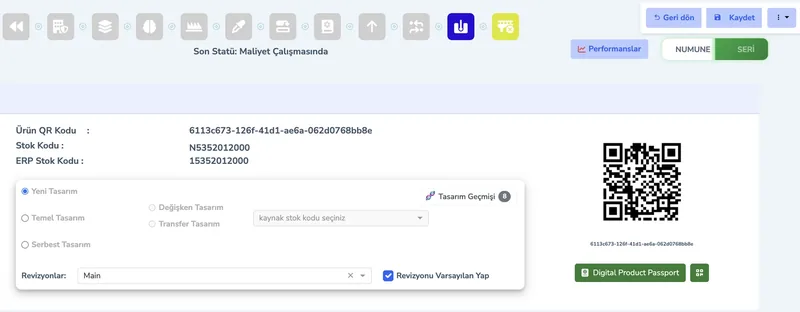
Screen from the demo environment; brands and amounts are demo data. Step 1Open the product card
At the top of the card are the status bar and the latest status; in the example, the product is in costing. The design type is selected: new, basic or free design. Next to it are the design history, revision selection, sample-to-bulk transition, the product QR code and the Digital Product Passport button.
In real working life, a style has more than one revision. A sample request can't be opened without knowing which revision is the default.
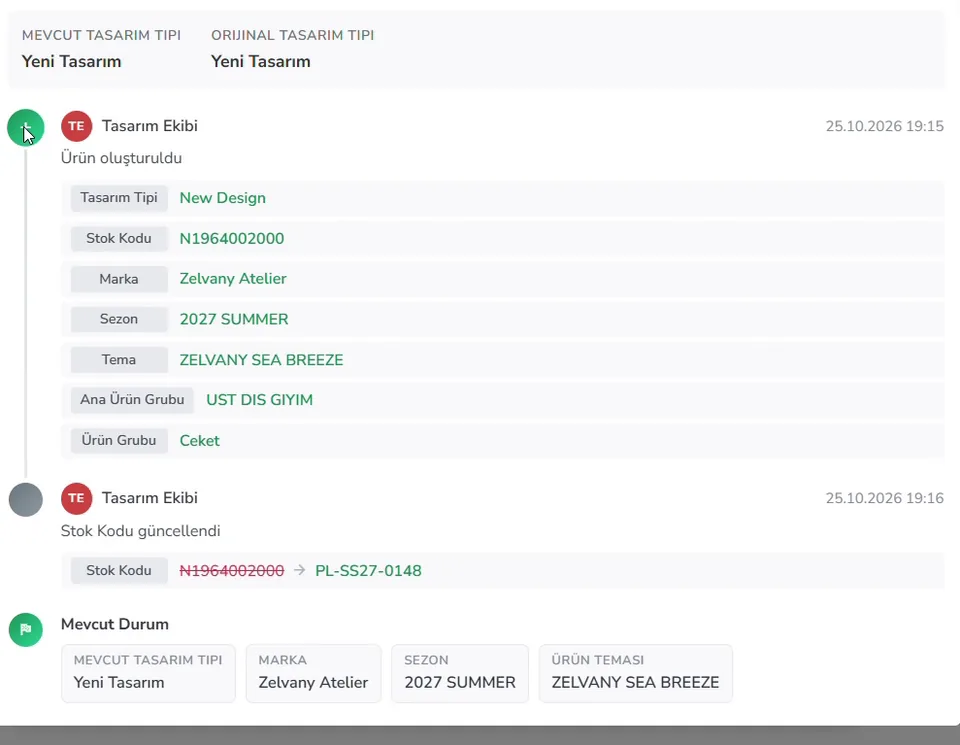
Screen from the demo environment; brands and amounts are demo data. Step 2Read the design history
The design history is a timeline: which fields the product was opened with (design type, stock code, brand, season, theme, product group), then every change with its old and new value, who made it and at what time. At the very bottom, the current state.
In real working life, when a detail changes because of cost or production, the designer is often the last to hear about it. Checking the history is faster than asking.
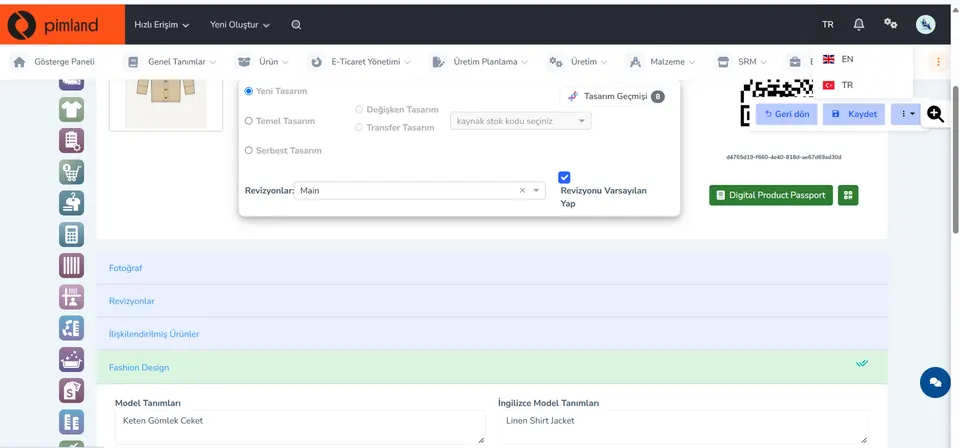
Screen from the demo environment; brands and amounts are demo data. Step 3Write the style description in two languages
In the Fashion Design section of the product card, the style description is in separate Turkish and English fields. You choose EN or TR as the interface language at the top right. The same card also has photo, revision and linked product sections.
In real working life, at a brand that sells or exports abroad, writing the style name correctly in two languages becomes part of the design team's job. A description written correctly once goes out the same way to everyone.
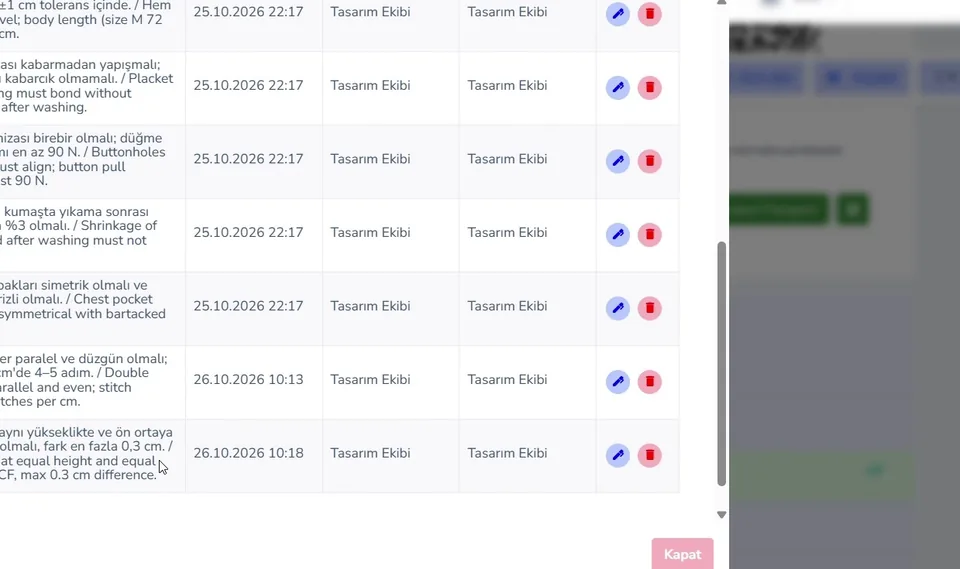
Screen from the demo environment; brands and amounts are demo data. Step 4See fit decisions in writing
The fit round's comments list: each line is a criterion or a correction, with its Turkish and English description, the team that added it and the date. The examples include criteria such as measurement tolerance, shrinkage after washing, pocket symmetry and stitch density.
In real working life, if everything said at the fit session doesn't become a line, the same discussion repeats at the next sample.


These screens are from the Pimland PLM module.
Open your card
Open your card
Read the short summary and the Pimland screens and answer at least 2 of 3 questions correctly to open the card. When all 20 cards are open, your Pimland Basic Certificate arrives in your account automatically.
How fashion, retail and manufacturing companies work, and 20 position cards
First the required reading, then the cards for 20 positions: you learn how a fashion company works.
- FirstTraining 1: How is a product born? · read to the end and complete it
- Each cardA summary of the position, audio narration and Pimland screens
- Card3 short questions at the end of each part; 2 correct answers open the next part · no time limit
- AccountWith a free account, your progress follows you on every device
- At the endOnce you complete all 20 cards, the Pimland Basic Certificate arrives in your account automatically
Certificate 1 · Pimland Basic Certificate
Reading is open to everyone; the part questions and the certificate require an Academy account.
PLM, PIM and SRM trainings
The shared language of the fashion world: PLM, PIM and SRM, with Pimland's real screens.
- OrderFirst PLM, then PIM, then SRM · one at a time
- Each training8 parts, in order · audio narration and Pimland screen
- Questions3 questions at the end of each part, 24 in total · 2 correct answers open the next part · no time limit, the questions change with every attempt
- UnlockPart questions open after your Basic certificate
- Verification14+ (date of birth in your profile); an e-Devlet education document for Turkish nationals
- At the endOnce the three trainings, ID and document are complete, Certificate 2 arrives in your account
Certificate 2 · Pimland PLM · PIM · SRM Certificate
Reading is open to everyone; the part questions and the certificate require an Academy account.
PRO · advanced training
Separate application, for selected candidates.
- WhoCandidates selected from applicants who hold both certificates
- OnlinePimland PLM software training and test
- On site1 day inside a fashion company, seeing PLM in use
- ApplicationWith “Apply for PRO training” on the PRO page; places are limited, and selected candidates hear back by email
Certificate 3 · Pimland PRO Certificate
Reading is open to everyone; the part questions and the certificate require an Academy account.
FAQFashion designer FAQ
4 questions
In Turkey, apparel companies also call the designer a 'stilist' (stylist), so the two words often describe the same job. The stylist who builds outfits for a product shoot, however, doesn't design the product; they build a look from existing pieces.
Besides design, they can go into positions such as pattern making, product development, sampling, quality, styling, e-commerce and merchandising. In a study of 85 graduates working in the industry, the most common position was pattern maker, followed by specialist designer (Çınar 2022). The positions at the Academy are this very map.
A piece of work that tells the season's story on a single board with images, colors, fabric swatches and references. It gives the team a shared feeling; measurable decisions are made in the color palette and the technical drawing.
Employers want to see how you think and how you develop a design. Not just the final visuals: research, a color palette, technical drawings and the revision story of a style set you apart.
· Pimland Academy team