How do you become a customer service representative?
DepartmentStore and customerModuleDPP
The customer service representative is the person at a fashion e-commerce brand who resolves customers' questions and their order, return and complaint requests coming in by phone, live chat, e-mail and social media.
 Card: Locked · your progress is saved in this browser · save it to your account
 PIMLAND 19 · DPP
Customer service representative
Store and customerCustomer service representative, in short
Correct information is checked first, then shared; every conversation is logged with its next step.
- Handles order, shipping, return and exchange requests through the panel.
- Answers product questions from the product card and reports recurring questions to the teams.
- Rhythm: start-of-shift announcements, logged conversations all day, campaign peaks, a weekly report.
- The most important documents are the knowledge base, the order and shipping record, the product card and the customer request record.
- Before you answer, confirm the product by stock code, color and size.
- Judged on first-contact resolution, customer satisfaction and records kept under the right category.
- Knowledge base and campaign rules
- Order and shipping record
- Product card and online size chart
- Customer request record
 E-commerce specialist
 E-commerce operations specialist
 Quality control coordinator
Read in detailall documents, workflow, cases
- Answers questions about order status, shipping, address changes and payment through the order panel.
- Opens return and exchange requests according to the rules, and follows the product's return and the refund.
- Answers questions on size, fit, fabric, care and color from the product card and the knowledge base.
- Logs complaints about a defective product, a missing piece or a delay, passes them to the relevant team and tells the customer the outcome.
- Reports recurring questions and complaints; the report becomes input for improving the product card and the product.
In a season
- Start of shift
Announcements, new campaign rules, shipping delays, known issues.
- All day
Calls and messages; every conversation logged under the right category.
- Campaign periods
Order questions peak.
- After sales and special days
Return and exchange requests go up.
- Weekly
The most frequent product questions are reported to the e-commerce and product teams.
Who do they work with?
- E-commerce specialist
- Quality control coordinator
 Product development specialist
 Store sales associate
- E-commerce operations specialist
From school to work
| What you learned at school | At work |
|---|---|
| You learn to be polite and clear when you communicate. | At work, accuracy comes alongside politeness. You answer a question you don't know by checking the source, not by guessing. |
| You learn to listen to a question and give a clear answer. | At work, if the same product question comes in a second time, what's missing is not your knowledge but the product page. The question you report gets the card fixed. |
| You learn to meet a complaint calmly and resolve it. | At work, a recurring defect complaint about the same product can signal a problem with a whole batch; it goes to quality control. |
| You learn to wrap up a conversation and take notes. | At work, the record starts when the conversation ends. You write it clearly enough that the next representative doesn't have to ask everything again. |
| You learn the basic principles of customer service. | At work, in fashion e-commerce the questions are about the product itself: how does it fit, what's the fabric, will it shrink in the wash? A representative who knows sizes and fabrics makes a difference. |
What do job ads ask for?
From 242 fashion and retail job ads published in Turkey in August–October 2026.
Separate job ad
In the sample of 242 job ads, there are 5 online fashion customer service and call center ads. Note: at export manufacturers, the title 'customer representative' describes a different job: the merchandiser who runs the order from sample to shipment.
Occupational standard
The Call Center Customer Representative (Level 4) standard of MYK (Turkey's Vocational Qualifications Authority) defines the job as preparation, answering calls, after-call tasks and software use; it also notes that the work can usually be done remotely or from home.
Product knowledge
Knowing basic concepts like size, fit and fabric makes a difference in fashion e-commerce.
The first 90 days
- Read the knowledge base, return rules and campaign terms in your first week; check the announcements at the start of every shift.
- Give every answer with the same skeleton: confirm the question, clear answer, source, next step, record.
- Once a week, report the most frequent product questions to the e-commerce team.
Which field of study?
You can start after finishing high school or an associate degree; some vocational schools in Turkey offer a Call Center Services program. In fashion e-commerce, knowing size, fit and fabric concepts also makes a difference.
Turning an angry customer into a calm one with correct information.
From the inside: documents, decisions, cases
Documents, handovers, decisions and mistakes that happen on the job.
A working day
- 09.00
Start of shift: announcements, new campaign rules, regions with shipping delays, known product issues. If a new collection has launched, you read the product notes in the knowledge base.
- 09.30
The phone and live chat queue opens. 'Where is my order?' is the most common question; you read the shipping status in the order panel and never promise a date that isn't in the panel.
- 11.00
A customer asks about the length of a pair of pants. You confirm the product by stock code and color and read the inseam from the online size chart; you suggest the customer compare it with a pair of their own.
- 12.30
Email and social media messages. Written answers use the same skeleton: confirm the question, clear answer, source, next step.
- 14.00
Complaint: the delivered item has a stain. You ask for a photo, log it with the order and product code, and start a return or exchange according to the rules; you choose the right category for the record.
- 15.30
Return follow-up: what is the refund status of returns that have reached the warehouse? If any are delayed, you ask the relevant team and update the customer.
- 16.30
Short meeting with the team lead: feedback from your reviewed calls. What you did well, what you would do differently next time.
- 17.30
End of day: you add unanswered product questions and recurring complaints to the shared list. The weekly report comes from this list.
A sample day; hours vary by company and season.
Workflow: before you, after you
- 1Resolve the order request or open it to the right team
- Input
- Customer request, order and shipping record
- Output
- Record resolved, or opened with an explanation
- Handover
- E-commerce specialist
- 2Answer the product question from its source, note the unanswered ones
- Input
- Product card, size chart, product passport
- Output
- Answer; a note for information not on the card
- Handover
- E-commerce specialist
- 3Log the defective product complaint
- Input
- Customer's photo, order and product code
- Output
- Record in the right category, with a photo
- Handover
- Quality control coordinator
- 4Collect returns caused by fit and measurements
- Input
- Return requests and the customer's description
- Output
- 'Tight', 'short', 'loose' notes per product
- Handover
- Product development specialist
- 5Route requests to be resolved in store
- Input
- Customer asking for an in-store exchange or pickup
- Output
- Note passed to the store and information given to the customer
- Handover
- Store sales associate
- 6Prepare the weekly report
- Input
- End-of-day lists
- Output
- Most frequent questions, recurring complaints, suggestions
- Handover
 Middle manager
Documents that pass through your hands
| Document | From | To | When | What for |
|---|---|---|---|---|
| Knowledge base and campaign rules | Team lead, e-commerce and marketing | Representative | At the start of every shift and with every new campaign | Everyone giving the same answer to the same question. |
| Order and shipping record | Order panel and shipping company | Representative | With every order question | Telling the customer the real status in the record, not a guess. |
| Product card and online size chart | E-commerce (PIM) | Representative | With product and size questions | A sourced answer to fabric, care and measurement questions. |
| Customer request record | Representative | Relevant team | After every conversation | The next representative not having to ask the customer everything again; the request reaching the right team. |
| Defective product report with photos | Representative | Quality control | With a product defect complaint | Seeing whether a recurring defect belongs to one batch. |
| Weekly question and complaint report | Representative and team lead | E-commerce and product development | Weekly | Fixing what's missing on the product card and the problem in the product itself at the source. |
Decisions
- Opening returns and exchanges that follow the rulesApproved by: You.
- A gesture outside the rules (refunding the shipping fee, an extra discount)Approved by: Team lead.
- Escalating a complaint to quality controlApproved by: You; based on the defined category and rule.
- The tone of the reply to a public complaint on social mediaApproved by: A template approved by the customer service manager; you apply it.
What are you evaluated on at work?
- First-contact resolution
- Customer satisfaction
- Record quality and the right category
- Response time and keeping promised callbacks
- Quality score from reviewed calls
Common mistakes on the job
Answering without confirming the product.
ResultInformation about another product with a similar name is given; wrong size, a return.
PreventionFirst confirm the product by stock code, color and size.
Promising a delivery date that isn't in the panel.
ResultWhen the promise isn't kept, a second and harsher complaint comes.
PreventionSay what the record says; explain the uncertainty honestly.
Writing the record incomplete or in a way only you understand.
ResultThe customer calls again and explains everything from the start.
PreventionRecord skeleton: what was asked, what was done, who owns the next step.
Putting a product defect under the shipping or 'other' category.
ResultThe quality problem doesn't show up in the report; the same batch keeps selling.
PreventionKnow the category list; if you're not sure, ask your team lead.
Filling in what isn't in the knowledge base with a guess.
ResultThe store and the website say different things; trust is shaken.
PreventionSay 'I'll find out and get back to you'; pass the question to the e-commerce team.
Case: what would you do?
Case 1In live chat, a customer asks, 'Will this dress shrink in the wash?' The product card only has the care instructions.What do you do?
A good answerYou share the care instructions and recommend following them; you make no firm promise about shrinkage. You pass the question to the product team and get back to the customer if an answer comes; you also add the question to the weekly report.
Shrinkage is not stated by guessing. If the same question keeps coming, what's missing is the product card.
Case 2On the same day, several customers write that the zipper on the same product gets stuck.What do you do?
A good answerYou log each request under the same category with the order, product code and photo. You send a combined report to your team lead and quality control.
These may not be one-off returns but the signal of a batch problem. Early reporting protects the other products on sale.
Case 3An angry customer says the shipment is late and that she bought the dress for a wedding this weekend.What do you do?
A good answerFirst you listen and confirm the situation from the record. You state the real status shown in the panel and offer the options within the rules: store pickup, exchange or cancellation. You don't give a date you can't promise, and you log the conversation.
What calms an angry customer is correct information and a real option; a broken promise makes the problem bigger.
Think of your own answer first, then open it.
How does this position work with the world?
In fashion e-commerce, some orders may go abroad; customers abroad write in English, and customs and return rules are different. When product information comes from a single multilingual record, you give the same answer in both languages. English terms such as ticket, escalation and first contact resolution are part of this job's daily language; with the digital product passport, the customer can also read the same product information from a QR code.
What changes with PLM?
| Before | With PLM |
|---|---|
| For a fabric or measurement question, you email the product team and wait. | Composition, care and online measurements come from the product record to the channel and your knowledge base from the same source. |
| A recurring complaint stays in your report; the product team sees it late. | When the complaint is linked to the product code, the quality and product teams see it in the product's history. |
| The store, the website and you may give different information about the same product. | In channels fed by a single record, the answer is the same everywhere. |
Career path
- Customer representative
- Senior customer representative (difficult requests, written channels)
- Quality and training coordinator or team lead
- Middle manager (customer service)
Glossary for this position
- SKU (stock keeping unit)
- The code that uniquely identifies each product option held in stock.
- Variant
- Each sellable option of the same style, distinguished by attributes such as color and size.
- Measurement chart
- A chart showing the target value of each measurement point of a style, size by size.
- Composition
- Information showing which fibers a fabric or product is made of, and in what proportions.
- PIM
- Product information management: the system that gathers the information, images and multilingual content a product needs for sale in one hub and sends it to the channels.
- Multilingual content
- Keeping the names and descriptions on the same product card in more than one language, in separate fields.
- DPP (digital product passport)
- A structure that links a product's identity, material, care and end-of-life information to a digital record opened by a QR code on the product.
What does the work look like on screen?
A representative's answers live in the product record. In this round, you'll find the answers to the customer's three most frequent questions (care, origin, size) on Pimland screens.
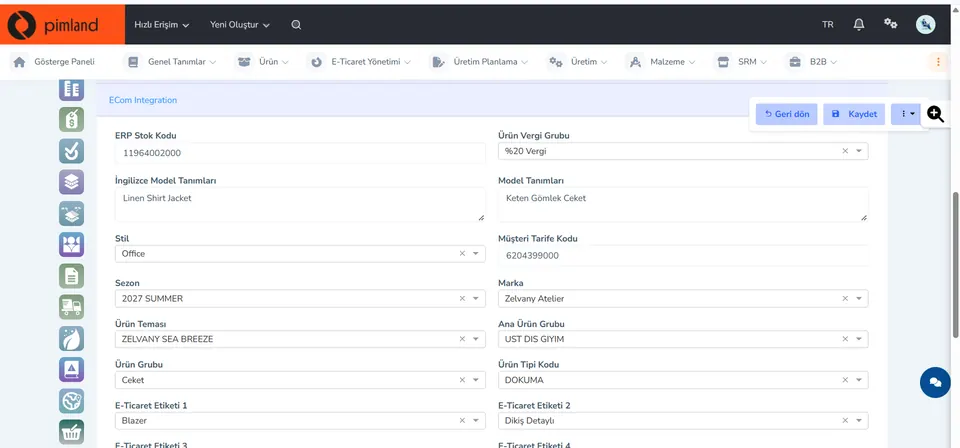
Screen from the demo environment; brands and amounts are demo data. Step 1Find the product by stock code
On the product card, the ERP stock code, the style description in Turkish and English, season, brand and product group sit side by side. You match the product the customer ordered by its stock code.
In real working life, giving the right answer about the wrong product is worse than giving no answer. Confirm the product first.
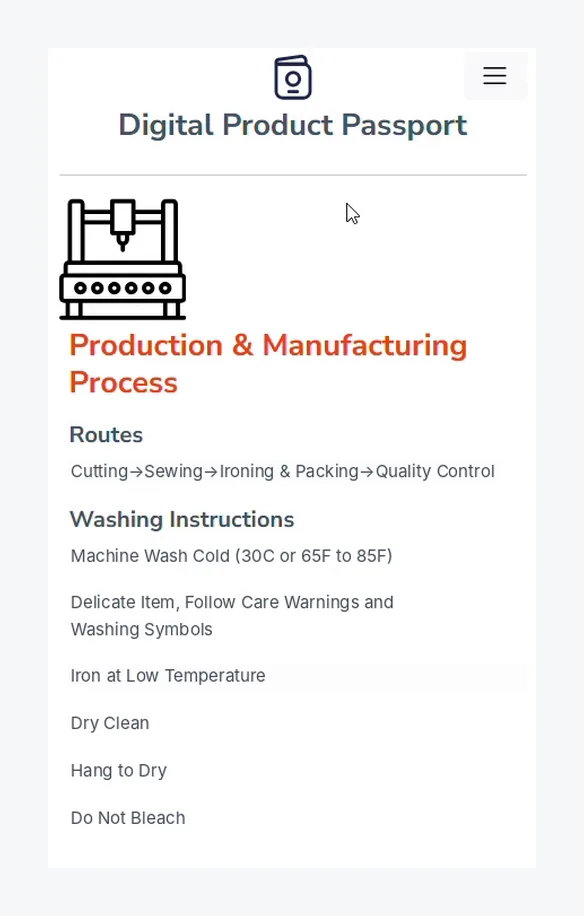
Screen from the demo environment; brands and amounts are demo data. Step 2The answer to 'Will it shrink?'
In the production and care section of the passport, the production route and washing instructions are listed in order: cold wash, delicate item warning, low-heat ironing, hang to dry.
In real working life, shrinkage is not stated by guessing. If all you have is the care instructions, the most honest answer is to recommend following them and to ask the product team for information.
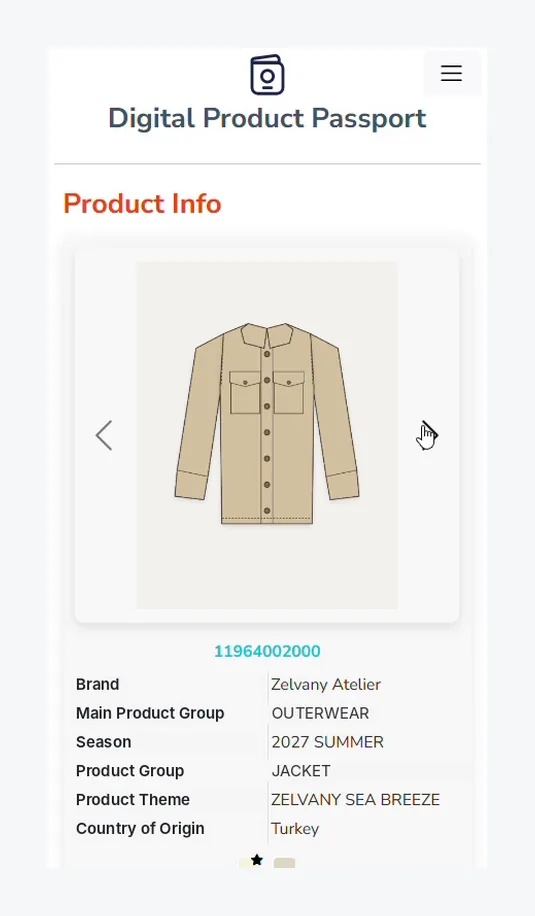
Screen from the demo environment; brands and amounts are demo data. Step 3The 'Where was it made?' question
The product information section shows the brand, product group, season and country of origin.
In real working life, the customer may ask the same question in the store too. Two different answers in two channels shake trust.
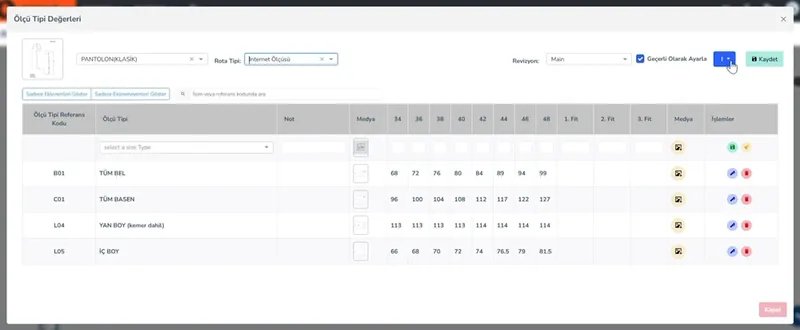
Screen from the demo environment; brands and amounts are demo data. Step 4Answer the size question with measurements
In the size chart, the 'Online Measurements' set gives the waist, hip, outseam and inseam by size. You help the customer compare them with their own measurements.
In real working life, saying 'take one size up' is easy; answering with measurements prevents a return.


These screens are from the Pimland DPP module.
Open your card
Open your card
Read the short summary and the Pimland screens and answer at least 2 of 3 questions correctly to open the card. When all 20 cards are open, your Pimland Basic Certificate arrives in your account automatically.
Your customer service representative card is open · 0/20
Next suggestion: All position cards
How fashion, retail and manufacturing companies work, and 20 position cards
First the required reading, then the cards for 20 positions: you learn how a fashion company works.
- FirstTraining 1: How is a product born? · read to the end and complete it
- Each cardA summary of the position, audio narration and Pimland screens
- Card3 short questions at the end of each part; 2 correct answers open the next part · no time limit
- AccountWith a free account, your progress follows you on every device
- At the endOnce you complete all 20 cards, the Pimland Basic Certificate arrives in your account automatically
Certificate 1 · Pimland Basic Certificate
Reading is open to everyone; the part questions and the certificate require an Academy account.
PLM, PIM and SRM trainings
The shared language of the fashion world: PLM, PIM and SRM, with Pimland's real screens.
- OrderFirst PLM, then PIM, then SRM · one at a time
- Each training8 parts, in order · audio narration and Pimland screen
- Questions3 questions at the end of each part, 24 in total · 2 correct answers open the next part · no time limit, the questions change with every attempt
- UnlockPart questions open after your Basic certificate
- Verification14+ (date of birth in your profile); an e-Devlet education document for Turkish nationals
- At the endOnce the three trainings, ID and document are complete, Certificate 2 arrives in your account
Certificate 2 · Pimland PLM · PIM · SRM Certificate
Reading is open to everyone; the part questions and the certificate require an Academy account.
PRO · advanced training
Separate application, for selected candidates.
- WhoCandidates selected from applicants who hold both certificates
- OnlinePimland PLM software training and test
- On site1 day inside a fashion company, seeing PLM in use
- ApplicationWith “Apply for PRO training” on the PRO page; places are limited, and selected candidates hear back by email
Certificate 3 · Pimland PRO Certificate
Reading is open to everyone; the part questions and the certificate require an Academy account.
FAQFrequently asked questions about the customer service representative
4 questions
In e-commerce and retail, both titles usually describe the same job. At export-oriented textile manufacturers, however, the 'customer representative' is the person who runs a foreign brand's order from sample to shipment; that job is close to a merchandiser's.
According to the Call Center Customer Representative (Level 4) standard of Turkey's Vocational Qualifications Authority (MYK), the job is usually done remotely or from home; depending on the needs of the work, it can also be done in the office or in the field. The final decision is the company's.
Confirming the question, a clear answer first, the source of the answer, the next step and a record of the conversation. This framework works on the phone and in written channels alike.
You can start after finishing high school or an associate degree. Clear communication, writing quickly and accurately, using several software tools at once and staying calm under stress stand out.
· Pimland Academy team