How do you become a costing specialist?
DepartmentCosting and purchasingModulePLM
The costing specialist is the person in apparel who calculates what a product will cost and checks whether this cost fits the target selling price and margin.
 Card: Locked · your progress is saved in this browser · save it to your account
 PIMLAND 08 · PLM
Costing specialist
Costing and sourcingCosting specialist, in short
Every style that goes over target comes to the table with an option.
- Gives a pre-costing at the design stage and draws up the costing sheet once the BOM is final.
- For styles over target, calculates simplification options and compares quotes against the BOM.
- Season rhythm: pre-costing, costing sheet, finalizing with the marker plan, margin summary, end-of-season comparison.
- The key documents are the bill of materials (BOM), supplier quotes, the costing sheet and the collection margin summary.
- On the fabric line, check the unit, width and weight together; compare them with the quote.
- You're evaluated on having costing sheets ready before line review and on the variance between planned and actual.
- Bill of materials (BOM)
- Supplier quotes
- Costing sheet
- Collection margin summary
 Sourcing / purchasing specialist
 Product development specialist
 Merchandiser
Read in detailall documents, workflow, cases
- Gives a preliminary cost at the design stage, based on similar products and estimated consumption.
- Once the BOM is final, calculates each line with quantity and unit price and produces the cost sheet: fabric, trims, labor, extra processes, packaging, logistics.
- Compares the fabric, trim and contract manufacturing quotes collected by purchasing with the BOM.
- Works out options for a style that is over target: a lighter button, a simpler pocket, another supplier.
- At the end of the season, compares planned cost with actual cost and reports the reason for the variance.
In a season
- Design
Pre-costing: similar products and estimated consumption.
- BOM
Detailed costing sheet. Updated as quotes come in.
- After the pattern
Fabric consumption is finalized with the pattern maker's marker plan; the estimate is replaced by the actual value.
- Before collection approval
The collection's total margin summary and options for styles over target.
- End of season
Planned cost compared with actual invoices; assumptions are refreshed.
Who do they work with?
- Sourcing / purchasing specialist
- Product development specialist
 Pattern maker
- Merchandiser
 Collection manager
 Fashion designer
From school to work
| What you learned at school | At work |
|---|---|
| You learn the basic concepts of costing and accounting. | In working life, a product's cost is calculated while the product is still at the sample stage, while decisions can still be changed. |
| You learn the price per meter of fabric and the basic logic of consumption. | In working life, the fabric line is unit consumption times unit price, plus wastage. If consumption is entered as an estimate, the cost changes once the marker plan is final. |
| You get to know basic ratios such as margin and markup. | In working life, you need to tell the two apart: for a product that costs 100 TL with a selling price of 250 TL, the margin is 60% and the markup is 150%. One divides the difference by the selling price, the other by the cost. This example is only to show the calculation. |
| You learn to write formulas and build spreadsheets in Excel. | In working life, formula discipline becomes the job itself. A small unit error grows once it's multiplied by the quantity. |
| You learn to check whether a calculation is correct. | In working life, a correct calculation comes with a solution. A good costing specialist doesn't stop at saying 'no'; they also bring the option that hits the target. The question isn't 'should it be removed?' but 'how do we make it fit?' |
What do job ads ask for?
From 242 fashion and retail job ads published in Turkey in August–October 2026.
Costing, pricing, margin
In 19% of the 242 job ads (47 ads). The sample had no ads with the title costing specialist; costing knowledge is asked for in many positions, from designer to merchandiser.
Excel
In 38% of the 242 job ads.
Sales data and analytics
In 58% of the 242 job ads.
Preparing quotes
A merchandiser assistant job ad on the exporter-manufacturer side explicitly listed preparing price quotes.
The first 90 days
- Build a costing sheet line by line: fabric, trims, labor, add-on processes, packaging, logistics, overhead.
- Get the actual consumption from the pattern maker, compare it with the estimate and note the difference.
- Get the margin, markup and target cost formulas down well enough to use them every day.
Which field of study?
Business administration, economics, industrial engineering, textile engineering, accounting and finance. What makes the difference is knowing the production behind the number: knowing why a sewing operation is expensive and how the fabric width changes consumption.
Taking the red line in the spreadsheet to the meeting with a solution.
From the inside: documents, decisions, cases
Documents, handovers, decisions and mistakes that happen on the job.
A working day
- 09.00
You enter new quotes from purchasing into the costing sheets. You never enter a price without checking the unit, currency and delivery terms.
- 10.00
The marker plan arrives from the pattern maker. You compare actual fabric consumption with the estimate and reflect the difference in the costing sheet.
- 11.00
You check which exchange rate foreign-currency items were entered at. If it differs from the rate the company uses, you flag it.
- 13.30
You produce pre-costings for design's new sketches, starting from a similar product's costing sheet and the estimated consumption.
- 14.30
You list the styles over target and calculate simplification options for each: fabric, trims, labor, add-on processes.
- 16.00
You discuss the styles over target cost with the merchandiser. Will the selling price change, or will the cost come down?
- 17.00
You update the collection's margin summary for line review.
A sample day; hours vary by company and season.
Workflow: before you, after you
- 1Give a pre-costing
- Input
- Sketch, costing sheet of a similar product
- Output
- Pre-costing
- Handover
- Fashion designer
- 2Build the costing sheet
- Input
- BOM, supplier quotes, labor quote
- Output
- Detailed costing sheet
- Handover
- Merchandiser
- 3Update consumption
- Input
- Marker plan
- Output
- Revised cost
- Handover
- Collection manager
- 4Come up with options for the variance
- Input
- Gap between target and actual cost
- Output
- List of simplification options
- Handover
- Product development specialist
- 5Prepare for line review
- Input
- All costing sheets
- Output
- Collection margin summary
- Handover
- Collection manager
- 6Close the season
- Input
- Actual invoices
- Output
- Planned vs. actual cost variance report
- Handover
 Middle manager
Documents that pass through your hands
| Document | From | To | When | What for |
|---|---|---|---|---|
| Target price and target margin (line plan) | Merchandiser | Costing specialist | Planning period | This is where the upper limit for each style's cost is calculated. |
| Bill of materials (BOM) | Product development | Costing specialist | As the BOM is finalized, with every change | The list of items on the costing sheet and their quantities. |
| Supplier quotes | Purchasing | Costing specialist | As quotes come in | Fabric, trim and contract manufacturing prices; the source of the unit price. |
| Marker plan and unit consumption | Pattern maker | Costing specialist | When the pattern is complete | Fabric consumption moves from an estimate to the actual value. |
| Labor or contract manufacturing quote | Contract workshop (via production follow-up) | Costing specialist | Before samples and orders | The cost of sewing operations and add-on processes (washing, printing, embroidery). |
| Costing sheet | Costing specialist | Merchandiser, collection manager, product development | From pre-costing onward, at every revision | The product's cost line by line; the current revision is marked. |
| Collection margin summary | Costing specialist | Collection manager, line review | Before collection approval | The collection's total margin, and the styles over target together with their options. |
Decisions
- Which cost revision of a style is the current one.Approved by: Your decision; you mark the current revision in the record and notify the merchandiser when it changes.
- The exchange rate to use on the costing sheet.Approved by: Finance and the middle manager set the currency policy; you apply it and report the difference.
- The simplification option to propose for a style over target.Approved by: The proposal is yours; it's discussed with design and the merchandiser, and the final decision is made at line review.
- The overhead allocation rate.Approved by: Finance and the middle manager set it; you apply the same rate on every costing sheet.
What are you evaluated on at work?
- Costing sheets ready before line review
- Variance between planned and actual cost
- Share of styles that hit the target margin
- Acceptance of the simplification options you propose
- Few calculation and unit errors
Common mistakes on the job
Unit error: entering a price per kilogram as if it were a price per meter.
ResultThe fabric line is wrong from the start, and the error is multiplied by the order quantity.
PreventionOn the fabric line, check the unit, width and weight together; compare them with the quote.
Not updating the estimated consumption after the marker plan arrives.
ResultThe costing sheet stays an estimate; the real cost only shows up at the end of the season.
PreventionOpen a new cost revision on the day the marker plan arrives.
Leaving foreign-currency items at an old exchange rate.
ResultThe margin works on paper but not on the invoice.
PreventionWrite the date of the rate on every costing sheet; when the rate changes, report the impact.
Skipping small items: labels, hangers, packaging, testing fees.
ResultEach one looks small, but together they erode the margin.
PreventionPut all item groups into the costing sheet template as fixed lines; ask about any line left empty.
Comparing FOB and DDP prices directly in the same table.
ResultThe quote that includes freight and customs looks expensive, and the wrong supplier is chosen.
PreventionConvert all quotes to the same delivery terms; show freight, insurance and customs on separate lines.
Case: what would you do?
Case 1The marker plan is in; fabric consumption is higher than you estimated and the style has gone over target cost.What do you do?
A good answerFirst you check the measurement with the pattern maker: was the calculation made with the correct fabric width? Then you calculate the options: a wider fabric, a size layout that improves marker efficiency, a simplification on another item. You open a new cost revision and take the options to the merchandiser and the collection manager.
A gap between estimate and actual is normal. What matters is that the gap becomes visible before the order is placed, while decisions can still be changed.
Case 2The new fabric quote brought in by purchasing is DDP; the old supplier's is FOB. The new quote looks more expensive.What do you do?
A good answerYou convert both quotes to the same delivery terms: you add freight, insurance and customs costs on top of the FOB quote, and only then compare. You write down the result together with the delivery terms.
A comparison made before the delivery terms are equalized leads to choosing the wrong supplier.
Case 3Design wants to replace a plastic button with a metal one on a style; people call it 'a small item'.What do you do?
A good answerYou work out the total impact by multiplying the number of buttons per piece, the new unit price and the order quantity. You also add the new button's MOQ and, if needed, the testing fee. You show the impact to design and the merchandiser; the decision is theirs.
A small item grows once it's multiplied by the quantity per piece and the order quantity. Your job is to make the impact visible, not to make the decision.
Think of your own answer first, then open it.
How does this position work with the world?
A costing specialist works with figures that arrive in different currencies and delivery terms: FOB, DDP, CMT and costing sheet are a shared language with suppliers abroad and with export customers alike. At an exporter-manufacturer, the costing sheet turns directly into the price quote given to the customer; one of the job ads reviewed explicitly asks the merchandiser assistant to prepare price quotes. The data required for the EU digital product passport (fiber composition, facility, certification) may enter the costing sheet as testing and documentation items; since in PLM the cost is calculated from the same BOM with the same item structure, a contract manufacturer abroad sees the same breakdown too.
What changes with PLM?
| Before | With PLM |
|---|---|
| The BOM is copied into the costing spreadsheet by hand; when the BOM changes, the spreadsheet goes out of date. | The raw material and trim lines come from the BOM; when the BOM changes, the cost line updates too. |
| Cost revisions pile up as file copies; people ask which one is current. | Every costing exercise is a revision; the current one is marked in the record. |
| Target and actual mark-up sit in separate files, in different people's hands. | In the financial values, target mark-up, actual mark-up and the calculated selling price sit side by side. |
Career path
- Costing assistant
- Costing specialist
- Senior costing specialist
- Middle manager (costing or product finance)
Glossary for this position
- Target cost
- The upper limit a product's cost must not exceed, calculated backward from the target selling price and target margin.
- Target margin
- The target a brand aims for, expressed as the difference between selling price and cost divided by the selling price.
- Markup
- The ratio of the difference between selling price and cost to the cost; not to be confused with margin.
- BOM (bill of materials)
- The list of all materials needed to make a product, with quantity, unit, supplier and price.
- Marker plan
- The cutting plan in which pattern pieces are laid on the fabric in the most efficient way; the fabric consumption per unit comes from it.
- FOB
- The delivery term under which the seller is responsible until the goods are loaded onto the ship at the port of loading, and the buyer takes over after that.
- DDP
- The delivery term under which the seller delivers the goods to the buyer's address with taxes and customs costs already paid.
- CMT
- Cut, make, trim: a way of working in which the workshop takes on cutting, sewing and finishing, while the fabric and materials usually come from the party placing the order.
- Contract manufacturing
- A brand having work such as cutting, sewing or pressing and packing done by outside workshops.
- MOQ (minimum order quantity)
- The lowest order quantity a supplier accepts for an item, often per color.
- Revision
- The new version of a style, tech pack or costing after a change.
- ERP
- Enterprise resource planning: the system that records the company's operations such as stock, sales, purchasing and accounting.
What does the work look like on screen?
In Pimland, cost is born from the BOM. In this tour, you'll go from the raw material and trim lines to the cost summary, and from there to the financial values.
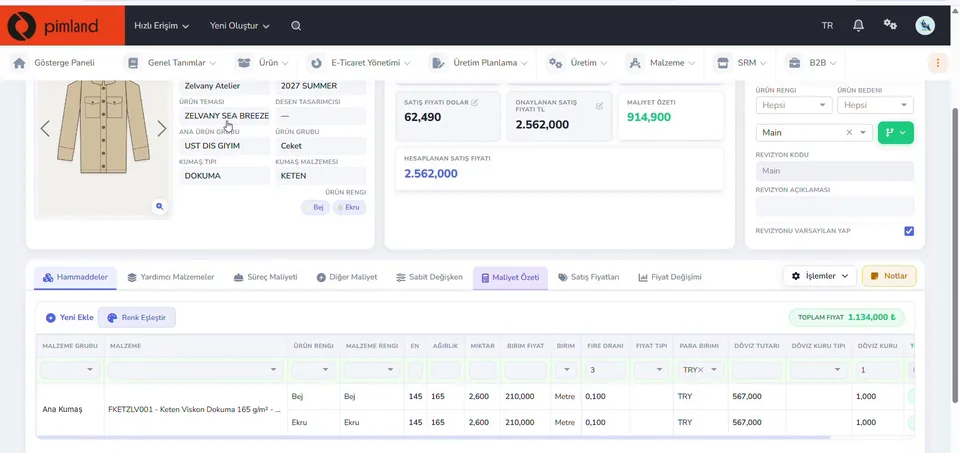
Screen from the demo environment; brands and amounts are demo data. Step 1Start with raw materials
On the raw materials tab, every fabric line shows: material, product color, width, weight, quantity, unit price, unit, wastage rate, currency, exchange rate and amount. At the top are the cost tabs: raw materials, trims, process cost, other cost, fixed/variable, cost summary, selling prices, price change.
In real working life, the quantity on this line is an estimate at first. It's updated when the pattern maker's marker plan arrives; if it isn't, the cost stays wrong too.
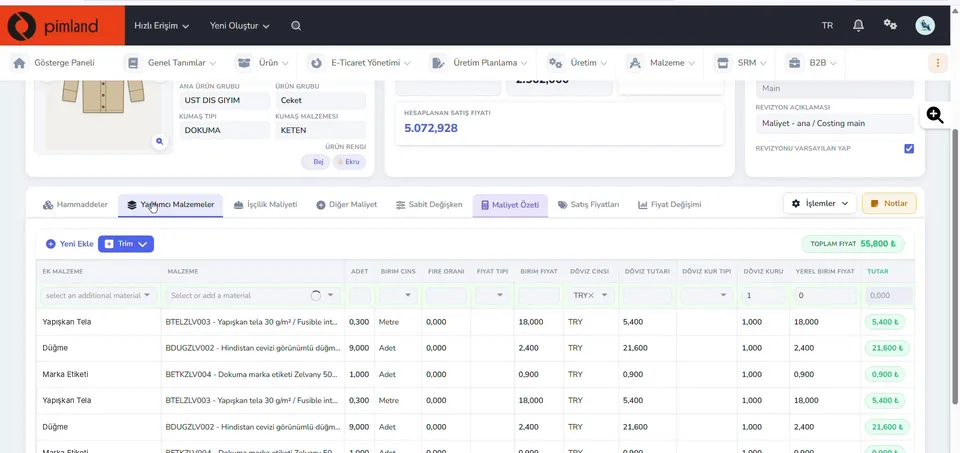
Screen from the demo environment; brands and amounts are demo data. Step 2Add the trims
On the trims tab, items such as interlining, buttons and brand labels are listed with quantity, unit, wastage rate, unit price, currency and exchange rate. Each line's amount and the tab's total are on screen.
In real working life, a small item like a button grows once it's multiplied by the quantity per piece and the order quantity. Don't dismiss it as 'a small item'.
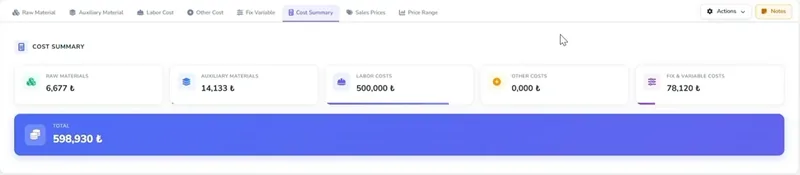
Screen from the demo environment; brands and amounts are demo data. Step 3Read the cost summary
The cost summary adds up all the tabs: raw materials, trims, labor, other costs, fixed and variable expenses, with the total below. This view is from the English interface.
In real working life, the biggest item in the summary isn't the same for every product. First you look at which item is driving the total; the option comes from there.
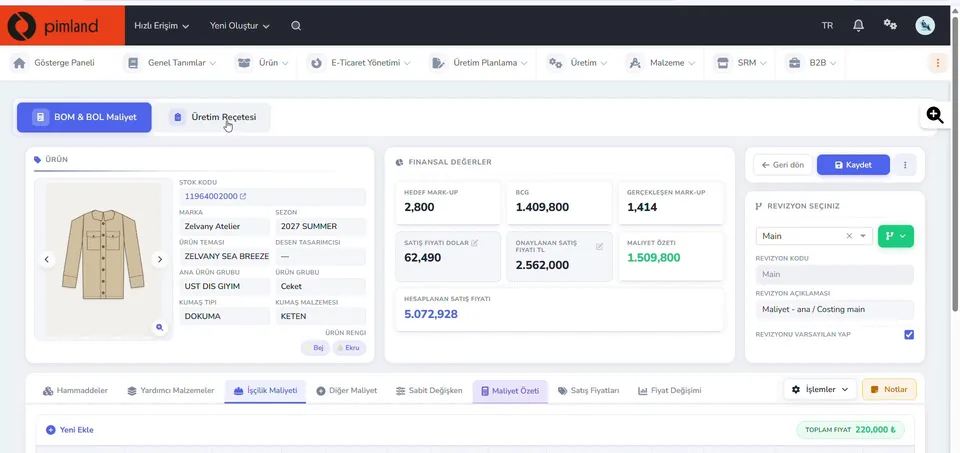
Screen from the demo environment; brands and amounts are demo data. Step 4Compare with the target
In the financial values, target mark-up, actual mark-up, approved selling price, cost summary and calculated selling price appear together. With the revision selector on the right, you keep different costing exercises separate.
In real working life, a style has more than one cost revision: the first estimate, after the quotes, after the marker. You must know which one is current.


These screens are from the Pimland PLM module.
Open your card
Open your card
Read the short summary and the Pimland screens and answer at least 2 of 3 questions correctly to open the card. When all 20 cards are open, your Pimland Basic Certificate arrives in your account automatically.
How fashion, retail and manufacturing companies work, and 20 position cards
First the required reading, then the cards for 20 positions: you learn how a fashion company works.
- FirstTraining 1: How is a product born? · read to the end and complete it
- Each cardA summary of the position, audio narration and Pimland screens
- Card3 short questions at the end of each part; 2 correct answers open the next part · no time limit
- AccountWith a free account, your progress follows you on every device
- At the endOnce you complete all 20 cards, the Pimland Basic Certificate arrives in your account automatically
Certificate 1 · Pimland Basic Certificate
Reading is open to everyone; the part questions and the certificate require an Academy account.
PLM, PIM and SRM trainings
The shared language of the fashion world: PLM, PIM and SRM, with Pimland's real screens.
- OrderFirst PLM, then PIM, then SRM · one at a time
- Each training8 parts, in order · audio narration and Pimland screen
- Questions3 questions at the end of each part, 24 in total · 2 correct answers open the next part · no time limit, the questions change with every attempt
- UnlockPart questions open after your Basic certificate
- Verification14+ (date of birth in your profile); an e-Devlet education document for Turkish nationals
- At the endOnce the three trainings, ID and document are complete, Certificate 2 arrives in your account
Certificate 2 · Pimland PLM · PIM · SRM Certificate
Reading is open to everyone; the part questions and the certificate require an Academy account.
PRO · advanced training
Separate application, for selected candidates.
- WhoCandidates selected from applicants who hold both certificates
- OnlinePimland PLM software training and test
- On site1 day inside a fashion company, seeing PLM in use
- ApplicationWith “Apply for PRO training” on the PRO page; places are limited, and selected candidates hear back by email
Certificate 3 · Pimland PRO Certificate
Reading is open to everyone; the part questions and the certificate require an Academy account.
FAQCosting specialist FAQ
4 questions
Both look at the difference between selling price and cost, but divide it by a different base. Margin = (selling price − cost) ÷ selling price × 100. Markup = (selling price − cost) ÷ cost × 100.
Target selling price × (1 − target margin). The selling price and the target margin are known; this gives the upper limit the cost can reach.
Fabric, lining and interlining, trims, labor or contract manufacturing, extra processes such as washing and printing, packaging, testing and documents, freight and customs, overhead share. The details vary from company to company; the skeleton stays the same.
No. Cost accounting records expenses that have already happened. The specialist responsible for product cost works while the product is still being developed, while decisions can still be changed.
· Pimland Academy team