Retail Efficiency and Decision Intelligence Event: 3 November 2026
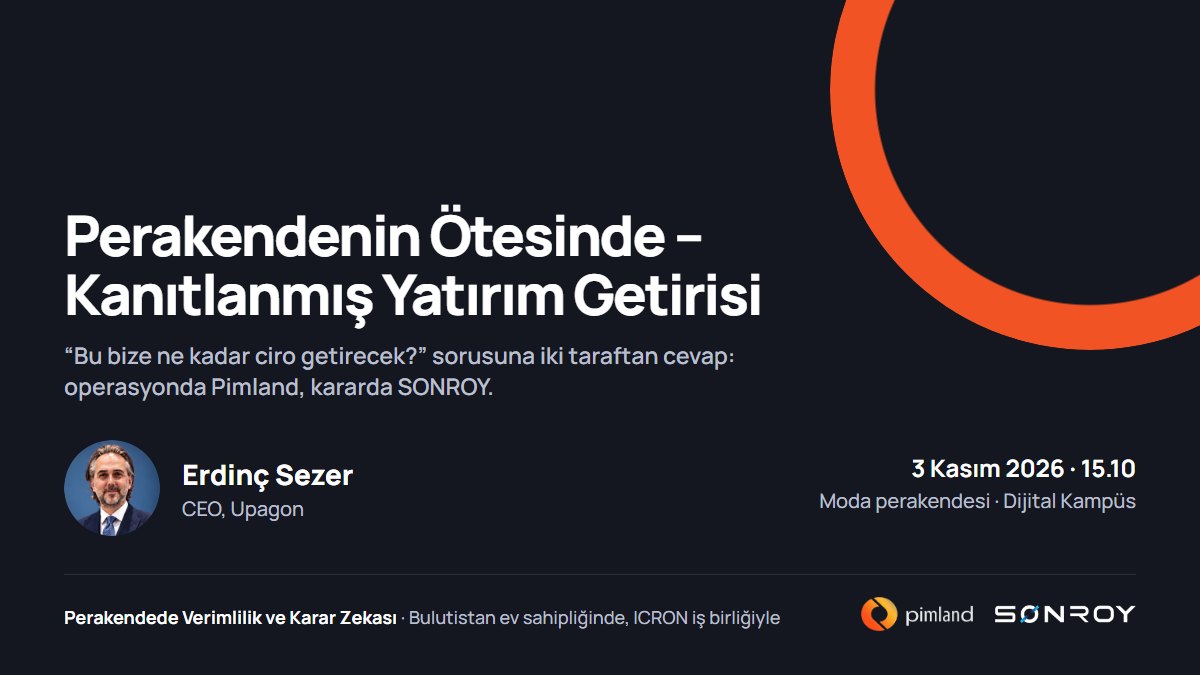
Whenever we start talking about AI with a brand, the first question is always the same: "How much revenue will this bring us?" At Retail Efficiency and Decision Intelligence, hosted by Bulutistan in collaboration with ICRON on 3 November 2026, we answer it with field measurements from fashion retail.
At 15:10, Upagon CEO Erdinç Sezer will speak on "Beyond Retail – Proven Return on Investment": the return does not come from a number on a slide but from a sequence. First the flow and the data in operations, then reasoning and approval in decisions.
In short
- What: Retail Efficiency and Decision Intelligence, with speakers from EY, ICRON, Upagon, Orbina, CreatorStation and Mimeda.
- When: Tuesday, 3 November 2026, 13:00–17:00. Upagon talk: 15:10–15:25.
- Where: Dijital Kampüs / Hangar.
- Host: Bulutistan · In collaboration with: ICRON.
- The talk in one line: on the operations side Pimland validates the flow and the data and improves the live data flow; on the decision side SONROY uses that data to move decisions forward.
Agenda
- 13:00–13:30 · Welcome and networking
- 13:30–13:40 · Opening · Oğuz Kaya, Bulutistan Managing Director, Market Development
- 13:40–14:10 · EY keynote: A Strategic View of Retail: Growth, Efficiency and Operational Transformation · Yusuf Bulut, EY-Parthenon Turkey Partner
- 14:10–14:30 · ICRON & EY conversation: From Cost Line to Profit Lever: Demand-Driven Workforce Management
- 14:30–14:40 · ICRON WFM product showcase
- 14:40–15:10 · Coffee break and networking
- 15:10–15:25 · Upagon: Beyond Retail – Proven Return on Investment · Erdinç Sezer, CEO
- 15:25–15:40 · Orbina: Every Conversation Is a Demand Signal
- 15:40–15:55 · CreatorStation & Mimeda: Influencer Marketing and Marketing Efficiency in Retail
- 15:55–16:10 · Joint Q&A
- 16:10–17:00 · Networking and close
"How much revenue will this bring us?" and the questions that follow
In every AI project taken to the board, this question never comes alone:
- When will the investment pay back?
- Which data can we trust?
- Will our team actually use it?
- Does it work with our existing systems?
- How do we trust the AI's recommendation?
We answer them from two sides, in order: operations first, then decisions.
Operations: Pimland validates the flow and the data
In fashion retail, product information is often rewritten at the channel by the e-commerce team. Three teams work from three spreadsheets, a bill-of-materials change gets lost in a chat group, and the gap between planned and actual cost grows. Pimland PLM, PIM and SRM run on one data model:
- The flow is validated: design, production and channels work on the same product record, so no version gets lost.
- The data is validated: every product card gets a data quality score, and missing fields show up before they reach a channel.
- Live flow: approved information reaches the website, marketplaces and stores at once, and Pimland is 100% integrated with Nebim.
Field numbers
Measured in the live operations of teams using Pimland (customer stories):
- Payback: 6 months
- Time to market 35% faster · content publishing 5x faster · revision cost 50% lower
- New product ready on every channel: from 8 working days to 4
- Entering one product into 3 channels: from 45 minutes to 15
- TR + EN description for one product: from 20 minutes to 5
- On-time supplier delivery: from 70% to 90%
- Same 6-person team in one season: 130 products instead of 100
Decisions: SONROY moves decisions forward with that data
Once the data is right and flows live, putting decisions on top of it is a setting, not a project. SONROY joins the product data Pimland has validated with sales, stock, returns, marketplace and store data in one living memory. It works in four steps: sense, think, recommend, learn. Examples from fashion retail in the talk:
- Category ranking in one sentence: "Push sales performance, keep stock above 5." The recommendation comes with its reasoning and the team approves.
- A rejection with a reason becomes a rule: your rejections, not your approvals, train the agent, and the company's unwritten rules are recorded for the first time.
- A return is a production instruction: read at size × colour level, returns change the size split of the next order and send a pattern note to the supplier.
- Channel gaps: opportunities such as a product selling 496 units in 79 stores but ranking 20th on the website become visible.
How is the return proven?
Proven ROI is not a number on a slide; it is a loop you measure on your own data every week. We suggest four measures: data quality score, time to market, human touches (recommendations corrected or rejected by hand each week) and decision outcome. Success is not the accuracy rate; it is the number of human touches.
Who should attend?
- General managers, operations and supply chain leaders at fashion and retail brands
- E-commerce, category and product management teams
- IT and digital transformation leaders taking AI projects to the board
We can show it on your own data in 30 minutes. If we do not meet at the event, book a demo to see Pimland and SONROY working with your product and operations data.
Frequently asked questions
When and where is the event?
Retail Efficiency and Decision Intelligence takes place on Tuesday, 3 November 2026, 13:00–17:00 at Dijital Kampüs / Hangar, hosted by Bulutistan in collaboration with ICRON.
What time is the Upagon talk?
Upagon CEO Erdinç Sezer speaks on "Beyond Retail – Proven Return on Investment" from 15:10 to 15:25. Questions are taken in the joint session at 15:55.
What will the talk cover?
A two-sided answer to "how much revenue will this bring us?": validating the flow and the data in operations with Pimland, and turning that data into reasoned, approved and measured decisions with SONROY, with field numbers and two short product videos.
What is the difference between Pimland and SONROY?
Pimland is a product operations platform: PLM, PIM, SRM and the Digital Product Passport on one data model. SONROY is a decision intelligence platform: it joins the same data with sales, stock and returns, recommends the decision with its reasoning and measures the outcome. One is the source, the other the reasoning.
What if I cannot attend?
Request a 30-minute demo to see the same flow on your own data: [email protected] or the demo form on this site.